
History Corner: No ghosts but lots of history in Weston cemeteries
While October is the time for spooky stories, Historical Society President Pam Fox has never encountered a ghost around town.
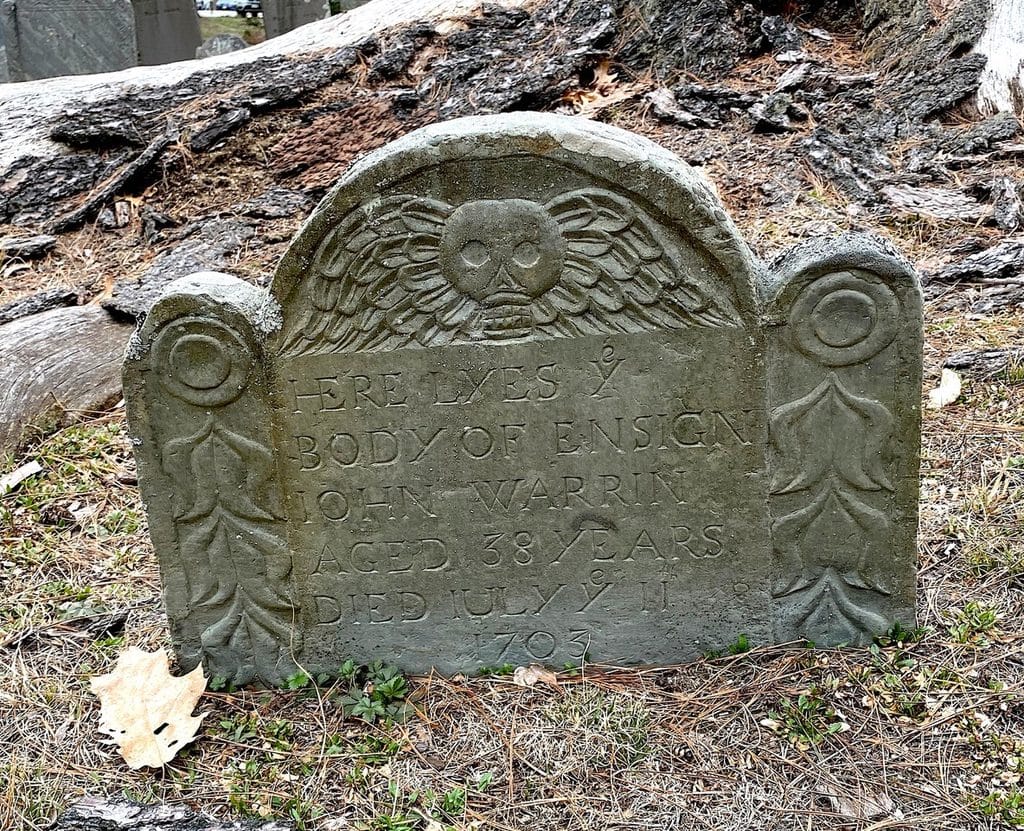
October is a time for apple cider, pumpkins, and spooky stories. I am sorry to say that in all my years studying Weston history, I have never encountered a ghost or discovered a haunted house. But I have spent many hours wandering through Weston’s cemeteries, admiring grave markers of all shapes and materials and thinking about those who came before us.
Fall is the perfect time to visit Farmers’ Burial Ground and Central Cemetery, both on Boston Post Road but very different in character. To guide your explorations, pick up the two Weston Historical Society informational brochures, which can be found atop the WHS display cases in the vestibule at Town Hall and Weston Public Library, next to the Local History Room.
Farmers’ Burial Ground is Weston’s oldest cemetery. The first recorded burial in the sparsely settled “Farmers’ Precinct” of Watertown was Ensign John Warren, who died in 1703, 10 years before the Town of Weston was incorporated. You can find his gravestone next to the stump of a massive central tree cut down because of damage caused by the roots. Ensign Warren’s marker is a fine example of the “winged skull” motif found on the earliest gravestones, often accompanied by the epitaph “Here lies the Body” or “Momento mori,” a Latin phrase meaning “remember that you must die.”
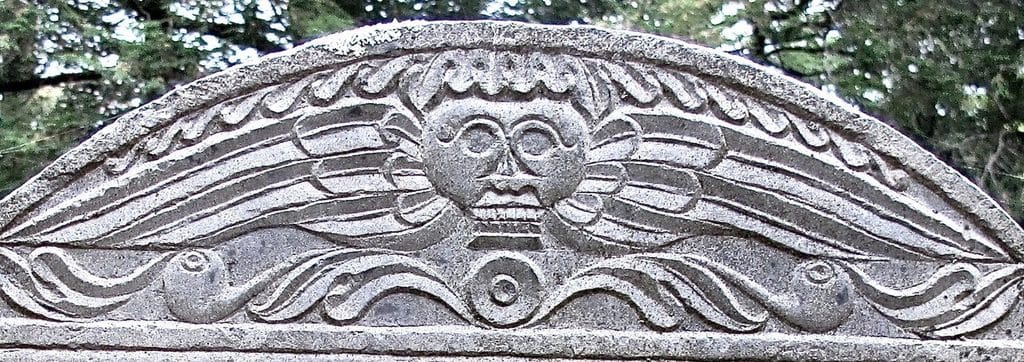
Until 1750, an estimated 90% of New England gravestones displayed winged skulls, emphasizing the mortality of man. The motif was gradually replaced by winged cherubs, also known as “soul effigies,” symbolizing the flight of the soul and a more optimistic view of the hereafter. At the end of the 18th century, cherubs gave way to the willow and urn, derived from classical antiquity, emphasizing mourning and the sadness of those left behind. The weeping willow is an ancient symbol of deep sorrow and the urn was a Roman repository for ashes. Along the way, epitaphs changed to “in memory of” or “sacred to the memory,” with messages of comfort.
Farmers’ Burial Ground is known for its slate markers, including an unusual number of large and double examples. Some represent the work of recognized carvers like Newton resident Daniel Hastings, a popular and prolific carver in the area west of Boston.
In 18th-century burial grounds, gravestones were positioned facing west. Bodies were laid with the head to the west so that on the Day of Judgment, the resurrected dead would sit up to face the rising sun. The small markers were usually footstones, often marked with the initials or name of the deceased, placed at the lower end of the burial plot directly opposite the headstone. In many cases, the footstones are no longer in their original position, although the Town of Weston has been commended for preserving them.
Approximately 180 early settlers are buried at Farmers’, although not all have markers. Many are important to the history of the town. Rev. Samuel Woodward, an early First Parish minister, has one of the largest gravestones, with a long epitaph testifying to the respect and affection of his congregation. Samuel Phillips Savage, Weston’s most prominent Revolutionary War patriot, is buried here, as is Josiah Smith, who built the tavern that bears his name. The graves of Revolutionary War soldiers have Sons of the American Revolution (S.A.R.) markers with the Minuteman logo and the year 1775. Along the south side of the cemetery, under the hemlocks, are the gravestones of people who died of smallpox.
Farmers’ Burial Ground was restored in 2016-17 with funds from the Community Preservation Act. Work included conservation of some 146 headstones and footstones that were tilting, broken, or fallen.
In a future column I will write about Central Cemetery, established in 1792. Central has a completely different atmosphere, reflecting 19th-century social and aesthetic changes. After you leave Farmers’, take a stroll through Central and see how many changes you can recognize.
Author

Related Articles
Your gifts bring grant dollars to the Weston Observer
On Nov. 1, the Observer launched its second year-end Institute for Nonprofit News/NewsMatch campaign.

Backyard Naturalist: Beavers: Nature’s Swiss Army knife of tools
As recently as 10,000 years ago, beavers as large as bears thrived across the continent. Now extinct, these creatures shared a common ancestor with your neighborhood beaver.