
Initial filings made for 133 Boston Post Road development
Less than a year after residents approved its MBTA Communities Act zoning districts, Boston Properties, officially known as BXP, is beginning the early stages of its 133 Boston Post Road redevelopment project.
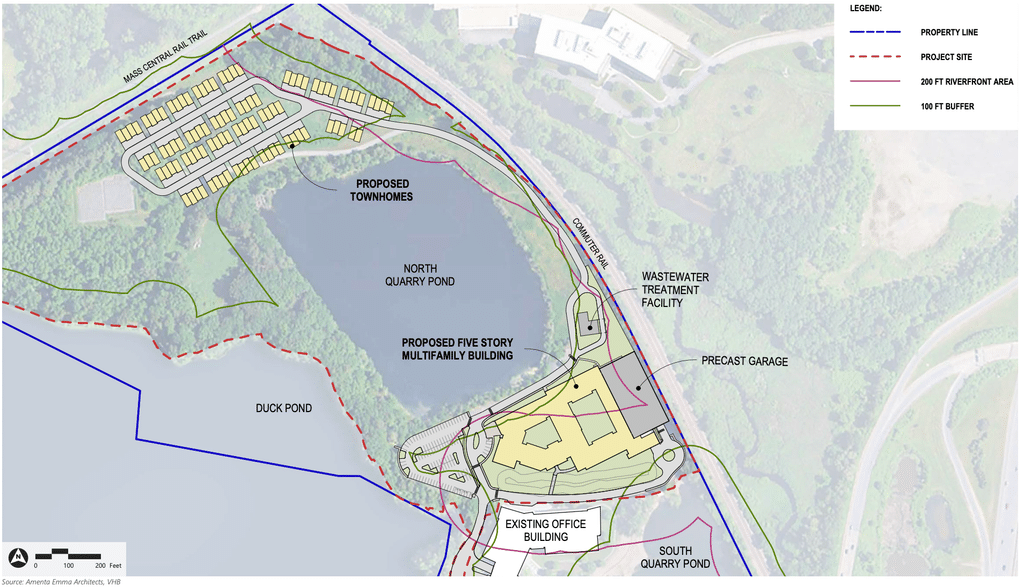
Less than a year after residents approved its MBTA Communities Act zoning districts, Boston Properties, officially known as BXP, is beginning the early stages of its 133 Boston Post Road redevelopment project.
Boston Properties in September submitted initial documents to the Massachusetts Environmental Policy Act Office (MEPA), which will review the environmental impact of the project. MEPA’s public comment deadline ended on Friday, Oct. 23, and the agency is expected to take action on Oct. 30.
The national real estate developer, headquartered in Boston, is planning a long-term, multiphase housing project on the site that could create up to 480 housing units at the former Stony Brook quarry, located just west of the Interstate-95 interchange. The company estimates the project will cost $300 million and construction, if the permitting process goes smoothly, could begin in summer 2027 and finish by January 2030.
Pitched to residents last year ahead of the October Special Town Meeting, Boston Properties has planned three distinct phases of the project: 100 townhomes in the northeast corner of the site, 280 multifamily units at the existing parking structure and 100 age-restricted units at the site of the existing 350,000-square-foot office building.
“BXP is excited about the opportunity to bring thoughtfully designed residential housing to 133 Boston Post Road in Weston,” said Boston Properties spokesperson Jenn Kuo. “Our vision is to create a vibrant, high-quality residential community that expands housing options, including affordable housing, while complementing the character of Weston and respecting its natural surroundings. We appreciate the ongoing engagement and collaboration of Town officials and community stakeholders and look forward to continuing to work together as we advance the project through the design and permitting process.”
The developer, according to its filing, will undertake the first two phases in the coming years. The office building is expected to remain on the site at least through 2040, as the company is still leasing office space – including a recently inked deal bringing Panera Bread’s corporate headquarters to Weston.
The townhomes are limited to 40-foot height restrictions, while the five-story multifamily building’s height is limited to 65 feet, as negotiated by the Select Board and the company in a development agreement that was also approved at the Special Town Meeting.
Boston Properties will also make improvements to the site, including 375 new parking spaces, for a total of 1,140; landscaping, stormwater mitigation measures, tree plantings and the replacement of the existing wastewater treatment facility.
Like any Weston project, traffic impacts on Route 20 will be a significant aspect. The state road is already clogged on most workdays – particularly during the morning and afternoon rush hour – and when all units at Modera Weston at the western end of Route 20 are leased out, more traffic is expected.
A traffic study conducted by engineering firm Vanasse Hangen Brustlin (VHB) states impacts should be minimal.
“While the project is expected to result in minor traffic impacts at the studied intersections under
the full build conditions, there are no feasible measures that would avoid these impacts,” VHB’s study states.
As Boston Properties kicks off its project at the state level, Weston will soon have its own say on the matter. The Planning Board has scheduled a site walk for today, which will be followed with a site plan approval public hearing on Nov. 4, according to the meeting notice.
The company will also need approvals from the Massachusetts Department of Environmental Protection, the Department of Transportation and the MBTA.
Development at 133 Boston Post Road is one piece of a growing web of Boston Properties projects along I-95. The company has partnered with Waltham to reconstruct and extend Green Street – an 850-foot dead-end road off Route 117 close to the Weston town line – down to the Route 20/I-95 interchange.
That project, which appears to be under construction, will create a shared-use path between Routes 117 and 20 and two new traffic lights on Route 20. It accompanies a planned 1,500-unit housing development at two locations: Jones Road in Waltham, the Waltham-Weston Corporate Center, and the office complex off Winter Street, known as the Bay Colony project, according to a contract provided by the state.
Additionally, the Green Street Connector project plays into a long-range MBTA plan to relocate the Kenda Green Commuter Rail station from its current location to the vicinity of Jones Road and Green Street.
Author

Related Articles
Weston Media Center enters streaming era with programs on Roku
Beginning earlier this month, content available through Weston Media Center became available to watch on the Roku platform.
Select Board declines to add senior housing project to Special Town Meeting warrant
A senior housing project that has been the center of town discussions will not be moving forward to a town vote.
Residents will weigh in on gas-powered leaf blower ban
The ability to clear piles of leaves might get more complicated after November’s Special Town Meeting.