
Backyard Naturalist: Tree swallows herald fall’s arrival
Such is the life of a tree swallow: filled with beauty, alive with frenetic activity and fraught with endless uncertainty. Carpe diem.
The August skies above Plum Island look as if a giant peppermill has exploded, its contents held aloft by gravity-defying forces. Wait–it’s tens of thousands of tree swallows (Tachycineta bicolor) swirling in torrential eddies en route to buggier climes down south. They’ve been harvesting waxy bayberries from the bushes in the dunes below to fatten up for the next leg of their migration. We featherless creatures gape from below and coax our cameras to capture the awesome splendor of so many birds engaged in such frantic activity.
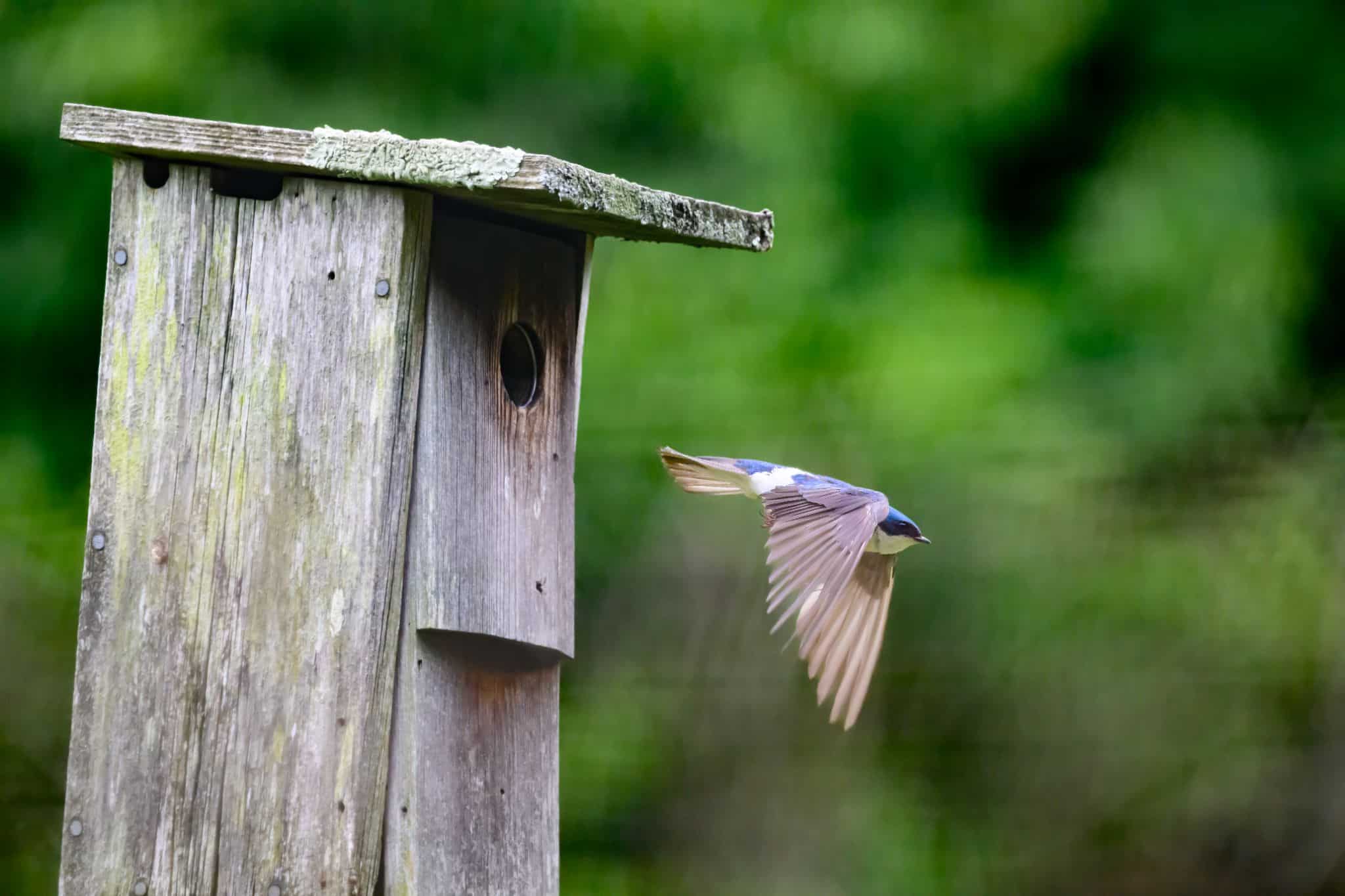
The swallow is one of our earliest spring migrants, arriving as early as mid-March. Weston’s bluebird nestboxes provide many a returning tree swallow with a place to start their family. First he will need to fight off his conspecific rivals (birds of his own feather), then the bluebirds, house sparrows and house wrens. Now he’s ready to show it off to prospective mates. Once paired, the female gets busy building a nest of dried grasses. The male will help by searching far and wide — if necessary — for loose feathers to weave into his mate’s structure. These feathers act like your down vest, providing a vital layer of insulation for the nestlings. Many such pieces of avian fluff are a prize won in a pugnacious tussle with another tree swallow.
By late April, almost every census block in the commonwealth will welcome back flocks of tree swallows.This species exhibits amazing philopatry, with an estimated 96% of birds returning to the area of their birth — often using the same nest box year after year. The swallow’s preferences are few but strong: first some open country where it can perform its aerial exercises. Next, a place where a “secondary cavity” nester can raise its young; a nest box or a place where woodpeckers have left cavities in dead trees will suffice. Rounding out the list of essentials would be proximity to a body of water where insects are plentiful.
My spring bird walks always include scope-filling views of newly-arrived tree swallows showing off their iridescent steely blue backs. When they’re not posing for their closeups, they’ll be swooping, darting and wheeling low over the Weston Station Pond. During the nestling season each adult will need to vacuum up 6,000 to 7,000 insects each day to sustain its growing family. The young will hatch after a couple of weeks, and in another three weeks be learning to snag their own winged prey. They’ll choose from a smorgasbord of creatures as small as aphids and as large as dragonflies, along with the occasional little snail or fish. A close look at the bird leaves you struck by its diminutive beak. Why carry a big beak around when you don’t need to drill holes for your home, peck in the ground for worms, probe in the muck for crustaceans or tear your prey apart like a raptor? It’s the perfect beak for a creature that spends almost all of its time in flight pursuing prey in the air.
So, if “one swallow does not a summer make,” just how many tens of thousands does it take to remind us of fall’s inevitable arrival? Enjoy the aerial “swallow song” to summer on one of their seasonal staging grounds. Appreciate that 80% of the nestlings will have perished by season’s end; fewer than half of the adults frantically winging over your head are likely to make the return trip. Such is the life of a tree swallow: filled with beauty, alive with frenetic activity and fraught with endless uncertainty. Carpe diem.
To watch a video of tree swallows gathering before migration, please go to bit.ly/4rdcS7m.
Author

Related Articles

Ideas in the Making at the AIC: Watercolor: flowing color and infinite possibilities
Water meets pigment, pigment meets paper, and magic happens on the page. That’s the quiet alchemy of watercolor — a medium simple in its ingredients and boundless in its results.

History Corner: Light in the Colonial dark: The Magic lantern and Declaration Day
When visitors arrive at the JST for Declaration Day festivities on Sunday, Sept. 13, they will experience a form of entertainment that predates film, photography, and the Tavern itself: the magic lantern show.