
Backyard Naturalist: The singing soul of our deep woods
The song of the wood thrush will stop Backyard Naturalist Michael Pappone in his tracks every single time.
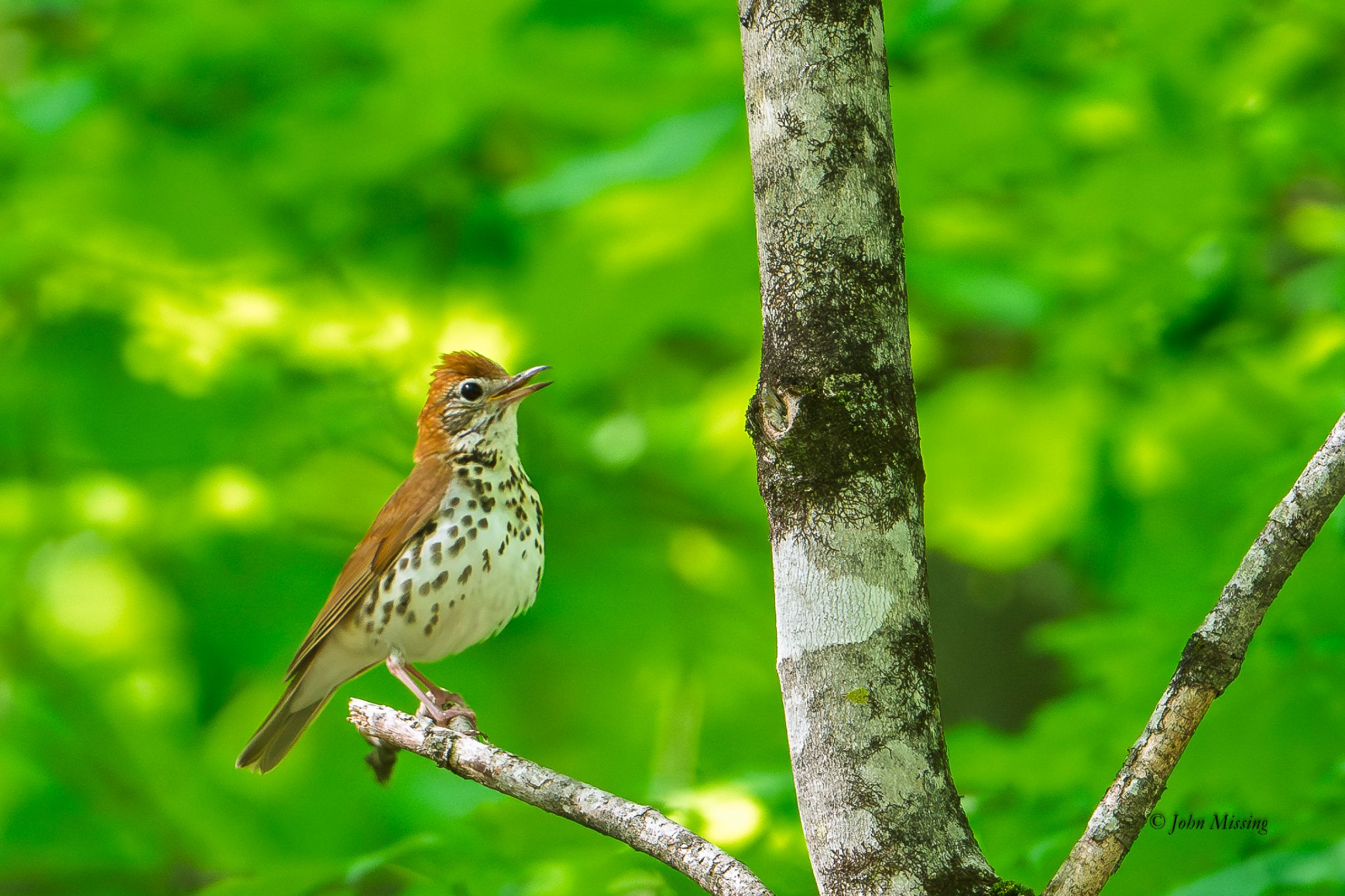
It will literally STOP. ME. IN. MY. TRACKS.
Every single time.
When the song of the wood thrush (Hylocichla mustelina) comes swirling through the forest like vapor caressing the branches, it’s time to freeze and let his ventriloquial notes wash over you. Exactly where is that bird? Its distinctive vocalizing seems at once both near and distant. For me the song is the very essence of inner peace – ornitherapy at its purest. I’m not alone in my assessment of this featherweight vocalist’s charm; in the words of our Concord neighbor, Henry David Thoreau: “Whenever a man hears it he is young; wherever he hears it, it is a new world and a free country, and the gates of Heaven are not shut against him.”
The bird’s ability to haunt the woods is a secret that hides deep in the nether regions of its respiratory tract. It’s called a ‘’syrinx.’’ Unlike our single set of vocal cords near the top of our throats, the wood thrush’s syrinx consists of muscles that the bird can control independently from each other. It can, consequently, actually harmonize with itself by producing overlapping flute-like echoes, overtones and complex trills. Thrushes can mix and match the several elements of these phrases into at least fifty distinct song versions.
If you want to experience the joy of a “song that carries out our prayers” (as the Ojibwe tribe would say), slink silently into the woods in the earliest morning where this persistent dawn singer has the room to himself. Seek out a Weston trail with plenty of tall trees. A mix of oaks, dogwoods and hemlocks sheltering an understory of modest shrubs and a shaded forest floor is best. This is where, as Thoreau tells us “the thrush alone declares the immortal wealth and vigor that is the forest.”
When he’s not singing, watch for him hopping about in the leaf litter, flipping over leaves and searching for the soil invertebrates – insects, millipedes, spiders, worms and such – that make up his family’s spring diet. Listen – now he sings again with the liquid coolness of things just drawn from the bottom of springs. Oh – you weren’t able to get out on the trail that early? Not to worry, the poet Sara Teasdale reminds us that he will be back at vespers: “I heard a wood thrush in the dusk/Twirl three notes and make a star.”

At this time of year the thrush family may be between broods. The species typically produces two each season: one in May soon after arriving from Yucatan, at the end of their 2,000-mile journey, and another in late June after the first brood has fully fledged. Young birds can fly two weeks after hatching, and they’ll become independent between two and three weeks later. Our thrushes will be gone by the end of August, tracing a return route back to their wintering grounds. They will have bulked up on lipid-rich fruits so they can fly all night, taking their GPS cues from the stars and the earth’s magnetic field. If we and they are both lucky, the same thrushes whose songs linger in my woods well into the summer twilight will meet their migratory challenges and return to nest nearby for another five or six seasons. And to sing once again “as if he were trying to put into those beautiful notes all the joy of life.” Thornton Burgess, American conservationist.
Author

Related Articles
Backyard Naturalist: Tree swallows herald fall’s arrival
Such is the life of a tree swallow: filled with beauty, alive with frenetic activity and fraught with endless uncertainty. Carpe diem.

Ideas in the Making at the AIC: Watercolor: flowing color and infinite possibilities
Water meets pigment, pigment meets paper, and magic happens on the page. That’s the quiet alchemy of watercolor — a medium simple in its ingredients and boundless in its results.

History Corner: Light in the Colonial dark: The Magic lantern and Declaration Day
When visitors arrive at the JST for Declaration Day festivities on Sunday, Sept. 13, they will experience a form of entertainment that predates film, photography, and the Tavern itself: the magic lantern show.