
Backyard Naturalist: Land’s Sake Farm: Weston’s shared backyard
How many of you readers consider Land’s Sake Farm to be kind of a second backyard?
How many of you readers consider Land’s Sake Farm to be kind of a second backyard? A place you can wander over to whenever the spirit moves you? Sometimes the spirit is in close communication with the stomach and you pop over for some fresh bread, eggs, produce, your CSA share, meat or even a sweet treat. Sometimes you just want a place where you can drink in the bouquet of moist, fertile soil, flowers in bloom or a whiff of happy livestock.
Tuesday brought a dozen or so spirited walkers to the farm for a closer look at the wildlife that call Land’s Sake home. We gathered bright and early before the punishing rays of the sun would succeed in chasing all sensible people indoors. Coffee was served; introductions were made. Then we huddled for a moment of silence–happy human silence, the better to acknowledge the soundtrack provided by the stars of the show–the birds. Those of us running the Merlin birdsong recognition app later compared notes with the ears-only folks to share a list of the dozen species vying for top billing on the hit parade of avian vocal performances. Without having taken a single step we could hear killdeer, red-bellied woodpecker, blue jay, flicker, phoebe, warbling vireo, mockingbird, house sparrow, Baltimore oriole, red-winged blackbird and yellow warbler! Merlin claimed to have heard others, as well.
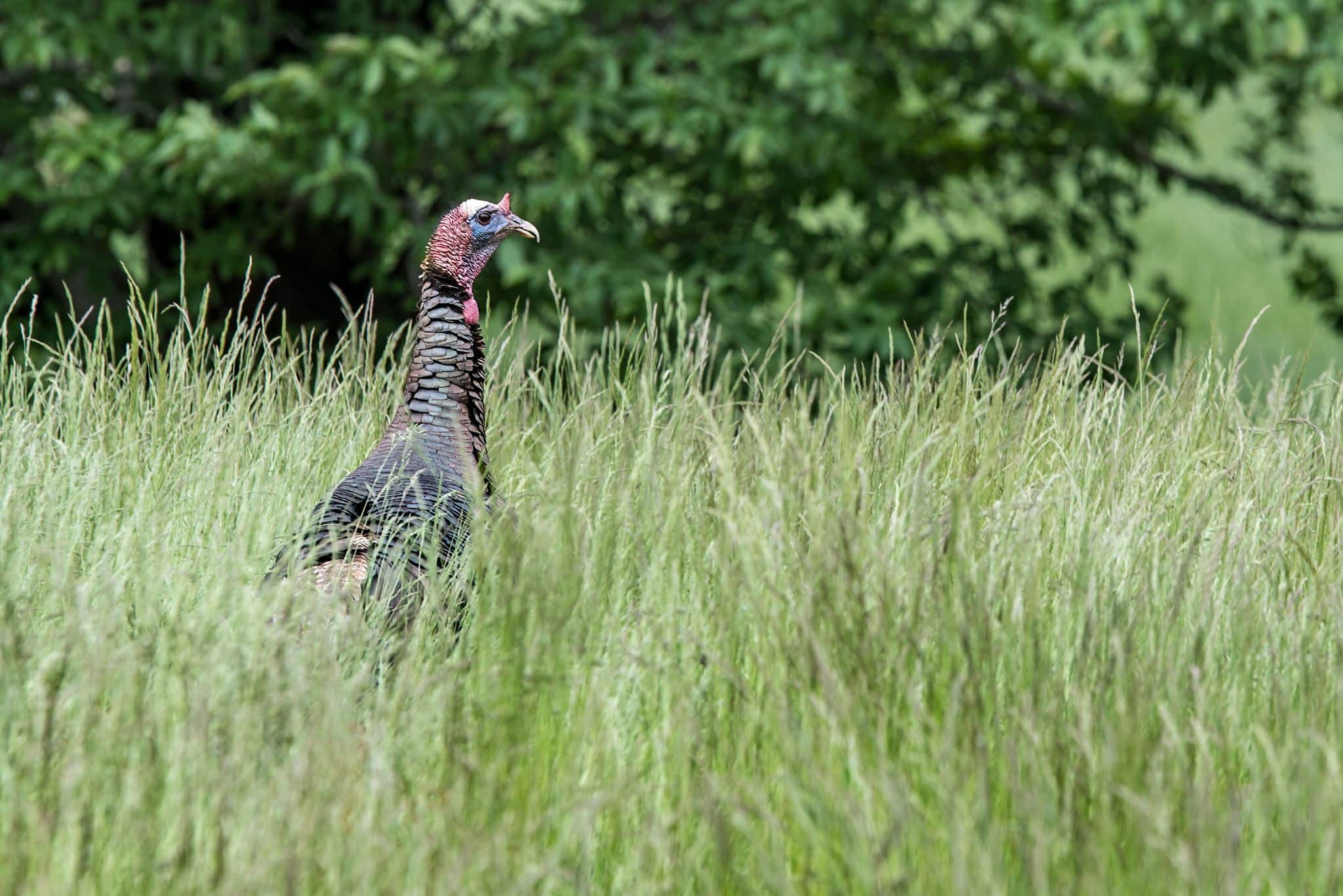
For the 90 minutes of our walk together, the birdsong never stopped. To be sure, the species that claimed the limelight changed as we made our way through the multitude of microhabitats on the farm’s 30 acres. The blackbirds and barn swallows were most at home in the cultivated spaces. The vireo, cedar waxwing, oriole, cardinal and mourning dove preferred the tree canopy The mockingbird imitated the others on his perches in the treetops or on the fencepost, flashing his white wing patches as he changed venues (hoping, no doubt, to be chosen as the group’s Bird of the Day). The eastern kingbird showed off his fly-catching abilities, sallying from outstretched branches to snatch bugs in midair, and gliding back to his launching spot to enjoy his snacks. The Carolina wren did a perfect imitation of my mnemonic “teakettle, teakettle, teakettle!” right on cue. A wild turkey came streaking down in the periphery and plopped behind some grasses growing in the fallows. Discussion ensued–what exactly had we just glimpsed? One walker’s “Turkey!” diagnosis was confirmed by a farm staffer after she’d taken a closer look.
Then, after a John Deer’s mega-treads squished through a puddle of standing water, a killdeer decided to stop by for a drink. This bird sports a black double-ringed necklace and watches us warily from huge orange-encircled eyes. He behaves like his cousins, the shorebirds you see at the beach; but this ground-nester is content to live his best life in the uplands of all fifty of our United States. It wasn’t long before we rounded the path and met the rest of his family, scooched down in the grass near the rabbit hutch. The mate and two fluffy “golf-balls with legs” emerged and practically dared us to pet their downy feathers. The parents switched to defense and put on their broken-wing display to deceive and distract us from any intentions we might have had to molest their flightless young.
Every walk has, explicitly or implicitly, a Bird of the Day. We did not need to scroll through our 36 species total to find our winner. It was there right in front of us.
Author

Related Articles
Backyard Naturalist: Tree swallows herald fall’s arrival
Such is the life of a tree swallow: filled with beauty, alive with frenetic activity and fraught with endless uncertainty. Carpe diem.

Ideas in the Making at the AIC: Watercolor: flowing color and infinite possibilities
Water meets pigment, pigment meets paper, and magic happens on the page. That’s the quiet alchemy of watercolor — a medium simple in its ingredients and boundless in its results.

History Corner: Light in the Colonial dark: The Magic lantern and Declaration Day
When visitors arrive at the JST for Declaration Day festivities on Sunday, Sept. 13, they will experience a form of entertainment that predates film, photography, and the Tavern itself: the magic lantern show.