
Backyard Naturalist: Sitting pretty in the catbird seat
Prowling low in your gnarliest rhododendron – that’s the favorite place for the skulker who goes by the name of the gray catbird.
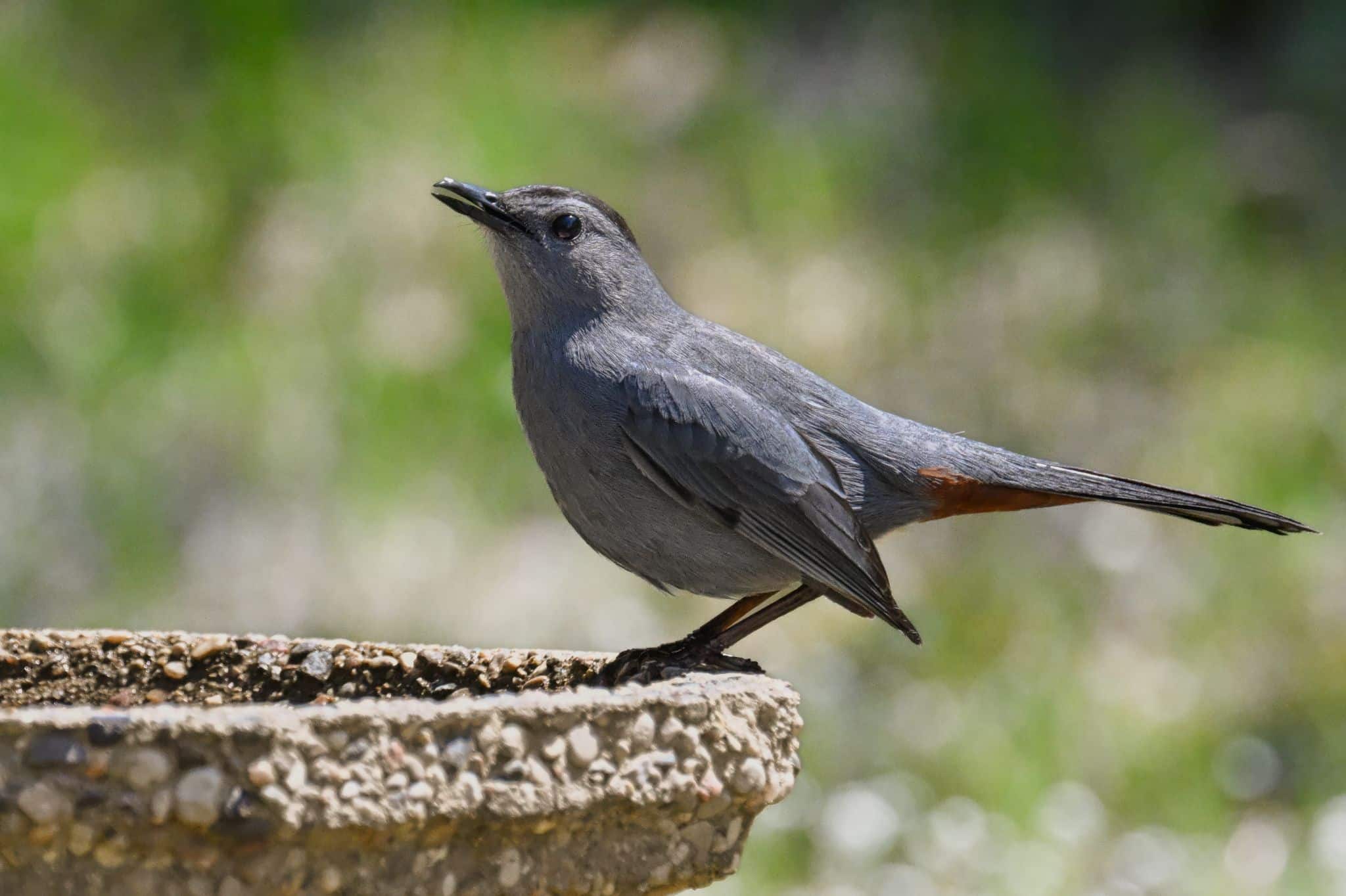
Prowling low in the densest part of your gnarliest rhododendron – that’s the favorite place for the neighborhood skulker who goes by the name of the gray catbird. His Latin name, Dumetella carolinensis, means “thorny thicket” bird of the Carolinas.
From his hidden post in your bushes, he’ll be up before dawn mewing, squeaking, whistling and whining, and “mingling in stolen notes from other bird songs” (Pete Dunne, “Essential Field Guide Companion”). He also mimics tree frogs and mechanical sounds. As part of the mimid family, he counts the northern mockingbird and brown thrasher as his kin. Each has specialized vocal chords known as a “songbird syrinx” that enables them to make two sounds at once, and a brain that enables them to copy the sounds of other birds, mammals and even cell phone ring tones. The mockingbird distinguishes himself by repeating all his song phrases three of four times. The brown thrasher repeats each of his phrases once. But the catbird lacks a “Repeat” button, and just babbles away. Don’t feel too bad if your ear gets fooled by these tricksters: even my Merlin app has trouble distinguishing the songs of these species from each other.
So, okay, I understand; you now actually want to see this bird. Well, you’re in luck, because our thorny thicket bird has an abundance of curiosity and a shortage of fear. If you stand near those babbling bushes patiently and make little “pishing” noises with your lips, he’ll find it difficult to resist the temptation to see what the fuss is about. Take a close look when he pops out and you’ll see a gray-bodied bird wearing a solid black skull cap, sporting a long blackish tail, and hiding rufous-colored feathers underneath the base of that tail. He’ll seem to look you right in the eye as if to question your motives or your right to block his view.
When the catbird is hungry, he’ll indulge his omnivorous nature by grabbing a protein-heavy mix during the breeding season, and change the ratio to mostly berries and fruits in the later summer and fall. The bird’s menu choices are a function of both what’s available at any given time, and what food the young are going to need to fledge. Catbirds will hop and run to track down their ants, worms, beetles, caterpillars and moths. And when they want fruit, they’ll sample various choices of berries, pears, and apples – more often leaving peck marks in way more items than they actually consume. This wasteful practice earned them the enmity of the 19th century farmers and orchard keepers.
Both the male and the female feed the young, after the female has gone to most of the trouble of constructing the nest, and all the trouble of sitting on the eggs. Sure, when she’s away, dad-bird will guard the nest. Guarding is important, too, as most predation takes place before the babies leave the nest. Squirrels, snakes, raccoons and other birds are among the catbird’s nemeses. Don’t expect to find that nest yourself. It’s buried deep in the thickets, low to the ground, but well out of sight.
The catbirds make themselves scarce at the end of August, as they begin their short migrations to warmer climes.
“….’sitting in the catbird seat’ meant sitting pretty, like a batter with three balls and no strikes on him.” James Thurber, “The Catbird Seat.”
Author

Related Articles

Backyard Naturalist: The miracle of metamorphosis, or a very hungry caterpillar
Backyard Naturalist Michael Pappone explores the caterpillar metamorphosis process in this week’s column.