
Backyard Naturalist: Come hear it sing – Our scrap of sky with wings
Our indigo buntings arrived back in Weston over the last few weeks after a 2,000-mile journey.
Those of you who have read this column from time to time know that the Backyard Naturalist is fond of the Mass Central Rail Trail. It has become one of Weston’s favorite shared backyards. The trail welcomes cross-country skiers and snow-shoers in winter, leaf-peepers in the fall, and runners, cyclists, walkers, in-line skaters and equestrians when the weather suits. In the spring and summer, you’ll also find naturalists of various stripes poking around in search of caterpillars, dragonflies, botanical treasures and last–but not least–birds!
Several of us birders incorporate chunks of the trail into our longer walks. So, why, with over 100 miles of verdant hiking trails in town, does this paved section deserve the naturalists’ special attention? I could list any number of reasons. But today my focus will be on one: the indigo bunting.
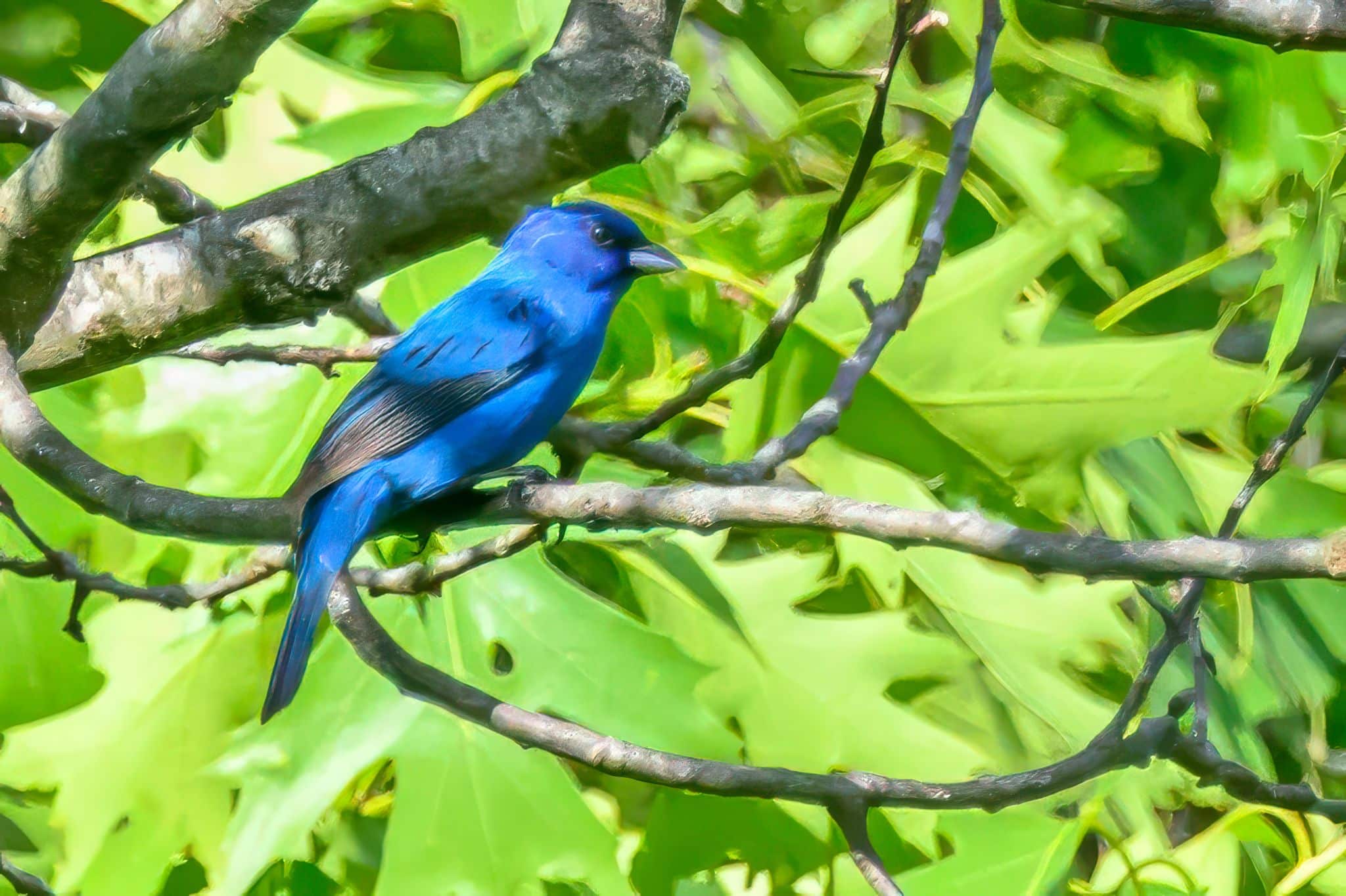
You English majors will recognize “Indigo Bunting” as the title of a short biography of Maine native, Edna St. Vincent Millay. When all of you have finished the book, point your binoculars at a five-inch ball of deeply azure feathers perched on a bare tree branch near Tower 166, just east of the old depot building. That would be where the male indigo bunting is singing his heart out from dawn until dusk. He’s advertising his vocal prowess, and, by dashing from tree to tree, signaling his willingness to defend a territory that stretches all the way from, say, here to there. A couple of towers down, another male’s voice marks the beginning of his territory. The two will play a call-and-response game throughout the breeding season to remind each other not to sneak up on the other’s mate. Those females are a subtle brown color, the better to blend into the background and keep the young safe from prying eyes–and from hungry predators’ beaks and fangs.
Our indigos arrived over the last few weeks from their neotropical wintering grounds, many having completed a 2,000-mile journey. They prefer nocturnal travel, the better to avoid becoming a hawk’s snack. Just how does a ⅔-ounce creature find its way in the pitch dark across the 600-mile Gulf of Mexico? Passerina cyanea possesses an internal clock that enables it to continually adjust the angle of orientation to a star even as that star moves through the night sky. It also helps to start with sufficient fat deposits to fuel the non-stop 30-hour flight.
Indigos favor shrubby clearings and canopy gaps where gypsy moths have defoliated trees–just like the conditions found on our own rail trail. Once back “home” on its breeding territory, Mr. Indigo will feast on grass seeds, berries, spiders, caterpillars, grasshoppers and beetles. He’ll then wait for the female to settle on her territory and watch as she chooses a nest site a few feet off the ground, constructs the nest, lays and incubates the eggs and feeds the young a protein-rich menu of spiders and insects. Meanwhile, our handsome “blue canary” will carry on, performing his musical repertoire from on high–providing the trail’s curious naturalists a chance to choose front-row seats from which to admire our very bluest of deep blue birds.
“Blue on the branch and blue in the sky
And naught between but the breezes high…”
“The Indigo Bird,” Ethelwyn Wetherald, Canadian poet
Author