
Backyard Naturalist: Citizen science at sea at Stellwagen Bank National Marine Sanctuary
A group of Stellwagen Sanctuary Seabird Survey volunteers, including our Backyard Naturalist, collected data on seabirds.
“What is your vote for Bird of the Day?”
The answer can usually be predicted by using a loose mental algorithm featuring these elements: bright/contrasting colors, proximity, behavior, number of participants who saw it well, and rarity. Every once in a while, the tally favors the whimsical, like “the BOTD turned out to be the otter!”
Yeah, bird nerd humor: it’s an acquired taste.
Recently, a group of Stellwagen Sanctuary Seabird Survey (S4) volunteers, selected from a roster of scientists and bird enthusiasts, gathered on the boat dock in Scituate Harbor to board the R/V Auk, a shiny aluminum 50-foot research vessel operated by the National Oceanographic and Atmospheric Administration. Our mission: collect data on seabirds’ location and behavior out on the Stellwagen Bank National Marine Sanctuary spread over 842 square nautical miles between Cape Ann and the outer reaches of Cape Cod.
These world-traveling marathoners are not our feeder birds. No, what we’re looking for is birds in the alcid (puffin) family, shearwaters, petrels, skuas, jaegers, gannets, terns and gulls. Our findings will be added to the vast database compiled since the program’s inception in 2011. By following a route made up of “mowing the lawn” transects, our data may help reveal previously unknown details about seabirds, who serve as barometers of change in our marine environment.
So what did our S4 volunteers find on this cruise?
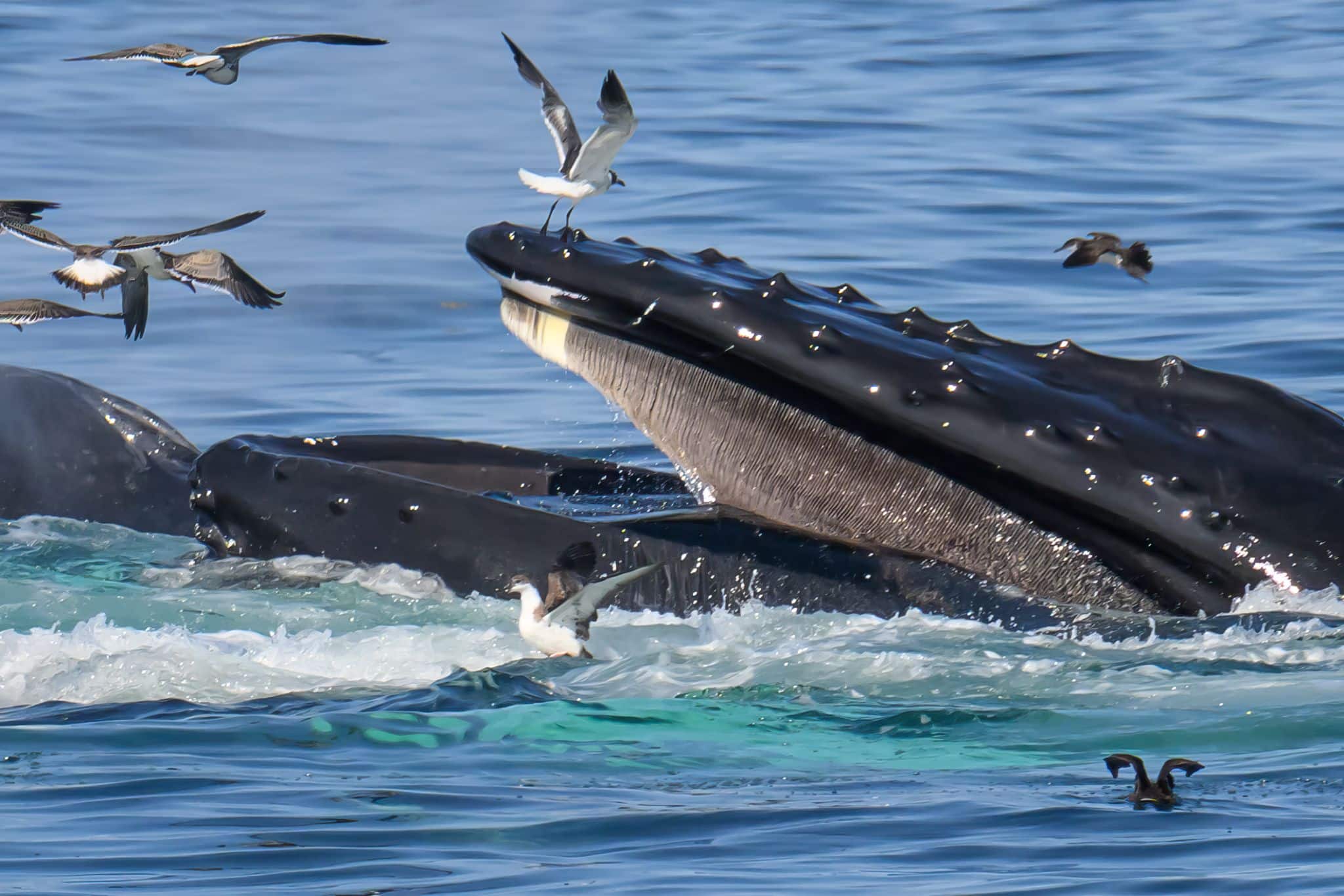
First of all, lots of time to share birding stories and project status updates with old friends and folks who are actively involved in scientific research – all under sunny skies and on a calm sea. However, we were all a bit perplexed by the low numbers of migratory species. Yes, there was plenty of wildlife. In fact, we did see literally tons and tons of gray seals, minke whales and humpback whales. Whenever we spotted a creature within 300 meters of the boat, a designated observer would announce the details to the designated recorder on duty. The bird’s (or mammal’s) sighting time would be noted on a log book, followed by the species name, the number of individuals, their distance, behavior (flying, feeding, diving?) and height of flight. Various gull species ended up dominating our logs. But we did count a number of migrant northern gannets, sooty shearwaters, and Wilson’s storm-petrels.
Oceanites oceanicus, the Wilson’s storm petrel or WISP, earned a right to be in the BOTD running. One of the most abundant and widespread species in the world, WISPs breed on the Antarctic coastlines and nearby islands – and call most of the world’s oceans home for the rest of the year. Out at sea, this ounce-and-a-half feathered wonder darts like a swallow just above the ocean swells, then slows and dips to patter on the surface as if it is ‘dancing’ its small crustacean prey into its beak. WISPs have the curious ability to drink salt water, thanks to salt-filtering glands, and tubular nostrils that they can use to excrete excess salt.
As compelling as the WISP’s Bird of the Day candidacy may seem, though, I’m feeling like the humpback whales really stole the show and deserve to be designated as honorary avifauna so that they can wear the BOTD crown. I could understand if others might vote for the ruby-throated hummingbird that shot across the bow like a bullet while I was blinking.
Author