
Backyard Naturalist: Keep an eye out for bald eagles feeding in Weston
While they’re not actually bald at all, Backyard Naturalist Michael Pappone loves our national bird.
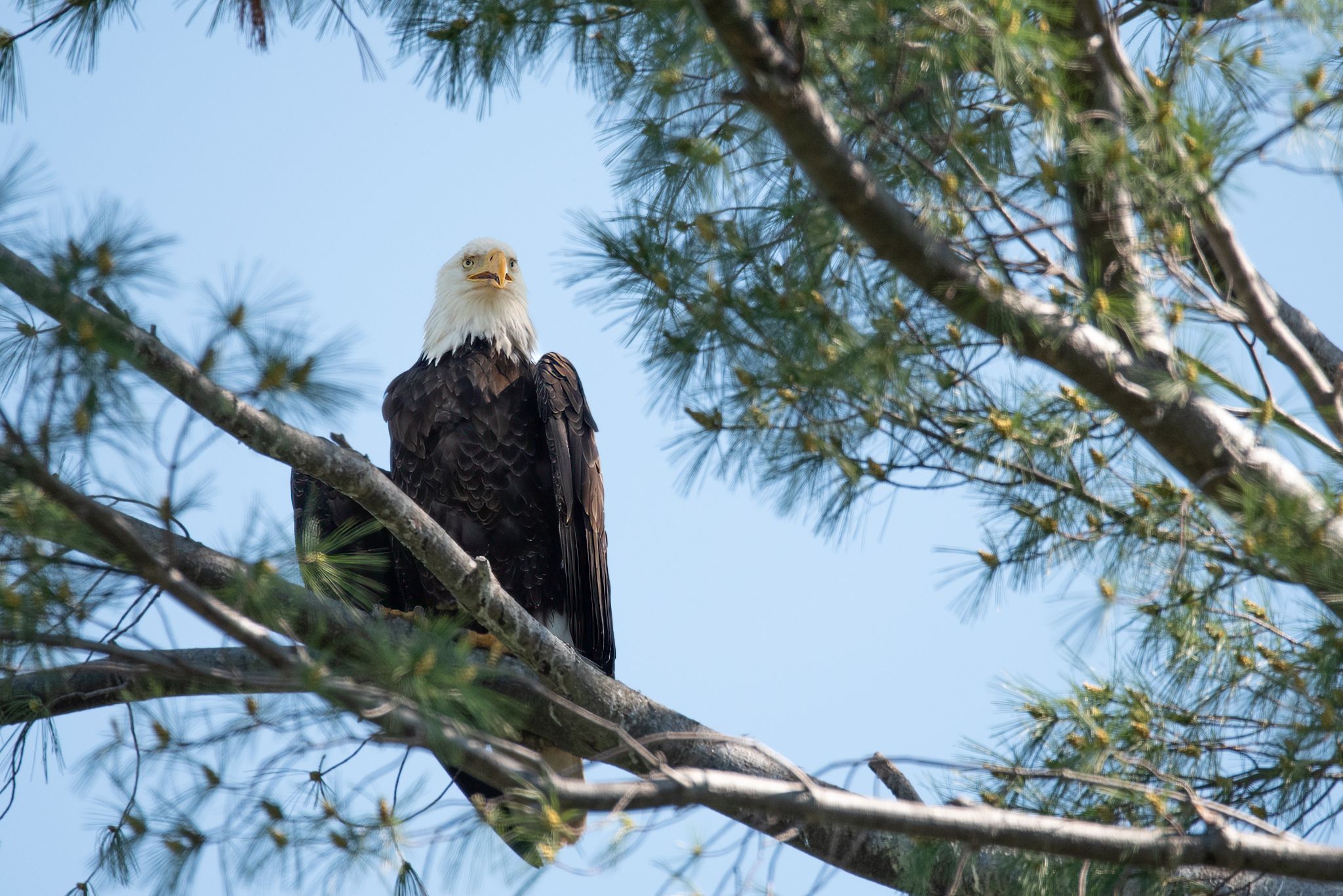
Well, of course they’re not bald at all. The ‘“bald” harks back to the old English “balde” meaning “shining white.” This heftiest raptor in all of North America (Haliaeetus leucocephalus) sports a seven-foot wingspan and weighs as much as a dozen pounds. Its razor sharp talons carry crushing power of 400-1,000 pounds per square inch—10 times that of the human hands.
Our national bird breeds across the entire continent, preferring sites that provide the tallest of trees for their huge nests. In good times, a mated pair may remain together for two or three decades, raising pairs of young on their one-ton nest. You’ll find them near open water where they can swoop down and snag fish. Eagles need about a pound of fish every day—and three times that amount during the breeding season. Those growing eaglets have voracious appetites.
Weston finds itself in the feeding range of several nesting pairs from surrounding towns. Our ponds provide a good supply of prey species: fish, heron eggs and chicks, as well as other waterfowl.
Eagles are ravenous hunters and eaters of small mammals as well as fish. And therein lies the greatest single risk to their existence locally. Among the hundreds of rodents that an eagle eats each year, any number of them have been poisoned by second generation anti-coagulant rodenticides (SGARs). SGARS cause fatal internal bleeding. And while the mice or rats are slowly dying, they become easy prey for raptors and other predators—which in turn causes the predators to die a terrible death, too.
The death of an Arlington eagle, MK, was the catalyst for the anti-rodenticide movement in the state of Massachusetts. In March 2023, MK was found struggling on the ground. Despite best efforts by a rescue group, she died painfully of rodenticide poisoning a day later. Before her, our local Baldy in Waltham had suffered a similar fate. Just weeks ago a Natick eagle succumbed, as well.
Save Weston Wildlife was formed in the fall of 2024, and successfully lobbied the town and schools to ban rodenticides on public property as of May 2025 (town) and January 2026 (schools).

Rodenticides are still being used on commercial properties in downtown Weston, and most likely, if you have a pest control company, they are also using SGARs in your home. Please ask them to not use them. Learn about other methods of rodent control at www.savewestonwildlife.org. Both of Weston’s state legislators, Senator Barrett and Representative Peisch, are supporting anti-SGAR policy at the state level, by including it in the Mass Ready Act, or as standalone legislation.
Remember, bald eagles suffered a disastrous decline starting in the 1950s when the toxic pesticide DDT was in widespread use. Breeding birds had disappeared from Massachusetts before Mass Audubon and the Commonwealth joined forces, committing the resources to welcome them back. To date it has been quite a success story. While our elected representatives work at the state level, please join SWW (find us on Facebook) to protect our local wildlife by getting rid of SGARs in Weston.
Thanks to Kristin Barbieri and members of Save Weston Wildlife for their contributions to this article.
Author

Related Articles
Backyard Naturalist: Tree swallows herald fall’s arrival
Such is the life of a tree swallow: filled with beauty, alive with frenetic activity and fraught with endless uncertainty. Carpe diem.

Ideas in the Making at the AIC: Watercolor: flowing color and infinite possibilities
Water meets pigment, pigment meets paper, and magic happens on the page. That’s the quiet alchemy of watercolor — a medium simple in its ingredients and boundless in its results.

History Corner: Light in the Colonial dark: The Magic lantern and Declaration Day
When visitors arrive at the JST for Declaration Day festivities on Sunday, Sept. 13, they will experience a form of entertainment that predates film, photography, and the Tavern itself: the magic lantern show.