
Backyard Naturalist: Watching “broadies” from the mountaintop
Broadies share the airways with a dozen other raptor species. On a good day, watchers can log falcons, eagles, hawks, vultures and ospreys, along with ravens, crows and occasionally the lone hummingbird.
Popular press around the world reports sustained growth in the number of people who count themselves as birders. More than a few of us would credit some bird of prey (raptor) as the species that took our birding interest to the next level: a so-called “spark” bird.
There are also spark people – those who thrill at the chance to turn their initial curiosity into an enduring passion. Paul Roberts is such a person. He’s my raptor-sparker and a deeply committed hawk watcher, having spent 50 years organizing and advocating for raptors. Some 30 years ago, after attending a two-session presentation led by Paul, the class joined him for a field trip atop Mount Wachusett. It was a memorable learning experience.
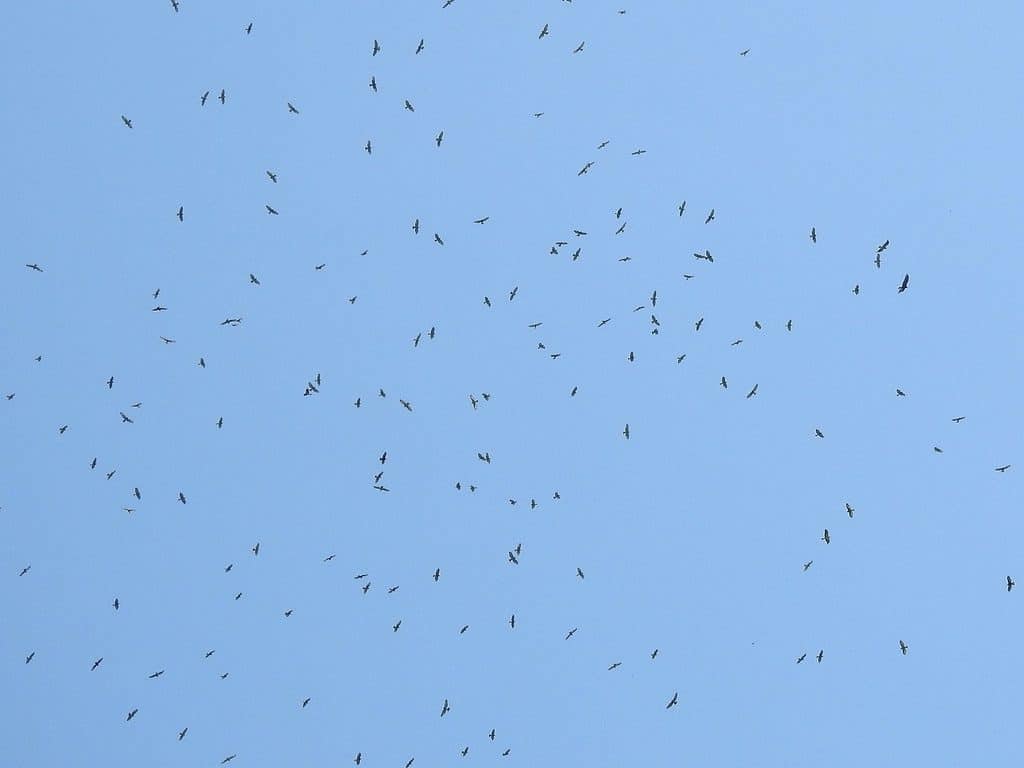
I made one of many return visits to the summit in September after receiving a report that Roberts and the band of watchers a couple of days earlier had counted over 6,000 broad-winged hawks migrating over the peak. The “force” was not with me on my windy-day visit; but I took the occasion to reconnect with Roberts a few days hence
What keeps hawkwatchers watching? Paul’s list includes the wonderful people who swap humor, knowledge and stories up on the watch sites while they lend their eyesight to spotting dark specks on the horizon that miraculously grow into birds. Before watch teams began systematically naming and counting the birds, science had very little useful data to ascertain the health and behavior of a species. Citizen science has come to play an important role in wildlife conservation. Incidentally, watchers are famously hospitable–greeting visitors, helping them ‘get on a bird’ and sharing scope views.
Of course, we all hope to see nature’s spectacles play out before our optics-enhanced eyes. Paul’s been at it long enough to have seen roughly half a million raptors migrating through Massachusetts alone. As he can attest, there’s nothing quite like those shy, solitary, forest-dwelling broad-winged hawks flocking together to migrate. It’s “the incredible beauty and power of seeing hundreds–at times thousands–of broadies, soaring up in thermals and kettles then ‘boiling off kettle’ and streaming southwest on a 5,000-mile flight to Brazil or Colombia. The awesome beauty…is rare and incomparable.”
Most of us see birds resting or feeding, or flying low over the ocean “but nothing compares with the poetic beauty of thousands of individual hawks swirling in the air, using the free lift of thermals (warm air rising from a bare mountaintop) to carry them to their winter grounds.”
Broadies share the airways with a dozen other raptor species. On a good day, watchers can log falcons, eagles, hawks, vultures and ospreys, along with ravens, crows and occasionally the lone hummingbird. Even when we are not ‘on’ a bird, watchers are treated to 360-degree views reaching from the Boston skyline to the ski resorts of southern Vermont.
But wait: here comes a “pair of merlins duking it out over the summit,” notes Roberts.
I may have struck out on my recent visit, but like a gambler, I know my luck will return, and I’ll see a spiraling kettle of “2,000 broad-wings stream over the mountain, rekettle, and rain down on the woods below” after deciding they’d been flying long enough for one day.
Learn more about these fascinating creatures and the thrill of bearing witness to their lives by checking out sites like hawkcount.org and rpi-project.org. You’ll see how citizen science has benefited nature, and maybe decide to join the team to do some hawkwatching and counting together.
Author

Related Articles

Your gifts bring grant dollars to the Weston Observer
On Nov. 1, the Observer launched its second year-end Institute for Nonprofit News/NewsMatch campaign.
History Corner: No ghosts but lots of history in Weston cemeteries
While October is the time for spooky stories, Historical Society President Pam Fox has never encountered a ghost around town.
Backyard Naturalist: Beavers: Nature’s Swiss Army knife of tools
As recently as 10,000 years ago, beavers as large as bears thrived across the continent. Now extinct, these creatures shared a common ancestor with your neighborhood beaver.