
Backyard Naturalist: Feisty little climate migrants survived Snowmageddon
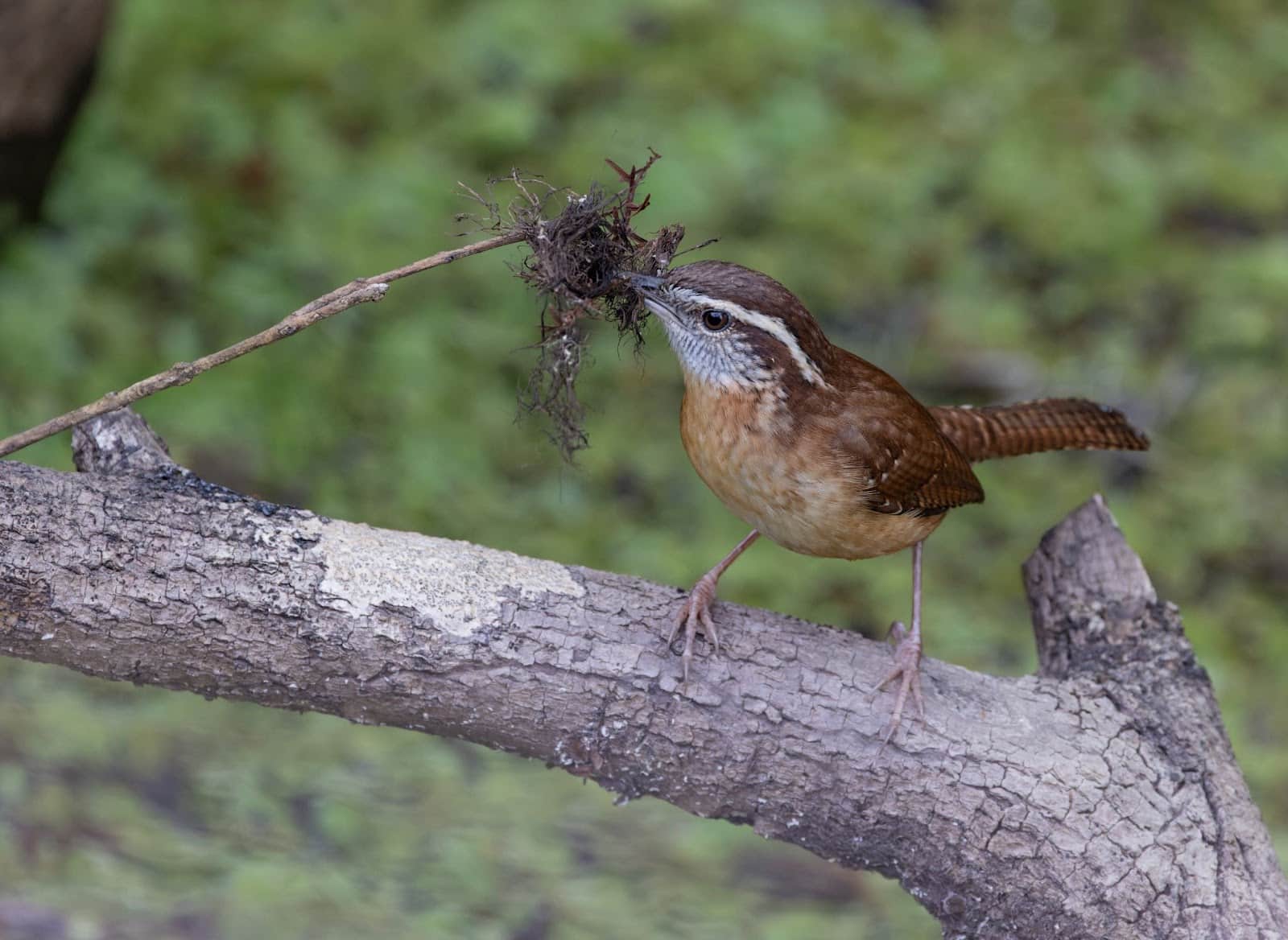
The Carolina wren is one of a growing list of climate migrants coming to Weston.
Help me, dear readers: Does anyone have an onomatopoeic expression that captures the sound of a curious songbird’s feet as they glom onto a window screen right in front of your eyes?
“Sproing” and “thud” do not sound right.
Last week, the bird body at the other end of those reptilian toes belonged to a now-familiar denizen of Weston’s woods: the Carolina wren. This normally shy bird responds so readily to my “pwish-pwish” sounds that I have to suppress the temptation to lure it in for a closer look every time I hear its signature “teakettle-teakettle-teakettle” song in the shrubbery. A “pwished”-upon bird consumes unproductive energy in responding, so most ethical birders now limit their interrupting of birds’ quotidian routines by refraining from habitual pwishing.
The ubiquitous Thryothorus ludovicianus was largely unknown in Weston 50 years ago. It joins the growing list of climate migrants (e.g., northern cardinals, red-bellied woodpeckers, tufted titmice and northern mockingbirds), all of which have found their ecological niches in our neighborhoods. While the catastrophic 2014-2015 ice and snow storms buried this wren’s food supply and decimated its local population, it has since rebounded vigorously. Unmistakable with their russet and cream coloring, white eye-stripe, long decurved bill and uplifted tail, they seem happy to forage below my winter feeders and will punch above their three-quarter-ounce weight to get their share of the suet.
Our brushy suburban yards, ringed by rhododendrons and the like, provide exactly the dense cover this permanent resident species craves. The more leaf litter, downed trees and viney tangles you are willing to leave in your woods, the more likely this wren will be to favor you with its presence. Your reward for allowing part of your property to remain untamed starts with this bird’s voracious breeding-season insect predation and the joy of its wonderful, clear-throated songs and calls. In this species, the male does the singing, impressing the females and defending their territory (these birds are highly philopatric, or likely to return to a particular area), owning the “teakettle” triplet, the cheer and the tsuk vocalizations. The female joins into their impressive shared call vocabulary with ti-dinks, rasps, chirts, pi-zets, scees, pees, growls and nyerks.
Carolina wren pairs are monogamous, with the male leading the way on nest-site selection and contribution of materials. While natural nest sites tend to be five feet above the ground in dense vegetation, this bird has an uncanny way of finding artificial sites that suggest a cheeky streak: glove compartments, shelves and the pockets of old coats left to hang in your garage, mailboxes and old shoes. My brother-in-law in North Carolina delayed the launch of his sailboat until the nestlings in the hollow of his mast had fledged. Fortunately, he managed to haul the boat out before the pair started their second or third brood of the season there.
Even in the off-season this prolific breeder will liven up your environs with its year-round, high-volume song and its big, bold inquisitive personality. Watch for them at your suet feeder. And don’t forget to share your favorite word for the sound of a bird’s feet landing on a window screen. I’ll buy the winner a beer at the Josiah Smith Tavern! Cheers.
“Pay attention; be astonished; tell about it.” Mary Oliver, American poet.
Author

Related Articles
Backyard Naturalist: Keep an eye out for bald eagles feeding in Weston
While they’re not actually bald at all, Backyard Naturalist Michael Pappone loves our national bird.
History Corner: George Washington really did sleep here!
George Washington once spent some time in Weston.