
Weston’s Knox: The K-9 whose game of fetch keeps community safer
Meet Knox, the Weston Police Department’s K-9.
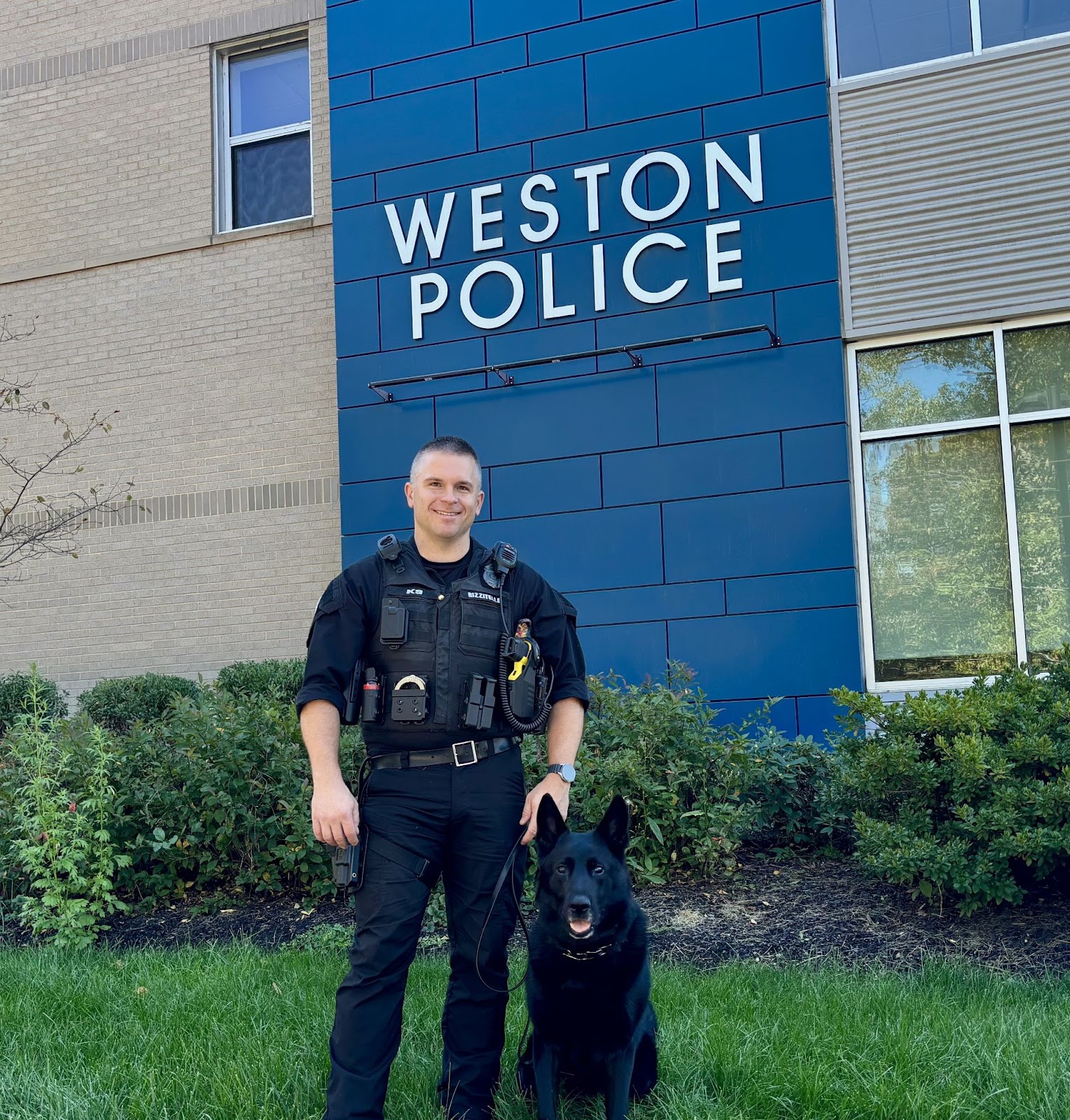
On a dark night in Belmont, police officers were convinced a man had tossed a handgun near a playground where two people had been shot. Officer Mike Rizzitello of the Weston police department unclipped Knox, his German shepherd K-9, and watched for the “proximity alert” – when the dog’s head snaps up, indicating he’s located the prize.
“That night he just stops, lies down and stares. I shine my light and there’s the firearm underneath him,” Rizzitello said.
To Knox, finding guns, shell casings, explosives, or missing people is a game with strict rules.
“He’s toy-driven. Everything to him is play,” said Rizzitello. “Finding a missing person – he’s been trained that you follow human odor, (and) at the end, you’re going to get your toy.”
Knox joined the Weston Police Department in 2018 as a 9-month-old puppy brought over from Slovakia. He looks every inch a sharp working shepherd – shiny black coat, ears standing at attention, dark, curious eyes, a strong wedge of a head positioned over a smoothly muscled body, ready for the miles he may be called to cover.
Knox is named after Henry Knox, the Revolutionary War general who hauled artillery through Weston on the route to Boston, on what became known as the Knox Trail. Almost two and a half centuries later, a different kind of mover goes to work here, hauling answers out of the woods and out from under playground leaves.
He was trained at the Boston Police K-9 Academy, where he spent 12 weeks learning human-odor tracking, and then 14 more weeks focused on finding explosives. Knox is trained monthly and certified annually, including a certification through the Bureau of Alcohol, Tobacco, Firearms and Explosives.
Now seven years into their partnership, Rizzitello and Knox operate as Weston’s K-9 team and as members of the Northeast Metropolitan Law Enforcement Council (NEMLEC) regional K-9 unit, which consists of roughly 30 dogs across the region trained to assist in missing-person searches, SWAT operations and other police work. By deploying multiple K-9s from across the region, police are able to surge into an area, cover more ground, and rotate crews to avoid fatigue.
In 2025, Knox assisted during SWAT-executed warrant cases, missing persons searches and mutual-aid calls. He also works locally responding to bomb threats at schools, venue sweeps for VIPs and large public gatherings including the Boston Marathon and Bentley University’s commencement.
Startup costs for Weston’s K-9 program came from the Stanton Foundation, which funded the costs for the dog, handler, and training fees before the town took over routine care.
“Roughly, he costs us about $2,000 a year,” Police Chief Denis Linehan said, most of which is food and veterinary care.
During a short demonstration at the Weston Police Department, Rizzitello hid a small odor-aid pouch, a fabric pad sprayed with explosive scent for the dog to locate. Caring little for strangers, Knox put his nose-down and swept every corner along the floor until his head snapped back, mouth closed to pull air across his olfactory system. Suddenly, there was a beat of stillness and a quick head-lift as scent lifted off the surface – the proximity alert. Knox glanced at Rizzitello and waited while his partner marked the find. Then the reward toy appears, and the tension transitions into play.
“When the odor is so strong in the air, he doesn’t have to look at the ground anymore,” Rizzitello explained. “When I see his head come up and he starts sniffing the air, that tells me we’re near someone.”
Why does quiet, affluent Weston need a K-9 team?
Rizzitello, who’s been a police officer for 17 years, said Knox can track down people with his nose in ways officers’ eyes and ears cannot.
“We’ve seen a large increase in residential housebreaks, stolen cars, and yesterday there was a scam for money,” he said. “Rather than calling other towns trying to get a K-9 we have one that’s here.”
Public perception of police dogs is slowly shifting, Rizzitello said. “People see pointy-eared shepherds and think aggression,” he said. “But 90% of what these dogs do is passive locating.”
Knox’s mere presence can also cool a potentially volatile event. “He’s never bitten anyone,” Rizzitello said. “A couple of times we brought him out and he de-escalated a situation. People decide they don’t want to fight a dog.”
Off duty, Knox lives with the Rizzitello family.
“My wife always says, ‘I can’t believe he’s a police dog,’” Rizzitello said, laughing.
Linehan says Knox is “like having another officer out there that provides our residents with a level of safety, ” and credits the handler’s devotion. “A big part of the success of a K-9 program is the handler,” the chief said. “You can see the bond in how the dog works for him.”
When called upon, Rizzitello says Knox is all business. But even hardcore cops need time off. For Knox, the perfect shift ends like it began —with a game. “He finds it and gets his ball,” Rizzitello said. “That’s the whole point – find the thing, get the toy.”
Sally Yuan is a student journalist at the Boston University School of Journalism
Related Articles
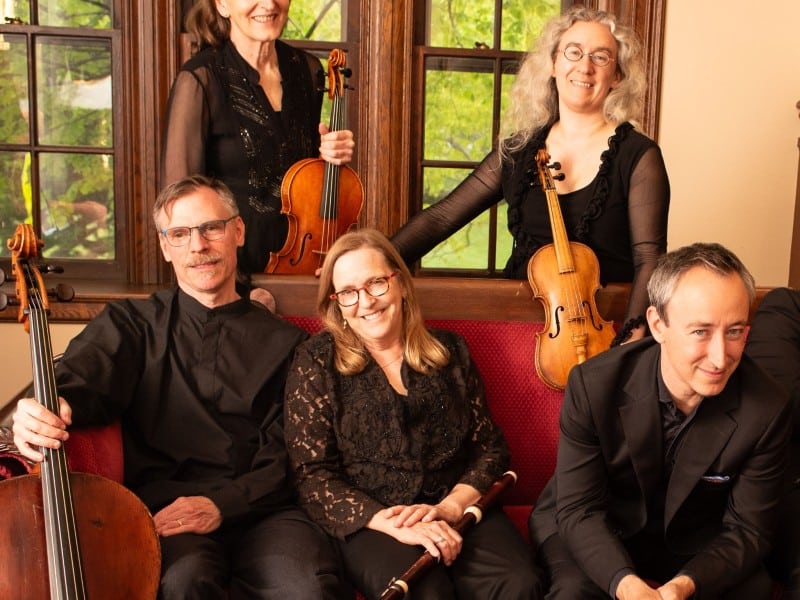
Musicians of the Old Post Road begins concert season
There’s something “magical” about performing period music on period instruments, says Suzanne Stumpf.
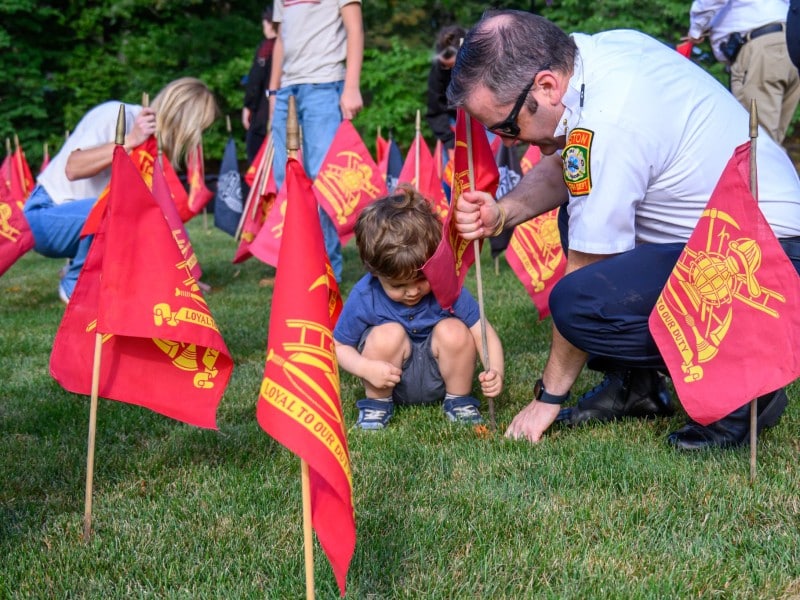
Photos: Westonians place flags for victims of terrorist attacks
In commemoration of the 25th anniversary of the 9/11 terrorist attacks, residents gathered on the Town Green, Sept. 11, 2026, to plant flags for each of the nearly 3,000 victims lost in those attacks.

Saying No to New: A guide for ditching distractions and reclaiming your life
Weston Native and New York Times editor Eric Athas has written “Say No to New: Why New Things Are Stealing Your Time, Money and Happiness and How to Take Back Your Life.”