‘Intentionality’: District seeking thoughtful AI use in classrooms
As administrators explore how artificial intelligence can be deployed in classrooms, a distinct theme rises from district leadership: intentionality.

In Kim Young’s ninth grade digital literacy class, students have started learning about AI without typing a prompt into a chatbot.
Instead, students are working on identifying AI-generated videos and photos, beginning by asking: Is what you see logical? Is there a verified, trustworthy source backing it up? Can a reverse-image search identify where the image came from?
This is one example of how Weston Public Schools is exploring its integration of AI into the classroom. As administrators explore how artificial intelligence can be deployed in classrooms, a distinct theme rises from district leadership: intentionality.
The district began studying AI integration last spring. When it releases its findings in 2027 and eventually implements some form of AI use, students will not be running loose with the technology. Instead, administrators said, students will learn how AI works, the risks and dangers of the tools and how the new technology can be used to further their education.
In a world where AI technology goes through seismic shifts every year, it is imperative that students understand its capabilities, according to Neil Trahan, assistant superintendent of technology and operations. While teachers are allowed to use AI to supplement instruction, they will continue to assign homework and classwork that require independent thinking.
“We want to make sure that students learn the critical thinking and the essential skills they need to be able to answer questions and write effectively without AI,” Trahan said. “But we also believe – we’re working with the [Technology Advisory] Committee on this – that we also have to prepare students for what they’re going into, whether that be higher education beyond high school or the workforce.”
Currently, Weston limits AI use for students up to seventh grade, while older students may access Google Gemini, the technology company’s AI model. This may change, Trahan said, depending on what path the district takes.
Last spring, the district began a months-long investigation into AI, as part of a broad digital literacy and computer science initiative. While AI is one prong of the plan, which also includes a wider variety of computer-based courses to strengthen students’ and faculty’s foundational technology skills, it is a major focus because of its potential to upend so many aspects of education and life. Student well-being is also a focus of this new initiative.
“AI is a piece of this intentional use, always considering the whole student, and that’s true throughout our K–12 curriculum, regardless of the topic we’re talking about,” said Young, the district’s secondary education technology integration specialist. “Student well-being is always a central element.”
The district has created a Technology Advisory Committee to ensure it receives a variety of viewpoints, including from staff, students, parents and other community members.
All of the district’s internal work and research, as well as community feedback, is about laying down a foundation that can be continually re-examined, according to Trahan, Young and Todd Whitten, assistant superintendent of teaching and learning.
“It’s a new frontier. That’s really how we have to look at it,” Whitten said. “And where we go is going to be the same as every time humans have set forth onto a new stage: planning makes it better.”
Daina Selvig, chair of the School Committee, said the Technology Advisory Committee’s work is key to implementing thoughtful, effective use of technology that serves students, while protecting academic integrity and creative outlets.
With students and staff already using AI, thoughtful integration of the technology can teach them how to use it, as well as when it is “not going to be the best tool to use to foster academic discourse.” A continuous review of the policy like the one the administrators pitched, is also what Selvig supports.
“Whatever we do is going to have to be iterative. Things will change, and we’ll have to change with it. I’m glad we are taking a thoughtful approach – quick, but thoughtful,” Selvig said. “[AI is not something] we can stuff back in the box, and I’m glad we’re not taking a blanket prohibition.”
Weston is not alone in exploring AI integration. Boston Public Schools is also researching how AI can be used in the classroom, in part due to “AI’s ubiquitous nature and nearly universal access to AI tools on personal devices,” according to its policy. At Wayland Public Schools, according to its policy, students may use certain AI tools approved by the district under teacher supervision.
Some of the nation’s largest public school districts, however, are clamping down on AI, at least for this school year. New York City Public Schools, the largest district in the U.S., has banned AI for all elementary and middle school students while it pilots limited use of the technology through specific high school courses. Los Angeles Unified School District, the country’s second-largest public school district, has implemented a near-total ban on AI, according to the New York Times.
Education is at an inflection point, but unlike during the pandemic, which was a sudden and total disruption to every aspect of education, Whitten said there is an opportunity to prepare, allowing the district to investigate how the technology can be used appropriately.
“When COVID happened, it was the Wild West. [It was like], ‘we need every tool, just give it to us and we’ll try and make it work,’” he said. “As we now get more and more distance from that, it gives us the opportunity to kind of think…is it a good time for us to consider a reset, and looking at, again, intentionality.”
He added that AI is an example of a 21st-century tool that schools can teach students to use effectively, much like how students were taught the skills to conduct research on search engines such as Google throughout the first quarter of the century.
Intentionality in Weston begins with the basics, according to Young. In fact, a good chunk of students’ educational experience with AI will likely look like the digital literacy lessons they already receive.
Back in Young’s classroom, she said she is seeing success with the hands-off approach. About 80% of students might say they were fairly confident in determining the validity of an image, but “the actual doing it helped their understanding.”
Regardless of where the district lands, Young said the AI plan will be under a microscope. Typically, the district might let initiatives play out for a few years, but AI’s ever-changing nature means they will consistently be reviewing it.
“There’s always a new thing. We also recognize that there is something about AI that may be a little different from the regular evolution of technology,” Young said. “At the same time, good teaching is good teaching. We are always looking for a productive struggle because we know that is when neurons are built.”
Author

Related Articles
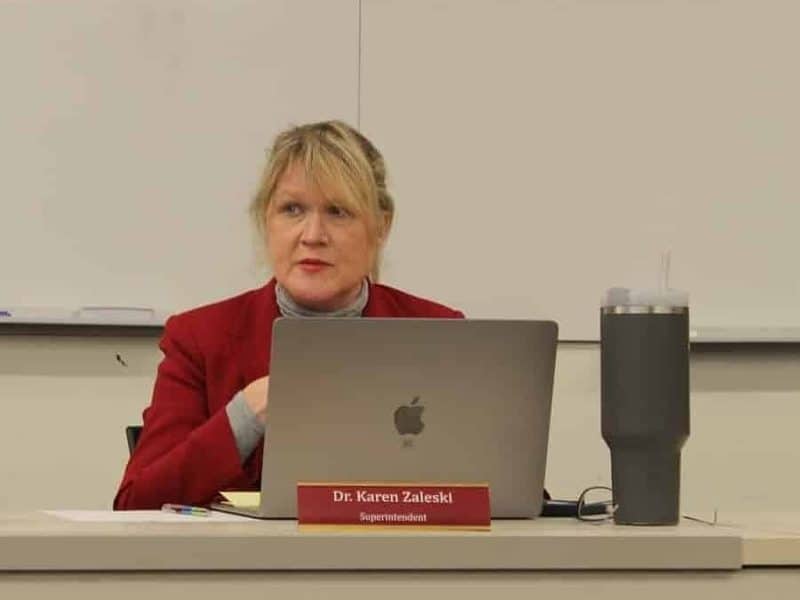
Zaleski will not seek contract; Trahan appointed acting superintendent
Superintendent Karen Zaleski will not pursue a successor contract with Weston Public Schools and will leave her role on Dec. 4

District to study MCAS trends
Although Weston Public Schools is making some strides in improving its already-strong MCAS scores, school officials said there remains room for improvement.
Schools, long-term debt focus of financial summit
A tight year for the education budget and long-term town debt were the focus at Weston’s annual financial summit as town officials kicked off budget-building season.