
Backyard Naturalist: The pileated woodpecker is better than any pest control
In this week’s Backyard Naturalist, Michael Pappone talks about our own Good Lord! bird, the pileated woodpecker.
When James McBride penned his 2013 National Book Award winner, he presented the fictionalized story of an enslaved youngster in Kansas who joined with John Brown in an ill-fated attempt to seize an armory in the American South. The protagonist was “armed” with the good-luck feather of an ivory-billed woodpecker – the Good Lord! bird.
How did all that work out?
Well, the Brown party was caught and hanged and the eponymous bird went extinct about 100 years later. Its closest cousin, however, is alive and doing exceedingly well right in our backyards, though.
Weston’s ample stands of mature deciduous trees are just what our own Good Lord Bird (aka the pileated woodpecker) craves for its nesting and foraging. I think about all the birders I travel with and always wonder: What was their spark bird – that special bird that lights the fuse that turns your casually warm feelings for birds and nature into a lifelong passion for all things avian? It’s not surprising that the pileated woodpecker is high on the list.
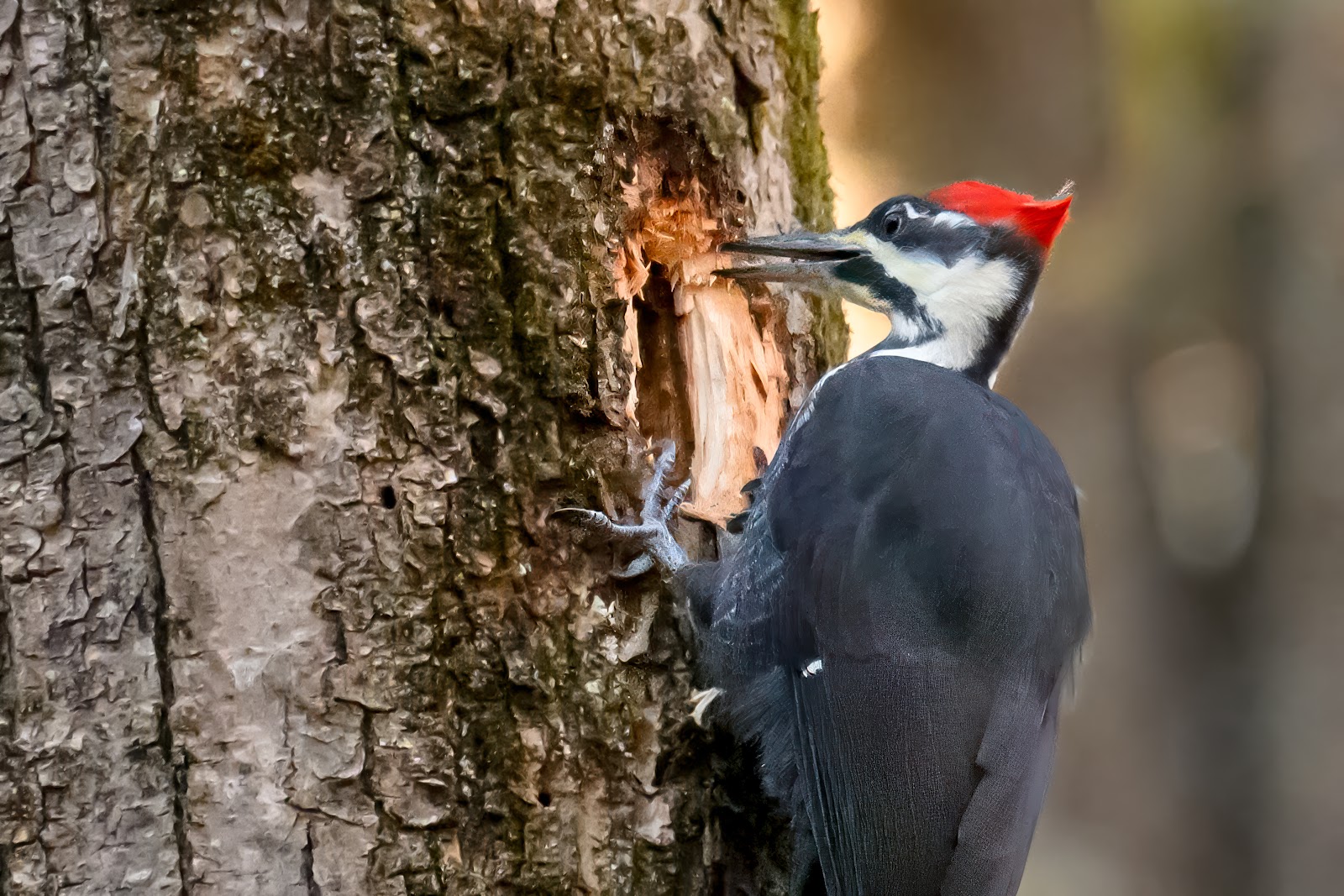
Why? Well, for one thing, size matters. This crow-sized woodpecker is the largest of its family in all of North America, more than 10 times the weight of our common downy woodpecker and boasting a wingspan of 2.5 feet. Add to that the striking contrast of its black and white flight feathers, prop it up on zygodactyl feet, top it off with a bright red crested head and mustache, give it a maniacal cartoon woodpecker call, and you’ve got yourself an unforgettable creature – if not your very own spark bird.
I have a vivid memory dating back to 1979 of cruising down Interstate 93 north of Manchester with a friend in his convertible, when all of a sudden this large bird with a distinctly undulating flight pattern (flap flap, glide; flap flap, glide) sails across the road in front of us. I couldn’t contain my enthusiasm; my colleague was unfazed. Not his spark bird, then – OK.
A PIWO pair, in alpha code-speak, (Drycopus pileatus in Latin) nests just beyond my driveway’s end in an old oak tree where they have excavated a suitable nest cavity. The pair reliably return around an hour before sunset to vocalize in the woods, reminding the neighbors whose territory this is, before settling down for the night. The species has a remarkably long life expectancy – nine to 12 years; it is likely that the same pair returns to this nest year after year. That’s a feat made immeasurably easier by the fact that PIWOs do not migrate.
When they’re not busy sparking the interest of wannabe bird nerds, or laying down the soundtrack for a jungle movie, they are acting as your home’s defender. This is not one of those woodpeckers that are harassing your house siding. No, indeed. This hungry animal feasts on those pesky carpenter ants that would otherwise be marching towards your house. It also loves the larvae of the beetle species that are attacking your trees. As a subcambial (below the bark layer) excavator, it pries off the layers of a tree to reach ant ‘galleries’ using its barbed tongue and sticky saliva to catch and extract its prey.
The pileated has an outsized impact on the environment around it, earning it a “keystone” species designation. Its chipping away at dead wood helps the wood decay faster; its fondness for insect pests protects living trees and its nest cavities are available in the off-season for owls, wood ducks, fisher cats and squirrels. If you’re in need of a look at this spark bird, walk slowly through the woods, paying special attention to the PIWO’s vocalizations and watching for downed trees that might contain a swarm of unsuspecting carpenter ants.
Author