
Backyard Naturalist: Loons: Guardians of the wilderness
We can all enjoy the company of loons without even leaving the Commonwealth thanks to the Biodiversity Research Institute.
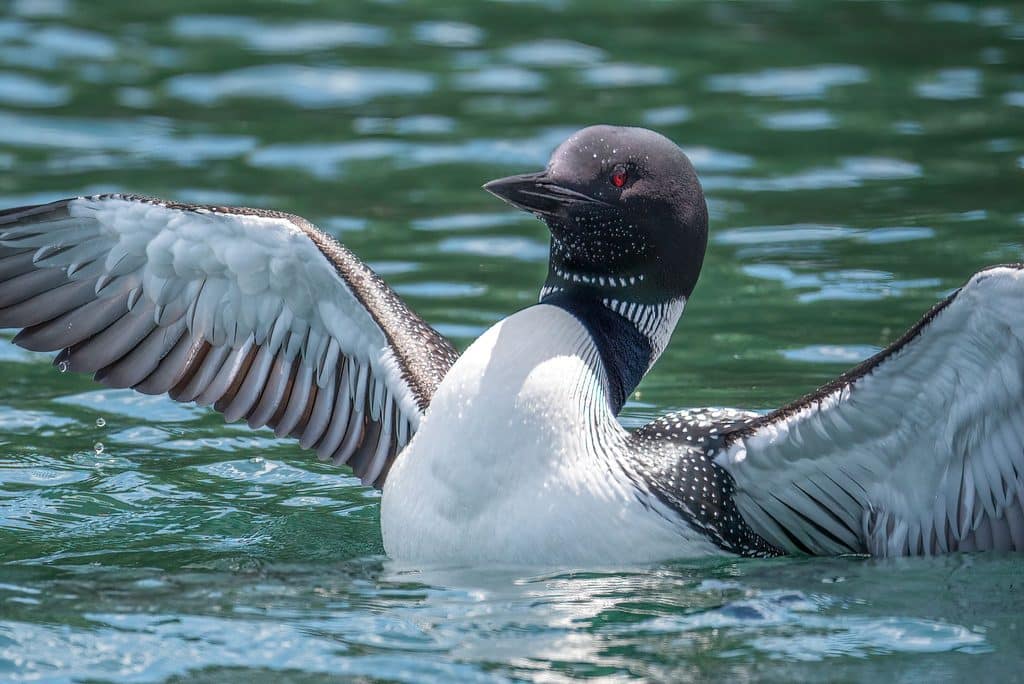
With school schedules crowding our daily thoughts and Mass Pike traffic choking our forward progress, don’t you yearn to reconnect with memories of summer’s solitude? Perhaps you were blessed to have loafed on a boreal lake dotted with islands and had the privilege of counting the common loon as a neighbor. Maybe you paddled the shoreline and found yourself staring down a red-eyed creature in its tuxedo. You could almost have imagined yourself lost between a couple of stanzas of Longfellow‘s epic poem, “The Song of Hiawatha.”
My childhood camping trips took us to loon country in northern Minnesota; summer vacations with our own children in the middle of Lake Winnipesaukee kept me in touch with this wonder of nature.
Now we can all enjoy the company of loons without even leaving the Commonwealth.
Thanks to the leadership of the Biodiversity Research Institute and its local partners, loons are for the first time in the last 100 years breeding on some 27 sites. BRI carefully moved young loons from northern lakes to our fresh water sites. Young loons not only returned to the ponds to which they’d been translocated, but successfully started families.
The common loon (Gavia immer) cuts an unmistakable figure in its breeding territory. Larger than any of the ducks and sporting a dagger-like bill, this 10-pound hunk returns to fresh water in March soon after the ice has thawed. It will have spent the winter months fishing in ice-free coastal waters. Courtship consists of swimming and diving displays, culminating in the synchronous resurfacing of the pair. Nesting pairs prefer lakes with crystal-clear water and protected inlets – or better yet, little islands free from human disturbance. They’ll build the nest near the shore (loons are ungainly on land), out of the wind, and protected from aerial predators by overhanging brush. The loon is so loyal to its nest (philopatry) that it is willing to defend it to the death, if necessary.
The female lays two eggs; both parents participate in incubation. Chicks stay close to their parents for the first eight to 10 weeks, often riding on their parents’ backs. They’ll learn from the older birds how to dive for tasty perch, propelling themselves forward with strong strokes of their legs and webbed feet. Loons require perfectly clear water, as they pursue prey visually – peering below the surface to scan for movement before diving. Once under water, a loon will resurface within a minute – though two- to five-minute dives are not uncommon. Loons have been clocked down beneath the lake’s surface for as long as 15 minutes, and as deep as 200 feet. During the course of a breeding season, the loon family will devour some 2,000 pounds of fish.
Adult loons have almost no predators. They are at risk mostly from “intraspecific trauma“ (fights over territory), motor boats, lead fishing sinkers, and starvation – especially if the water becomes murky and they can’t find food.
Chicks face danger from unpaired male loons, crows, gulls, bald eagles, and snapping turtles. Raccoons, mink and fox all target loon eggs. Loons that survive may live up to 35 years.
No account of this magnificent creature is complete without acknowledging the vocalizations that haunt loon-inhabited ponds. Their extensive vocabulary of hoots, toots, tremolos, mews, wails, and yodels each has its own meaning and purpose. Who wouldn’t find some refuge nearby when listening to this guardian of the wilderness signaling that all is well?
“I cannot cause light; the most I can do is try to put myself in the path of its beam.” – Annie Dillard, American naturalist/author
Author

Related Articles

The Student Observer: When doing your part isn’t enough
One of the frustrating things about group projects is that doing your part isn’t always enough.

Backyard Naturalist: Tree swallows herald fall’s arrival
Such is the life of a tree swallow: filled with beauty, alive with frenetic activity and fraught with endless uncertainty. Carpe diem.