
Town Government 101: What gets paved when? Weston roadwork explained
In Weston, the question is not whether all roads lead to Rome, but rather what the quality of the ride itself will be.
Editor’s note: This article is an installment of “Town Government 101,” a series of stories explaining how municipal government works. Have a question about how Weston operates? Email us at [email protected].
In Weston, the question is not whether all roads lead to Rome, but rather what the quality of the ride itself will be. A trip down the newly paved section of Dean Road may be smooth, but drivers leaving for Lincoln will be met with the potholes of Concord Road.
Public road improvement and maintenance is overseen by the Department of Public Works (DPW). Over the past decade, the department has worked to bring all the public roadways in town to the same level so the department can focus on preventative maintenance instead of structural improvement. Deciding where roads fall on that list is not as simple as declaring which road is the worst and going from there, according to Town Manager Leon Gaumond.
“It’s a combination of money, condition of roads and the capacity to handle the projects,” Gaumond said. “Are we automatically going to redo the worst road every year? No, because we have to time other things in, like if we know that National Grid is doing work in a specific area, we might want to do our road surfacing work in that area at the same time.”
The project to improve roads across Weston comes from a Select Board directive made more than a decade ago. In 2015, the town commissioned a pavement management study from civil engineering firm Vanasse Hangen Brustlin. Current director of the DPW Richard Sullivan said the study allows his department to work off of data instead of anecdote.
“We wanted a quantifiable foundation to start from,” Sullivan said. “It also documented the need for when we go to the Select Board to ask for money.”
The survey judged the roads on a Pavement Condition Index (PCI), which rates streets from 0 (needing base rehabilitation) to 100 (no immediate maintenance needed). In 2015, almost 30 of about 90 miles of town roads needed base rehabilitation.
The Select Board at the time decided to bring public roads up to 70 PCI, which has directed the DPW’s plans on road improvements since. Sullivan estimates that between 70% and 80% of the roads in town are now up to 70 PCI.
“The lowest PCI isn’t always the first to be worked on…it’s a multi-prong approach between preventative and rehabilitative work,” he said. “We have a list every year of what we’d like to do, but sometimes roads move up and down the list.”
The town coordinates its road work with utility companies to prevent having to dig up the same stretch of road and redo work. If a utility company is going to dig up a road next year, for example, the DPW might schedule road work then to keep interruptions to a minimum. Sullivan says he meets with National Grid monthly to help schedule future roadwork and keep abreast of utility work in town.
Other work is also factored into the schedule. Sullivan said it is a careful balance between working through the PCI project and maintaining the work that has already been done.
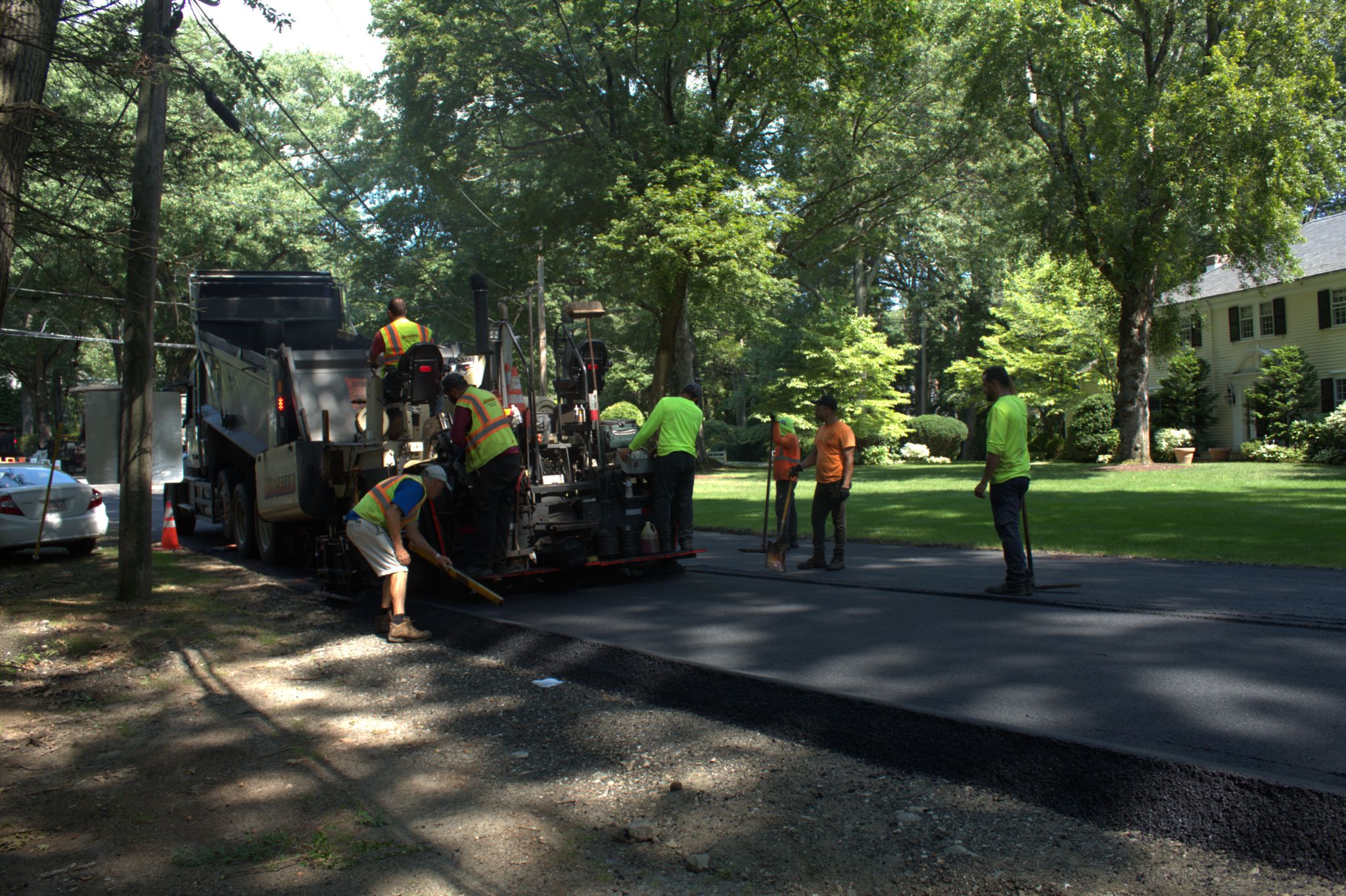
Once a street has been chosen, they have to be inspected before work can start. Once drain pipes are inspected and coordination is complete with the cable or utility company, work can begin. Last week, Sherburn Circle, Dean Road and Stonecroft Circle were repaved. Next on the list are West Cliff Road and Rolling Lane.
The department’s budget is set every year at Town Meeting, which includes how much is invested in road improvements every year. The town allocated $1.5 million to public way construction for fiscal year 2027. The state has also granted Weston almost $750,000 to help improve public ways.
“We’re getting to the tail end [of the project],” Gaumond said. “There’s probably only a few years left of funding before we can drop down to maintenance.”
Some roads are out of the town’s purview. Between 15 to 20 miles of the streets in Weston are privately owned, according to Sullivan. Repair and keeping of these roads are up to the owner, which may be a developer or a developer’s trust, according to Gaumond.
Gaumond said he was interested in having another study done to quantify the progress that has been made in the 11 years since the initial study and reaffirm what work lies ahead.
“We’re trying to plan intelligently for the future,” Gaumond said.
Author

Related Articles
How much does it cost to litigate a 40B project decision?
Working through Chapter 40B projects can be pricey for a community, especially if it ends up in court.

Drunk driving arrests in Weston double in three years, but few are town residents
Arrests for driving under the influence doubled in a recent three-year period, though only two were Weston residents.

Eden Leonard to lead Land’s Sake Farm
Eden Leonard is Land’s Sake Farm’s new executive director.