
History Corner: A tale of two taverns: Josiah Smith and the Golden Ball
Did you know that Weston has two taverns that were operating during the Revolutionary War?
Did you know that Weston has two taverns that were operating during the Revolutionary War?
Owned by men with very different political views, they are important reminders of these turbulent times, when the colonies were divided between those who championed independence and those who remained loyal to the king.
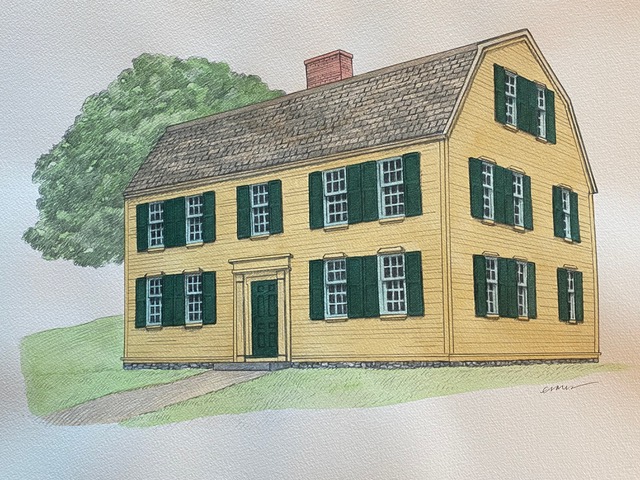
The “Patriot” tavern belonged to Josiah Smith, who built it in 1757 and operated it throughout the war years. The “JST” and Weston Historical Society exhibits will be open Saturday, May 16, from 11a.m. to 3 p.m. for Celebrate Weston.
In his history of Weston, Daniel Lamson called it “one of the most noted between Boston and Worcester.” Josiah’s son Joel took over the business after his father’s death and added the east addition with a second-floor ballroom.
Josiah and Joel were well-known “Liberty Men.” Josiah, along with his brother Bradyll and Samuel Phillips Savage, represented Weston at the First Massachusetts Provincial Congress in Concord in October 1774. It was here that delegates seized the reins of power and planned for Massachusetts to separate from British rule. The following spring, Joel was one of the 103 Weston men who marched to Concord to join the fight against the British.
Less than a mile away, “at the sign of the Golden Ball,” was a second tavern, built in 1768.
Innkeeper Isaac Jones was known for his Tory sympathies. He became a target of patriot wrath when he served tea to customers despite a boycott of tea, which had become a symbol of British oppression. Jones issued an apology, but that was not enough to prevent his tavern from being sacked in March 1774 in what has become known as the “Weston Tea Party.”
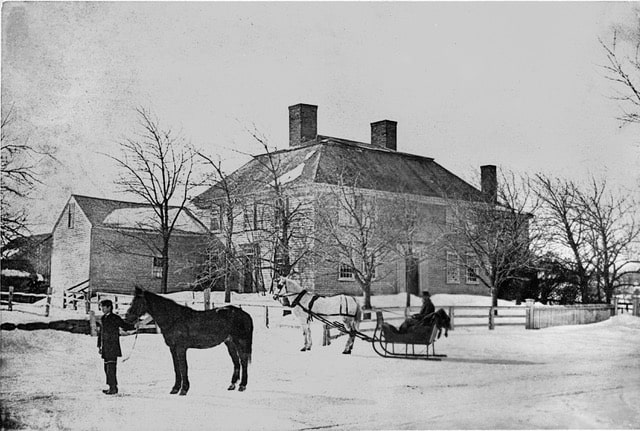
Isaac Jones also hosted British spies. In February 1775, British Gen. Thomas Gage, whose troops were bottled up in Boston, sent two spies to map the countryside. They stopped at the Golden Ball “with an intention to get a drink and so proceed; but upon our going in the landlord leased us so much, as he was not inquisitive, that we resolved to lye [sic] there that night. . .” The two men were “not a little pleased to find, on some conversation, that he was a friend to the government; he told us that he had been very ill-used by them some time before; that since he had shewed them that he was not to be bullied, they had left him pretty quiet. . .”
Two years later, a British officer, Thomas Anbury, was a prisoner of war on his way to Cambridge with the captured army of Gen. John Burgoyne. (Enlisted men camped in the area but officers stayed at inns and taverns). Anbury was put up for the night at the Golden Ball and later wrote: “. . . above all, the landlord is a friend of our Government, and like all of that description, has been much persecuted. He was not without his apprehensions of being sent to prison for attentions shewn [sic] to the officers who stopped at his house, which was nothing more than the common civility he shewed to all his guests: in short, he was deemed by the Americans a rank Tory.”
Despite pressure to shun Isaac Jones and force him to close his tavern, the Golden Ball remained open throughout the war. By 1777, he was carting military supplies for the Continental army. The following year he was elected as a Weston selectman, indicating that he was by then considered a respected citizen. The Golden Ball Tavern closed its doors in 1793. The “Tory Tavern” served as a residence for six generations of the Jones family, until 1963, when it was purchased and carefully restored as a house museum furnished with items saved by the family.
Today, the museum is open every Thursday from 10 a.m. to 4 p.m. and on the second Sunday of the month, March to November, from 1 to 3 p.m. Visiting the GBT is an ideal way to celebrate this 250th anniversary year.
Author

Related Articles

Backyard Naturalist: The miracle of metamorphosis, or a very hungry caterpillar
Backyard Naturalist Michael Pappone explores the caterpillar metamorphosis process in this week’s column.