
Backyard Naturalist: The barred owl, Weston’s neighborhood owl
“Who cooks for you? Who cooks for y’all?” Michael Pappone dives into barred owls and their vocabulary in this week’s Backyard Naturalist.
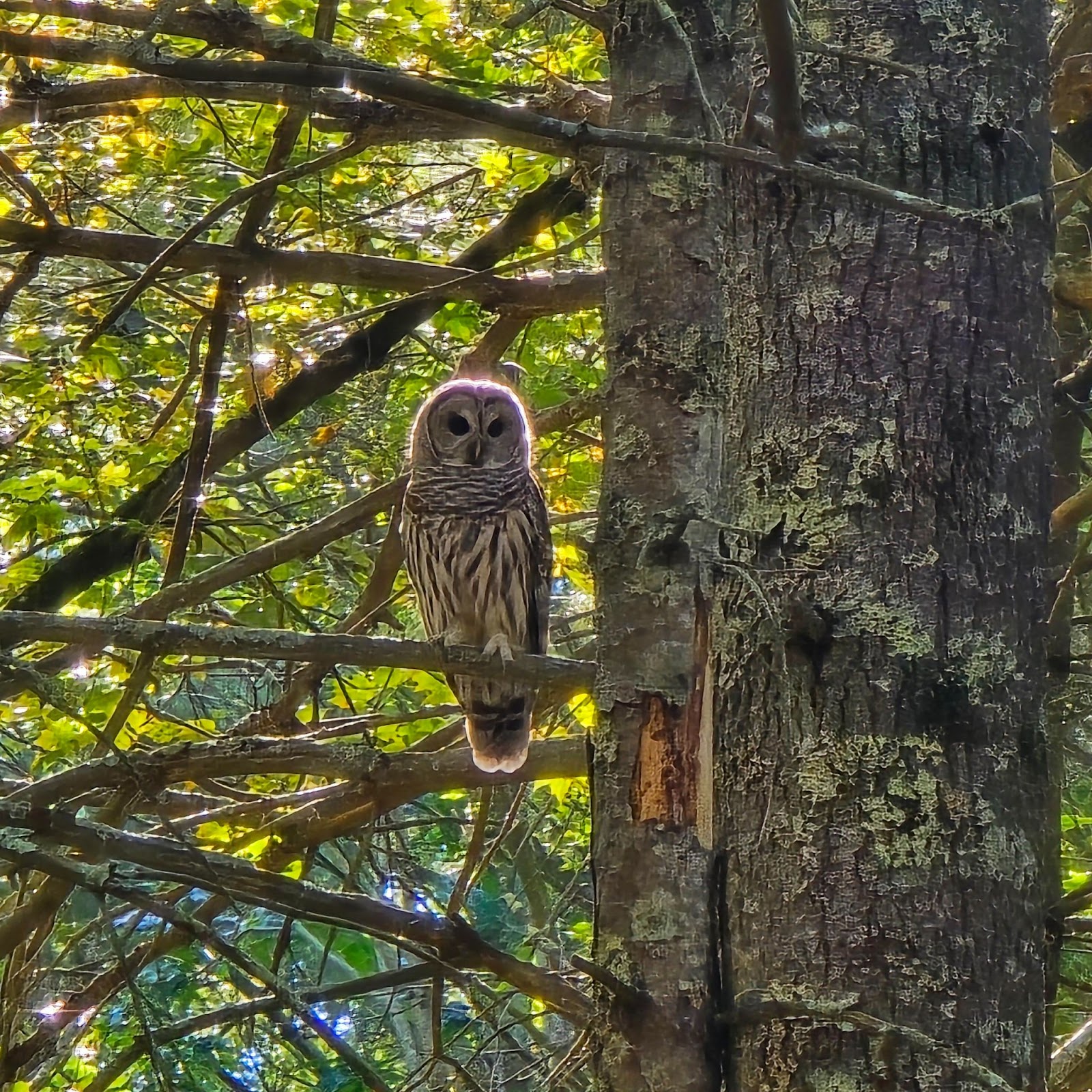
Long before the first light scattered the stars, the insomnia demon found me and turned loose a chowder of memories and to-do lists along with a host of Backyard Naturalist topics vying for next-column status.
From the open window wafted the repeated, soft query “Who cooks for you? Who cooks for y’all?” The barred owl struts its vocal stuff for a respectable five minutes.
According to the Mass Audubon Breeding Atlas, the barred owl (strix varia) is doing fine in the commonwealth, having nearly tripled their distribution in the state over the last 50 years. No mean feat as we witness the decline of so many other species of our avian friends.
This bird thrives in the wooded wetland habitat that Weston generously provides. Here they find an abundance of tree hollows, their preferred nesting sites, and a plethora of prey species ripe for the picking. I have delighted in watching these silent hunters ferry back chipmunks, squirrels and even frogs — sometimes in broad daylight — to their nestlings. Like most owls, though, they do spend their days mostly tucked away in nest cavities or roosting on branches.
During nesting season, barreds exhibit characteristically territorial behavior, enhancing their vocabulary with loud “whoots” and hoarse “yowls,” punctuated by bizarre beak-clacking and caterwauling. The din evokes visions of “Jurassic Park.” They’re telling potential intruders: “If you can hear me, you’re too darned close!” A couple of neighbor kids and their dad once popped wide-eyed out of the woods and showed me a photo of a pair of wings they’d found intact on the nearby trail. This luckless individual had failed to heed the warning to steer clear — and owls will murder their cousins. Ah “…nature, red in tooth and claw.” (Tennyson)
Barreds are easily attracted to imitations of their calls. During the pandemic, my wife remarked to a neighbor that I’d go out hooting “who cooks for you–who cooks for y’all’’ in the back yard after sunset, and insist that the owl answered me. He said, “I do the same thing!” Maybe we were hooting at each other the whole time?
Barred owls are believed to mate for life; and over 10 breeding years produce an average annual brood of three owlets. The eggs take about a month to hatch, during which time the female tends the nest and the male does all the hunting, making regular deliveries of small critters to share. The young are altricial, that is, unlike shorebird chicks or even common barnyard chicks (precocial), they’re helpless at birth. It takes five weeks before the owlets are ready to venture outside the nest and another four months until their parents stop providing most of their meals.
Not all broods succeed. And when they don’t the consequences linger. A few years ago, my vernal pool pair up the street raised two owlets to fledge, as they had in previous years. These fluffy chicks spent that morning on their limb outside the cavity. I had looked forward to watching them venture forth to forage, first for juicy beetles and grasshoppers, and then to meatier stuff. Alas, by afternoon, no trace of them remained. Vulnerable fledglings count great horned owls, raccoons, fisher cats (a weasel species) and red-tailed hawks as threats.
The parents have shunned this nest cavity ever since.
Owlets that reach maturity are magnificent creatures, standing two feet tall and have a wingspan of over four feet. The noble strix varia weighs in at only about a pound and a half, with females outweighing males by some 25%. For the bird nerds out there, that is an example of ‘reverse sexual dimorphism’ where the usual gender differences between a pair trade places. It’s typical of hawks and falcons as well.
Fun facts: your backyard barred, unlike most yellow-eyed owls, has deep brown eyes, a feather structure that allows silent flight and asymmetrical ears that hear 10 times better than we can. These are super-stealth critters that can nail prey with deadly accuracy. In Weston, you are almost certainly within walking distance of a barred owl’s territory.
So next time you are out for an evening stroll, listen for this feathered neighbor to ask “who cooks for you?”
Author