Pilot program could provide ‘first-of-its-kind’ traffic data
A Cambridge-based startup is proposing a free pilot program that would provide advanced traffic data to the town.
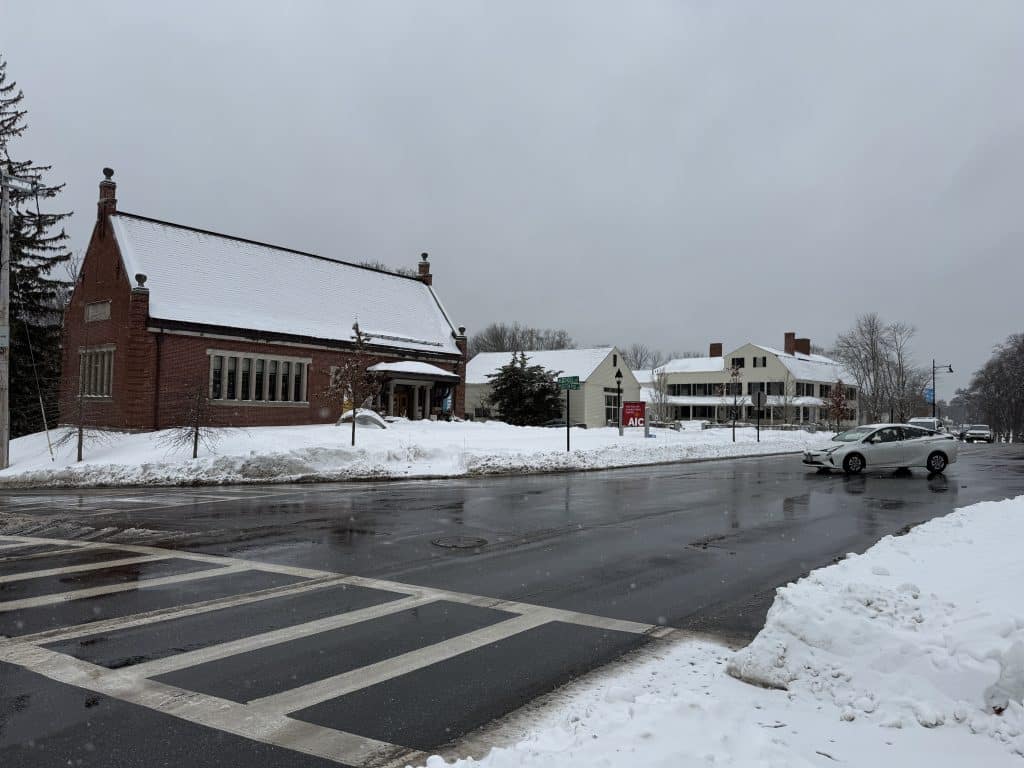
A new pilot program could add another dimension to Weston’s traffic surveys.
Literally.
Cambridge-based startup XRoadz has proposed working with the town free of charge to set up a dual camera-lidar system at the intersection of Merriam Street and North Avenue, as well as the intersection Boston Post Road, School Street and Church Street. Lidar, which stands for light detection and ranging, uses light pulses and other systems to map environments, and is often used by topographers to map the Earth’s surface.
Rather than mapping geography, XRoadz’s lidar system in Weston will be used to generate what Town Engineer Jason Lavoie said is “first-of-its-kind” data for the department’s traffic studies.
“From this technology, from the volumes, the movements, the crashes and near-misses, you have a whole model of the intersection, and from that, you can extract the issues and then look for fixes,” Lavoie said. “This type of data really shows what the intersection use is, which then leads to the safety needs of the intersection and to what extent any fixes are needed and/or what to implement.”
The Select Board has yet to issue a decision on the pilot program. The Department of Public Works and XRoadz first approached the board on Feb. 10, and while all three board members were receptive to the pilot, concerns about privacy laws led them to ask for town counsel’s input before giving it the green light.
On top of regular traffic metrics, such as volume, speed and movement counts, XRoadz’s system will also generate data on bicycles and pedestrians, as well as car crashes, turning movements and near-misses in the intersections, according to CEO and founder Bryce Germain.
“One of the most important differentiations of this technology is our ability to not only manage vehicles, but also account for vulnerable roadway users like pedestrians and cyclists,” Germain said in an interview. “There’s a lot of nuance to these things, so we have an opportunity to not just deploy something, but deploy something that’s meaningful on behalf of the town.”
According to Germain, the cameras, lidar and edge computation system allow processing of data on site, which “enables us to really understand where everybody is in the scene, what they’re doing and how they’re moving.” From there, data can be aggregated and advanced analytics can be applied to intersection improvement designs.
The sheer volume of data is attractive to the town, too, according to Lavoie. XRoadz’s pilot is slated to operate for six to 12 months, which he noted is a much longer period of time than spot studies that typically run for 2, 12 or 24 hours.
“This program will study intersections continuously for a minimum of six months,” Lavoie said. “This type of data really shows what the intersection use is, which then leads to the safety needs of intersections and to what extent any fixes are needed and what to implement.”
While the intersections are public roads, there were several questions on privacy and data protection. XRoadz said it retains “subsamples” of data for training its system, and Germain added that privacy is an important aspect of the project.
“We already get an advantage because we use lidar, which means that even though we prefer to store the video footage as well – and we need that for automation purposes – most of the interactions can be driven through a lidar interface, which extracts away the personal identifiers,” he said. “We’ll continue to work and improve, and I think that’s a very important thing.”
XRoadz was founded in 2023, and this will be the startup’s first public deployment of its technology. Germain said the company’s philosophy is figuring out how technology and robotics can be taken onto the streets to improve safety for all.
Germain said XRoadz selected Weston because of the town’s “facilitation of conversations” from the Select Board, Department of Public Works and Traffic and Sidewalk Committee, as well as the robust discussions held with residents at meetings.
“To me, that is a really great representation of what we’re looking to partner with for these very select pilots,” Germain said. “We’re a Cambridge company, we are starting in Massachusetts, we want to support the broader local community of the greater Boston area. Also, I don’t think it’s very controversial to say that Boston’s traffic could use some help.”
Author
Related Articles
29th annual Rotary Club car show set for Sept. 26
For Richard DeVito Jr., a member of the Weston & Wayland Rotary Club, relating life experiences to the cars people drive is the essence of the organization’s biggest community event: the annual Antique and Classic Car Show.
Flock contract frozen as Police seek feedback
The national conversation about police surveillance has come to Weston.

Steps for Sotos to raise money for first-of-its-kind MGH clinic
A local family is hosting Steps for Sotos, a walk-a-thon to raise money for MGH’s Sotos Syndrome Clinic.