
Weston absorbing insurance cost increases
In the last two years, nearly $3.5 million has been added to Weston’s operating budget, and it’s an invisible driver.
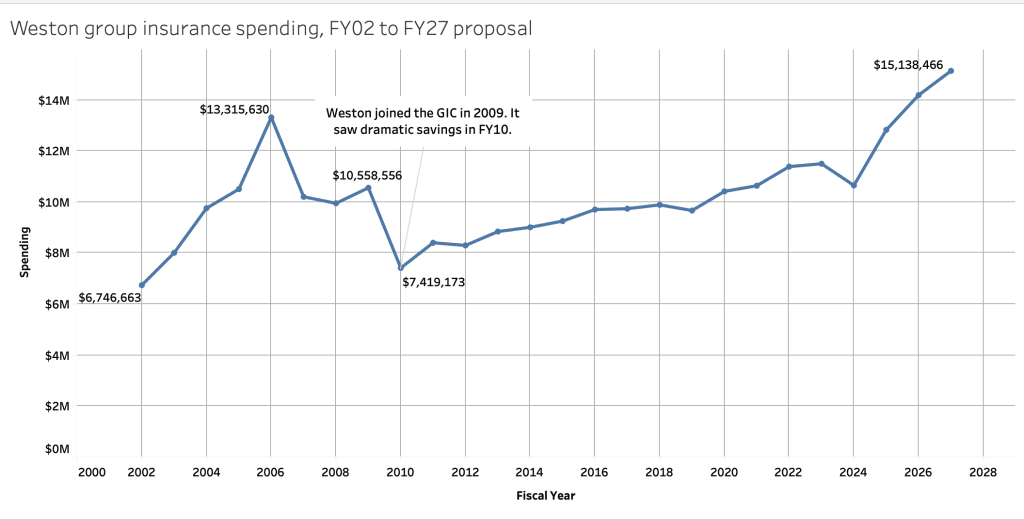
In the last two years, nearly $3.5 million has been added to Weston’s operating budget, and unlike capital projects or additional personnel, the cost-driver is invisible.
From the Pioneer Valley to Cape Cod, insurance benefits for municipal employees have spiked at dramatic rates. In FY26 the group insurance line item increased 10.6%, on top of the 20.4% increase from the previous year, according to the budget proposal shared by the town at the March 16 Finance Committee meeting.
Excluding the Weston Public Schools’ budget, which typically represents about half of the town’s entire annual operating budget, insurance, particularly in recent years, can represent the highest dollar-amount increase each year.
“Some of the best health care in the United States is here in Massachusetts, so bravo to us, good for us,” Town Manager Leon Gaumond said in an interview. “The downside is that it’s very expensive.”
Although Weston’s spending on employee insurance has increased at a higher rate than usual in recent years, there is plenty of wiggle room in its budget.
The town had about $11.68 million in excess levy capacity in FY26, about 10.4% of the maximum levy, making it one of 44 communities across Massachusetts to have more than 10% of excess levy capacity, according to the Division of Local Services.
“Look, it’s easier for Weston than it is for a lot of other communities. We do have excess levy capacity within our budget, so we don’t tax the maximum,” Gaumond said.
While developing the FY27 budget, Town Hall staff used a 10% placeholder for its group insurance line item. That number, however, was an overestimate, as Weston is estimating a 6.7% increase, avoiding a third consecutive double-digit spike. In dollars, the town is expecting a $952,324 increase for FY 27.
Since 2009, Weston has been a member of the Group Insurance Commission (GIC), a state agency providing health insurance to municipal employees. With 280,000 subscribers and 460,000 members, the GIC negotiates health care plans with providers.
The GIC set its rates at its March 5 meeting, where Margaret Anschutz, director of health policy and analytics, said several factors drive cost increases, including previous years’ claims, medical inflation, anticipated claim trends and changes in coverage, as well as provider consolidation in the state. The GIC in late February voted to drop GLP-1 weight-loss drugs, such as Ozempic or Wegovy, from its coverage.
The average premium increase among the state’s array of plans offered is 8%.
“Large benefit firms are projecting a 9% to 10%-increase nationally for large employers,” Anshutz said. “While we came in under the national range, this is due to recent benefit cuts, particularly GLP-1s.”
There are other insurance providers out there. Weston could enroll in the Massachusetts Interlocal Insurance Association, another joint-purchasing group or it could insure itself, but while those options may help in the short-term, Gaumond said it might not be a solid long-term plan.
“What we’re doing now might be the best thing, not only for the town side of government, but also for the employees as well,” he said.
Weston’s annual trends
According to the Division of Local Services and the town’s budget proposal, Weston’s insurance spending has gone from about $6.75 million in FY02 to FY27’s proposal of about $14.19 million. The benefits of joining the GIC in 2009 were immediately felt as insurance spending fell by $3.1 million in FY10 – a 29.7% drop in one year.
Much of the growth has been gradual, with the only double-digit percent increase occurring from FY10 to FY11. That slow incline continued until FY25, when the town was whacked with a 20.4% increase, amounting to $2 million.
Although Weston may be able to absorb the health insurance spikes in recent years, many other communities around Massachusetts have been hit hard.
In the Pioneer Valley, dozens of communities and school districts in the Hampshire County Group Insurance Trust have seen 20% rate increases, with some municipalities preparing to layoff employees to stay afloat. In eastern Massachusetts, Melrose residents approved a Proposition 2 ½ override in November to fund its budget, in which insurance costs were a major driver.
Author

Related Articles

Heirloom seeking liquor license, dinner hours
Heirloom, through a citizens’ petition at Town Meeting, is seeking a liquor license, which would also bring dinner hours.

Grant to progress Stony Brook culvert replacement
A state grant program is beginning the replacement process for two culverts serving Stony Brook.

PHOTOS: Two officers, dispatcher welcomed to Weston Police Department
The Weston Police Department on March 18 swore in two new officers and welcomed a new dispatcher in a swearing-in ceremony.