Town Government 101: What’s in a feasibility study?
You hear about feasibility studies for a variety of projects around the community – fire and police stations, the school building project, to name a few – but perhaps you may not know what the document actually represents.
Editor’s note: This article is an installment of “Town Government 101,” a series of stories explaining how municipal government works. Have a question about how Weston operates? Email us at [email protected].
You hear about feasibility studies for a variety of projects around the community – fire and police stations, the school building project, to name a few – but perhaps you may not know what the document actually represents.
At its most basic, it is exactly what it says in the name: it is an assessment of a project that asks whether a project can be undertaken, and if so, how much will it cost? On a deeper level, a feasibility study can examine existing conditions, potential project locations, the needs of the people served by the project, impacts on operations and, depending on the project, environmental and other external factors. Some studies, such as Weston’s January 2026 Fire Station study, may also include conceptual designs.
With the School Committee and Weston Public Schools considering a reconstruction of the Middle School and High School campus, voters will be asked to appropriate $2.75 million to fund a feasibility study at the November Special Town Meeting. The town is enrolled in the Massachusetts School Building Authority’s (MSBA) project pipeline, and the feasibility study is required to remain in the process. If it is not approved, the town will be removed from the pipeline.
School Building Committee Chair Ken Newberg said the study will examine district enrollment and educational needs. It will also consider the costs and tradeoffs of renovations versus additions and new construction, as well as lay out all possibilities for consideration.
If some of this sounds familiar, that’s because it is. The district completed its own feasibility study in 2025, and presented it to residents last fall. That study, however, cannot be used in the MSBA’s building process.
The $2.75 million appropriation sets a funding ceiling on the study, and pays for the design team, as well as specialist experts, architects and engineers, all of whom will examine the conditions and limitations of the school buildings, the environmental constraints, code and accessibility compliance and energy systems. It also covers a project manager representing the town, according to Newberg.
He noted this funding request is in line with several other studies funded by communities around the state: $3 million in Shrewsbury, $2.75 million in Milford and $2.5 million in Holliston.
“A feasibility study ensures that Weston makes a decision about the future of the high school based on evidence and expert advice, not gut feelings,” Newberg said. “It looks at what students need, what the existing building can support, and which building options offer the best educational value at a responsible cost.”
Approving the feasibility study at the November Special Town Meeting does not commit Weston to a final plan, approve the building project, authorize construction or set a project budget.
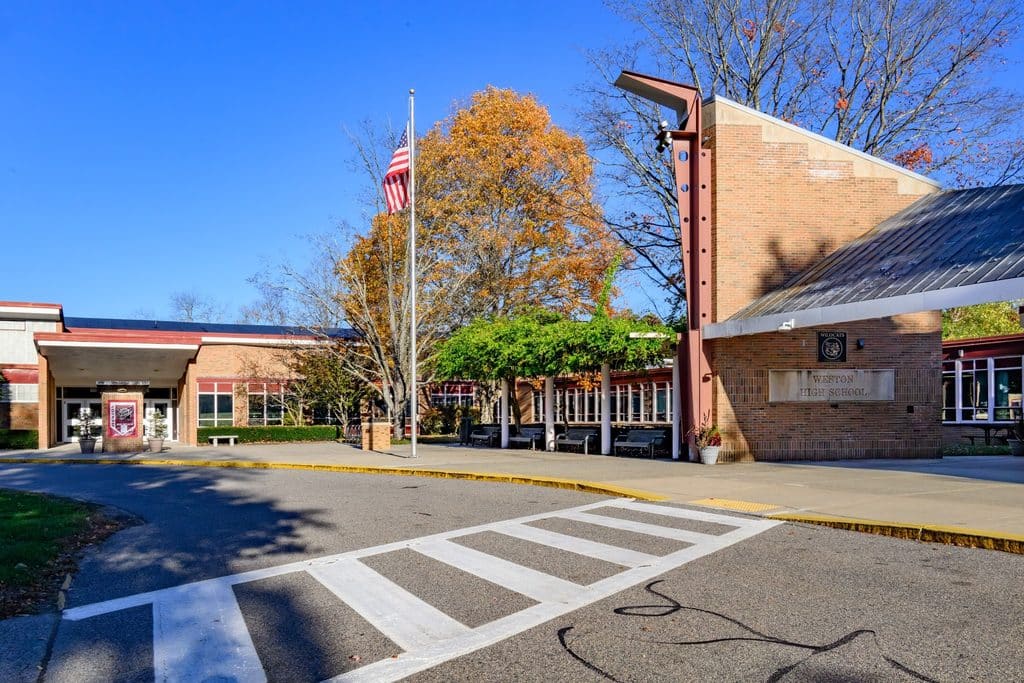
Special Town Meeting is set for Nov. 23 at Weston High School.
Author

Related Articles

School Committee delays vote on Zaleski contract
The School Committee delayed a vote on Superintendent Karen Zaleski’s contract extension at their Oct. 5 meeting

New Regis president emphasizes liberal arts
In the age of artificial intelligence, Regis College’s new president is doubling down on humanity.