
Tour of historic cemeteries slated
Weston Historical Society President Pam Fox will lead a free tour of cemeteries in town on Oct. 26.
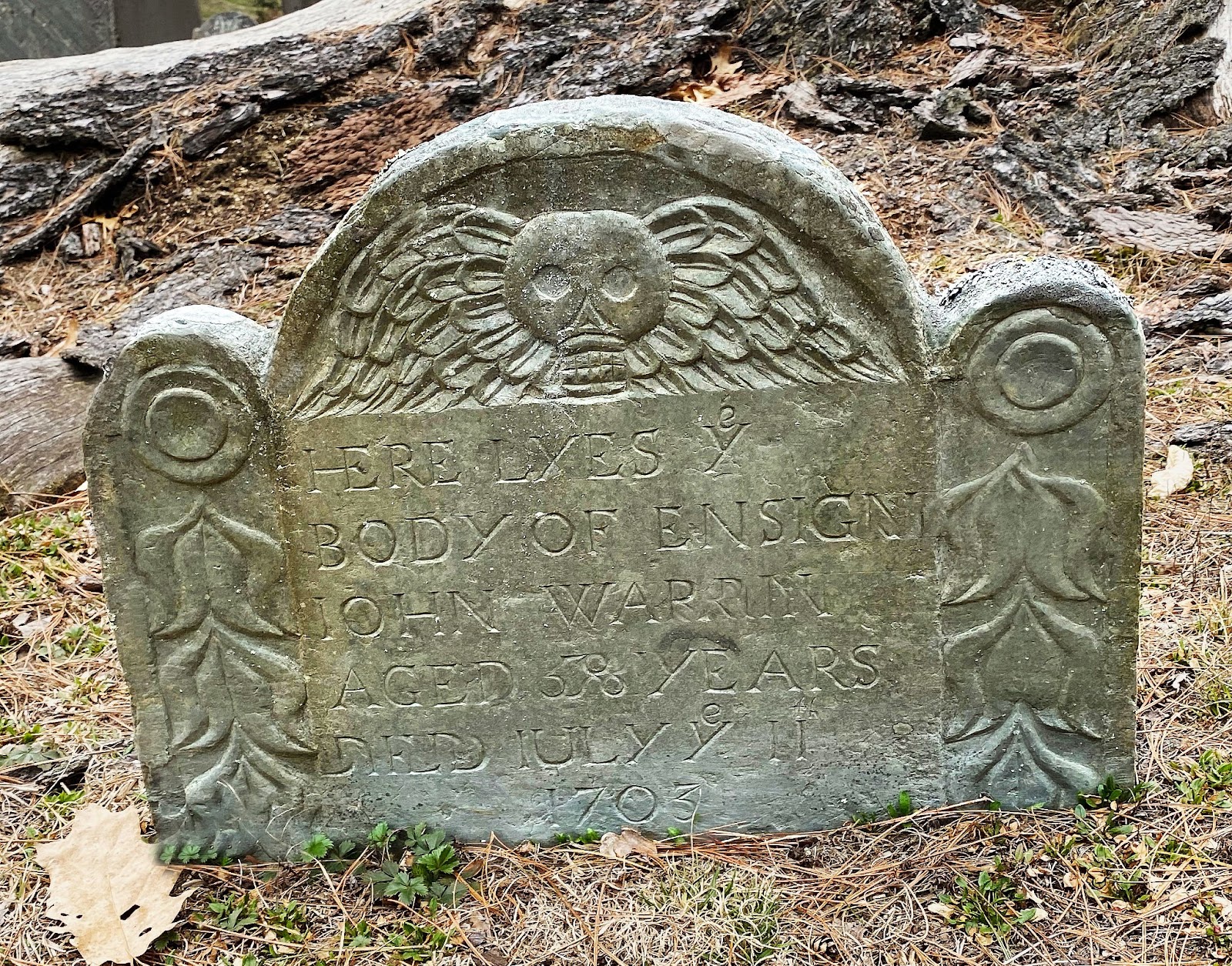
Special to the Weston Observer
On Sunday, Oct. 26, Pam Fox, president of the Weston Historical Society and author of “Farm Town to Suburb: The History and Architecture of Weston, Massachusetts,” will lead a free tour of Farmers Burial Ground and Central Cemetery on Boston Post Road, co-sponsored by the Weston Historical Society and Golden Ball Tavern Museum. Fox will share stories about customs, gravestone artistry, and the prominent people of Weston laid to rest in the town center. The tour will begin at the Golden Ball Tavern Museum, 662 Boston Post Road, at 2 p.m. Light refreshments will be served following the tour.
Fox will explain early burial practices in Massachusetts cities and towns. The English Puritans who settled here were searching for a more “pure” religion and rejected Anglican traditions. Burial grounds were established and maintained by the community. The earliest grave marker in Weston is that of Ensign John Warren, who died in 1703. His marker in Farmers Burial Ground is an example of the “winged skull,” the first imagery employed in gravestone carving as a solemn reminder of the fleeting nature of life on Earth.
Over the course of the 1700s, the winged skull was replaced by the “winged cherub or soul effigy,” with its round cherubic face. Along with generic winged cherubs, some carvers created “portrait stones.” These were not actual portraits of the deceased, but instead were more realistic, resembling people in their hairstyles, distinct facial features, and clothing. In the late 18th and early 19th centuries, the willow and urn motif appears, influenced by neoclassical philosophies in the new nation. The willow was an ancient mourning symbol and the urn was used in imperial Rome to contain ashes.
At Central Cemetery, Fox will emphasize the many changes that combine to give this cemetery a completely different appearance. Markers are no longer oriented to face the east. New materials—granite, marble and even iron—are used, in addition to the earlier slate. New shapes like obelisks appear. Some plots are marked with granite curbing, and trees and shrubs enhance the landscape.
For those who cannot attend on Oct. 26, self-guided brochures of Farmers and Central are available at Town Hall next to the Weston Historical Society’s display case in the entrance hall.
Author

Related Articles
29th annual Rotary Club car show set for Sept. 26
For Richard DeVito Jr., a member of the Weston & Wayland Rotary Club, relating life experiences to the cars people drive is the essence of the organization’s biggest community event: the annual Antique and Classic Car Show.
Flock contract frozen as Police seek feedback
The national conversation about police surveillance has come to Weston.

Steps for Sotos to raise money for first-of-its-kind MGH clinic
A local family is hosting Steps for Sotos, a walk-a-thon to raise money for MGH’s Sotos Syndrome Clinic.