
The Backyard Naturalist: The forest’s feathered tricksters
Loud, clever, and unexpectedly helpful, blue jays bring both drama and renewal to our backyards and forests.

Loud, clever, and unexpectedly helpful, blue jays bring both drama and renewal to our backyards and forests.
If you’ve ever stopped to catch your breath on a Weston trail walk or stretched out to relax in your backyard only to be harangued by a sharp “jay! jay!” call, you’ve likely encountered one of our town’s most striking and vocal residents: the blue jay. With its vibrant plumage, lively personality and undeniable intelligence, this bird is both admired and misunderstood.
Of all our resident avian species, the blue jay (Cyanocitta cristata) is perhaps the most easily recognizable. Its size, blue wing markings and prominent crest, accented with black and white markings, make it one of the most eye-catching species in the region. Interestingly, those beautiful blue feathers contain no actual blue pigment. Instead, microscopic structures scatter light in a way that reflects the color blue — a trick of physics known as structural coloration. Without light, those brilliant feathers would simply look dull brown.
But blue jays are far more than pretty feathers. As members of the corvid family – which includes crows and ravens – they are renowned for their problem-solving skills. Jays are clever and adaptable, traits that have helped them thrive in forests, parks and suburban yards alike. They’re known for caching acorns in the soil in the fall, many of which go unretrieved. Blue jays thus inadvertently end up planting oak trees, and performing an important function in forest regeneration.

I’ll be the first to acknowledge that blue jays deserve their reputation of being noisy and aggressive bullies. Yes, I do cringe a bit when I see them bumping the chickadees and nuthatches off their perches. But, little ones, know that those screams serve to warn you and the rest of the forest of approaching predators. Oh, and does that red-tailed hawk imitation serve to scare other birds away from your food sources? I’m going to chalk it up as an example of typical corvid ingenuity.
While monogamous breeders, blue jays will form small family groups or loose flocks, to say, mob a predator. During migration, we can find them in larger numbers. We can enjoy a relative abundance of blue jays year-round, though it’s likely that many of our summer breeders will have departed for the south, only to have been replaced by their cousins from the north for the season. It is not unusual for an adult blue jay to live for seven years – a captive female is recorded as having attained an age of 26! And how about this for a neat trick: to protect their own hearing, they close their external ear canal to shut out sound, while the increased air pressure in the inner ear relaxes tension on the eardrum. But wait,there’s more: blue jays (as well as other birds) can regrow hair cells within their ears! Fine, you say, but why do they wipe crushed ants on their wings?
For those of us who welcome them, blue jays add drama and color to the everyday rhythms of our birding lives. You can get some up close and personal face time with these fascinating creatures by setting out peanuts or sunflower seeds. My birdfeeder cam shows them carefully selecting the best morsel, weighing one nut against another before flying off to stash their prize.
So next time you are startled by a jay’s raucous call, consider the role that bird played in our ecosystem and the unique ingenuity it displays in living its best life right outside our windows. This bird is not only a splash of blue in the trees — it’s a gardener of forests, a performer of mimicry, a family-oriented parent and a symbol of adaptability. In short, the blue jay is one of nature’s boldest reminders that beauty often comes with brains and personality to match.
Michael Pappone and his family migrated to Weston in 1982, where they’ve nested ever since. When not seeking out the indigo buntings on the Rail Trail or the yellow-headed picathartes in tropical Ghana, Pappone spends time in his Weston garden, serving on committees of the boards of Mass Audubon, Concord Museum, and the Town of Weston. He is a member of the Nuttall Ornithological Club, Weston Forest and Trail Association, Brookline Bird Club, and volunteers for the National Oceanographic and Atmospheric Administration’s seabird count on the Stellwagen Sanctuary.
Author

Related Articles

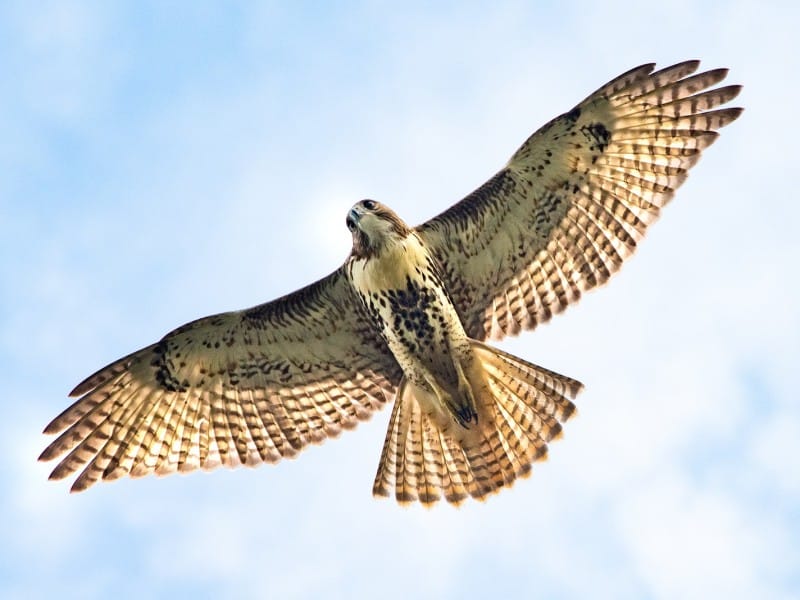
Backyard Naturalist: Make way for red-tail hawks
To Michael Pappone, nothing says “free as a bird” quite like a red-tailed hawk soaring overhead on a sunny day.