Shifting Landscape: Agroforestry experiment takes root
Weston’s Sears Land, previously home to farmland and mill workers, is undergoing a transition.
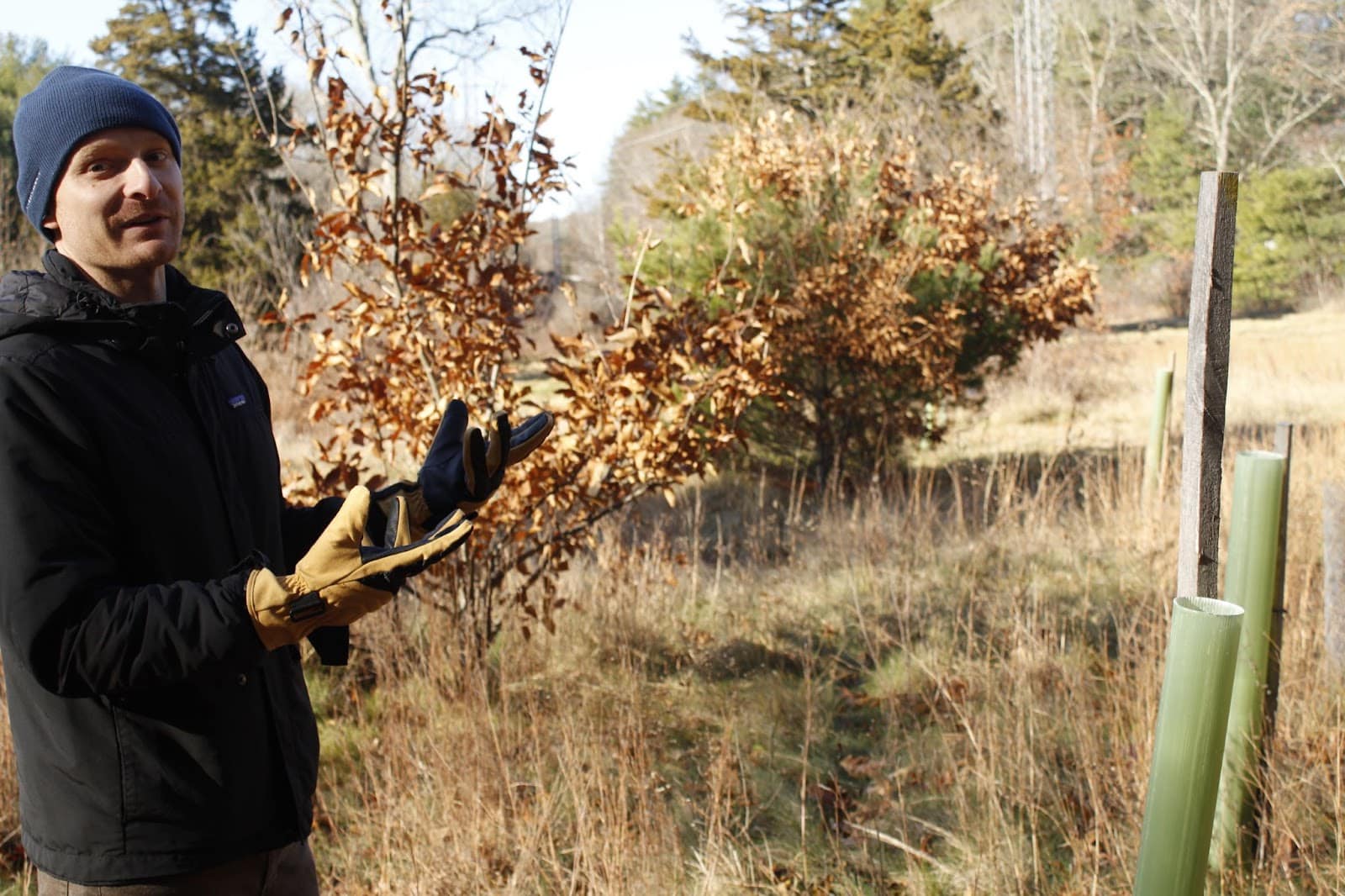
Weston’s Sears Land, previously home to farmland and mill workers, is undergoing a transition.
What was once an agricultural field off Crescent Street is returning to forest. Turner Frankosky, a Weston resident and graduate student at the Yale School of the Environment, is aiding the transition through an agroforestry project he is conducting on a portion of the land.
Agroforestry integrates trees with crops in an effort to increase biodiversity, increase production and create a more resilient ecosystem. It allows land to house more trees, which increases forest cover, while also providing useful plants like blueberry bushes.
Frankosky keeps track of the species that have grown naturally on the former agricultural field and plants species that will help transition to a healthy, biodiverse environment.
“It’s been cleared for so long, and now the trees are starting to come up,” he said in a recent interview. “Our conservation practice shouldn’t necessarily be to maintain it as a field, we actually should let the ecosystem do work here.”
Frankosky grew up in Weston, and moved to California for his undergraduate degree at the University of Southern California. He worked as an actor before the COVID-19 pandemic, during which he moved back to Massachusetts. He would go for walks at the Codman Community Farms in Lincoln, and eventually started working there as a farmhand.
“I was so shocked by COVID and had nothing else to do except wander around, and found myself wandering over towards Codman,” he said.
He grew to love farming, which became an overall passion for land management, including forestry.
“I was kind of hooked. This is fascinating,” he said.
He completed an online forestry program through Yale before becoming a full-time master’s degree student there.
The Sears Land was already returning to forest in 2024, when Frankosky pitched his agroforestry project to the Conservation Commission as a way to preserve native species, produce blueberries and increase environmental resilience on a parcel of the land. He started the project, which takes up less than an acre of the Sears Land, as part of his certificate course on forestry.
As Frankosky researched the environmental and agricultural history of the Sears Land, he said he grew to appreciate Weston in a way he hadn’t before.
“Now that I’m back, I’m realizing there’s actually so much rich history here that I find so meaningful,” he said, “and this project is a way for me to engage in the history of the town, and put myself into the town as well.”
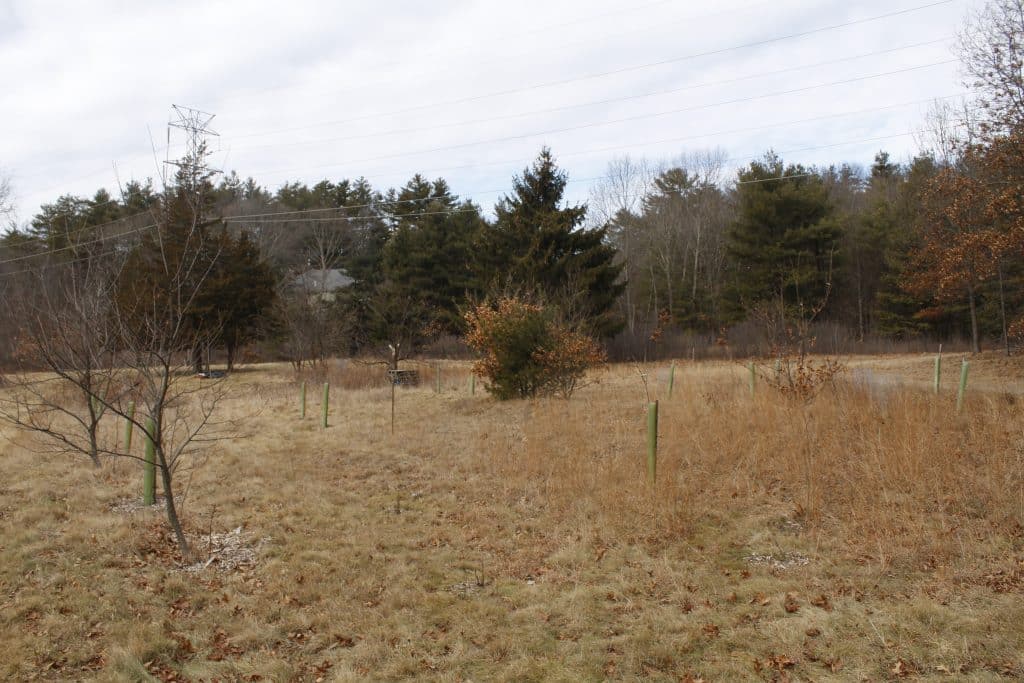
The Sears Land was farmland for many years, and includes a Christmas tree farm and a chestnut tree orchard where scientists studied resistance against the chestnut blight.
Frankosky’s plan is to change the landscape in small increments. He wants to practice alley cropping, creating lines of trees interspersed with understory crops — plants such as elderberries and blueberries that grow beneath a forest canopy.
He continues to monitor the land on regular visits back from his environmental studies in Connecticut. While the return to forest was already underway when Frankosky began, he is helping the existing aspen, oaks and hickories — some of which are now protected by tree tubes to prevent deer, mice and moles from eating the roots. There has been some browsing by deer, but Frankosky said a certain amount is necessary to facilitate growth.
He is adding species, including mulberries, that he believes will help nurture the landscape. Mulberries are Frankosky’s favorite, in part because of the environmental benefit that comes from how birds disperse berry seeds through their excrement. Mulberry trees are also nitrogen fixers, which means they help bring nitrogen into the soil that makes it more fertile.
The experiment will continue as the seasons change. Frankosky recently told the Conservation Commission he plans to improve community outreach about the project and plant more understory crops in the spring.
As Frankosky builds the landscape, he wants to include the community in his work. He has worked with the Gifford School, a therapeutic day school that serves students with complex social, emotional and learning challenges. Students have helped conduct prescribed burns and plant naturalized species. Science teacher Patrick Williams said the Sears Land project allows his students to get hands-on experience to augment classroom learning.
“[Frankosky] welcomed us with open arms and was happy to educate the students with what he’s working on and find work for them to get involved,” Williams said. “It’s an invaluable thing to have as a science teacher, to be able to show some of this work in action.”
Frankosky said people come across the land regularly because of heavy foot traffic from the surrounding trails. He gets emails from curious walkers, and wants to increase his connection with the community.
“Our ecosystems are going to change. What do we envision them being?” Frankosky said. “These ecosystems may have looked the same in our entire lifetime, but have not always looked that way… we can influence that process, and that’s what I want people to start thinking about.”
Author
Related Articles
Cuneo reflects on Observer’s journey from idea to print
Charlie Cuneo is stepping down from his position as president of the Weston Observer’s board of directors at the end of February.
Solo ski: Weston native completes Antarctica expedition
Eliastam, who lived in Weston until she was 13, completed a 700-mile trek across Antarctica on Jan. 18.
Back to the basics: Weston eye doctors provide care in El Salvador
Two Weston ophthalmologists say their trips to El Salvador to provide care are eye-opening.