
Weston’s Joe Ferguson sees ‘music’ in glasswork
You have likely seen Joe Feguson’s work outside the Library and AIC, but what drives the man behind them?
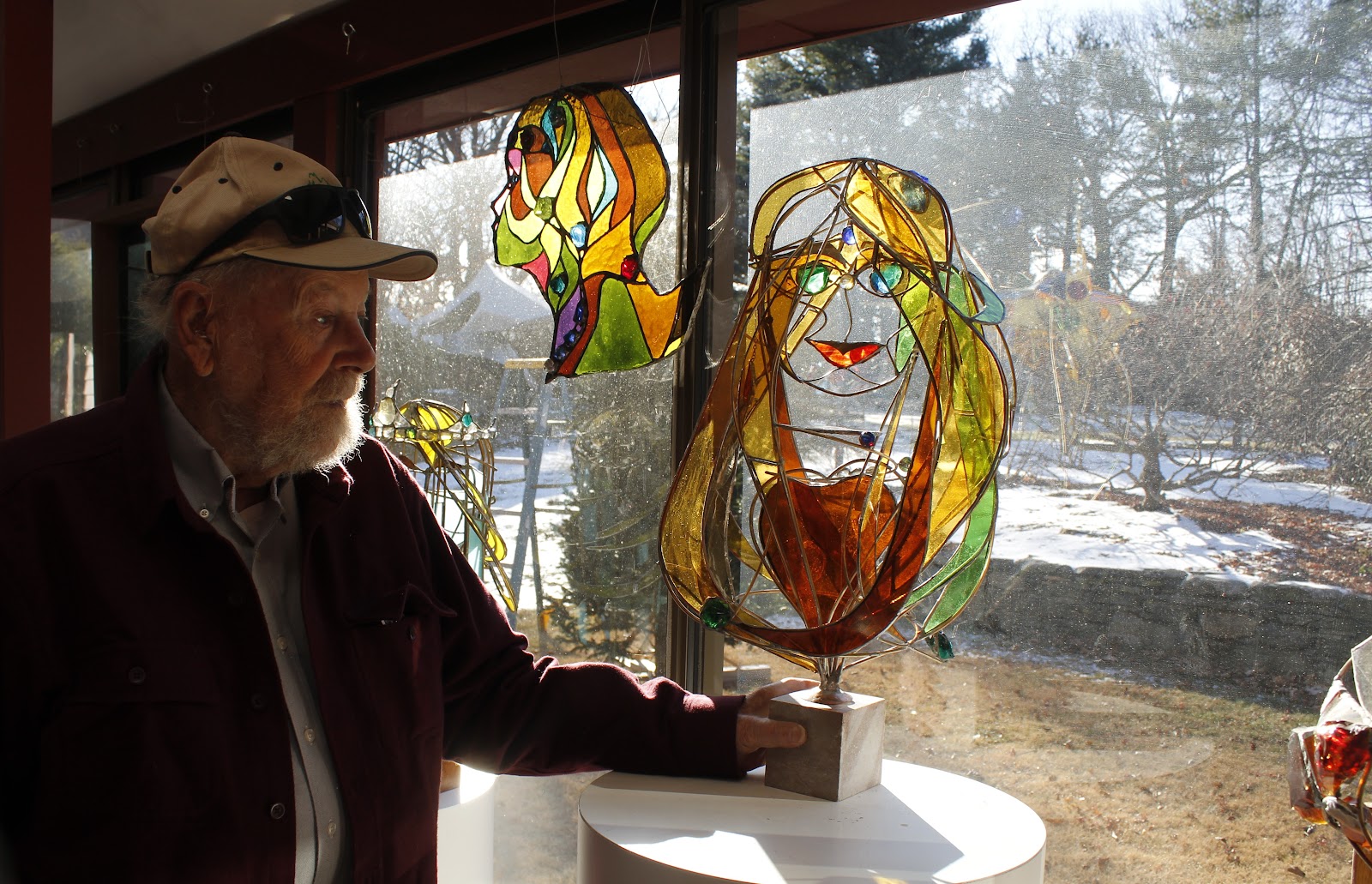
On Boston Post Road, a silver mass arcs over the grass outside of the Arts and Innovation Center, greeting all who pass down the main road of town: the sculpture, Counterpoint. Yellow glass captures sunlight in the window of the Weston Public Library, the spray of the glass that makes up Solar Flare visible from the road. These are the works of Joseph Ferguson, an artist who has been based in Weston since the 1960s and who focuses on stained glass.
“No other art form is like that,” he said of his preferred medium. “The light is coming through the glass and it’s like part of the piece is the light.”
Ferguson and his wife, Isabel moved from Wellesley into a fixer-upper home in Weston decades ago so he could have studio space to work on large sculptures. Before they purchased the property, he said, it was being rented out to college students who left beer cans all over the home.
Ferguson’s place now is a far cry from the mess he remembers. Light pours in through the windows, catching in the stained glass faces displayed on the porch. The yard is home to a fleet of large sculptures made with colored glass and metal, capturing the light of the winter sun that makes it past the clouds.
Ferguson’s interest in art is lifelong. He says he always drew as a child and sketched portraits of his Army buddies during the Korean War. Ferguson worked as a junior draftsman for New York Central Railroad as a young man before enlisting. After the conflict, he enrolled in the Edinburgh College of Art.
While in Scotland, he studied stained glass and experimented in other mediums, such as soldering pieces together for large sculptures. He was not interested in medieval-style work but gravitated towards more abstract pieces, he said, drawing inspiration from the artists involved in rebuilding churches after World War II.
“They were rebuilding all of the European and English churches, and there was a conscious effort to try and put more modern work into them. Coventry Cathedral had been bombed and they were rebuilding it,” he said. “A lot of the stained glass and sculptures were done by modern English artists and they were setting a trend. I was influenced by that.”
He also met Isabel, who was studying at the University of Edinburgh. The two traveled Europe for their honeymoon. The trip solidified Ferguson’s love of stained glass when they watched how the light changed the windows at a chapel in Paris.
“When all the clouds obscured the sun, all the blues would come out. Then when the clouds passed, and the sun came really bright on the windows, all the yellows would come bursting forth,” he said. “It was like music. It had a musical pattern to it.”
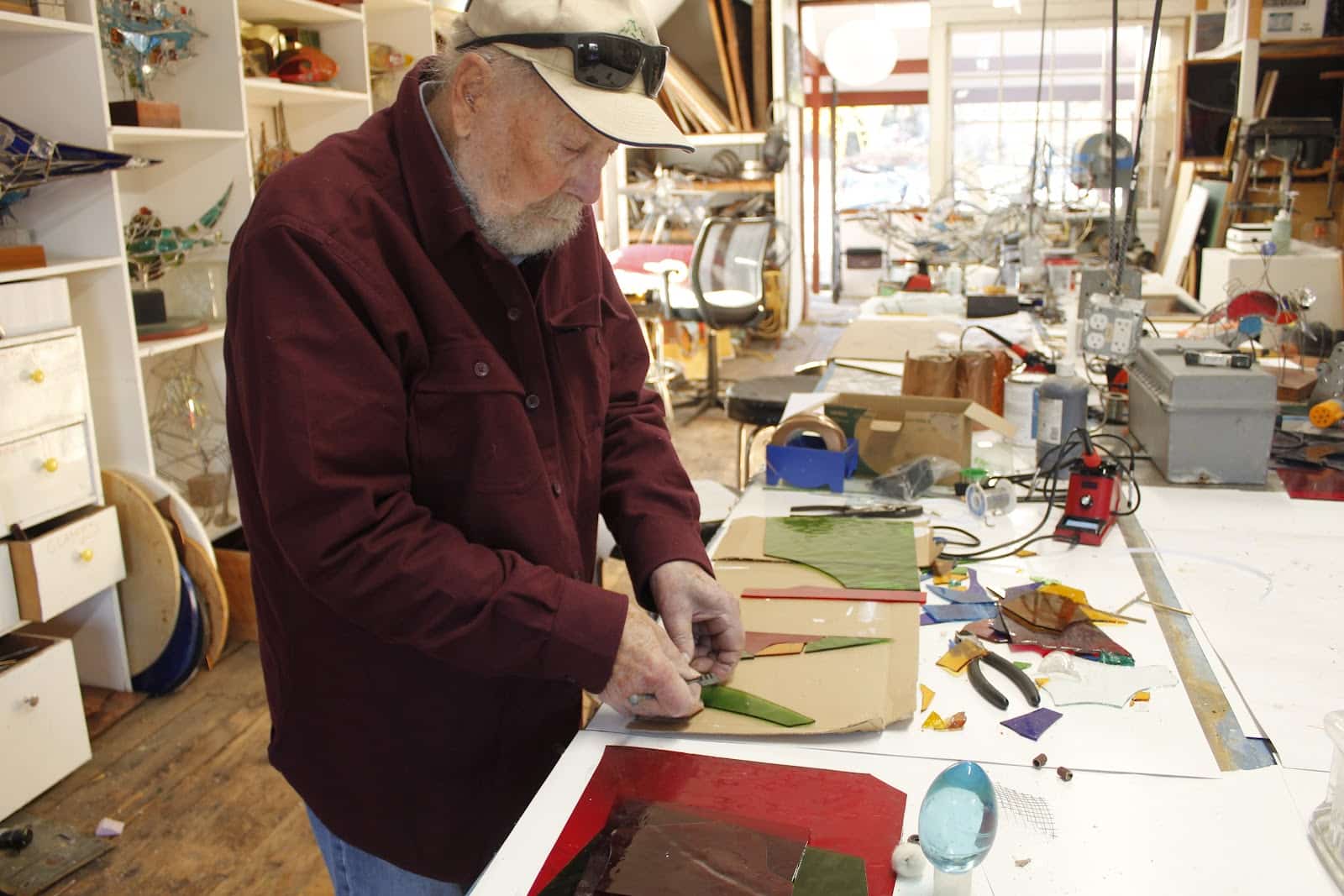
His work has been displayed throughout New England. Counterpoint was installed outside the AIC in 2022. Cecily Cassum, the chair of the AIC’s advisory board, said Ferguson’s statue Counterpoint was a natural fit for the building’s yard on Boston Post Road.
“It is beautiful. There’s not a lot of public art in Weston, so it’s become the piece people know,” she said.
Several of his pieces, including a memorial to his late wife, are on loan to the Weston Public Library. Outside of Weston, his work has been displayed at Burlington Sculpture Park, the Curtis Memorial Library in Maine and the Harvard Divinity School Library. Ferguson said that he is glad to have his work on display so people have a chance to interact with art.
“I’m really glad to have that because I’m always surprised at how few educated people don’t go to museums,” he said.
Jennifer Warner, director of the Weston Public Library, said she is grateful to have Ferguson’s work on display. She said that patrons often make positive comments about the work, and beyond that, it is important to make art accessible to people.
“[Art] is a different way of seeing the world and how others see the world. It’s a way to speak to people; it’s a certain kind of language. It’s like a particular love language and we’re lucky for those who are able to speak it,” she said. “[Ferguson is] an absolute treasure and we are so grateful he’s so generous in sharing his gift with us.”
As Ferguson ages, he has done less work with large scale sculpture. He brings pieces into the studio to repair and strengthen them against the outdoor elements, but his primary focus remains stained glass. He is currently experimenting with artificial intelligence-generated images based on stories he writes about his work. One story follows the life of stained-glass figure Lenor, in which he pairs images with voiceover and music and posts it to YouTube.
Ferguson said that using artificial intelligence allows him to keep creating as he becomes less physically capable.
“I don’t want to weld anymore and do the dirty work and heavy lifting and all that stuff,” he said. “I feel so liberated because it’s easy to do. As you get older, you get lazy…The big sculptures outside, cutting metals, and welding them and lifting heavy objects is hard work and I don’t want to do that anymore…The AI is just a tool to express, it assists you in a way.”
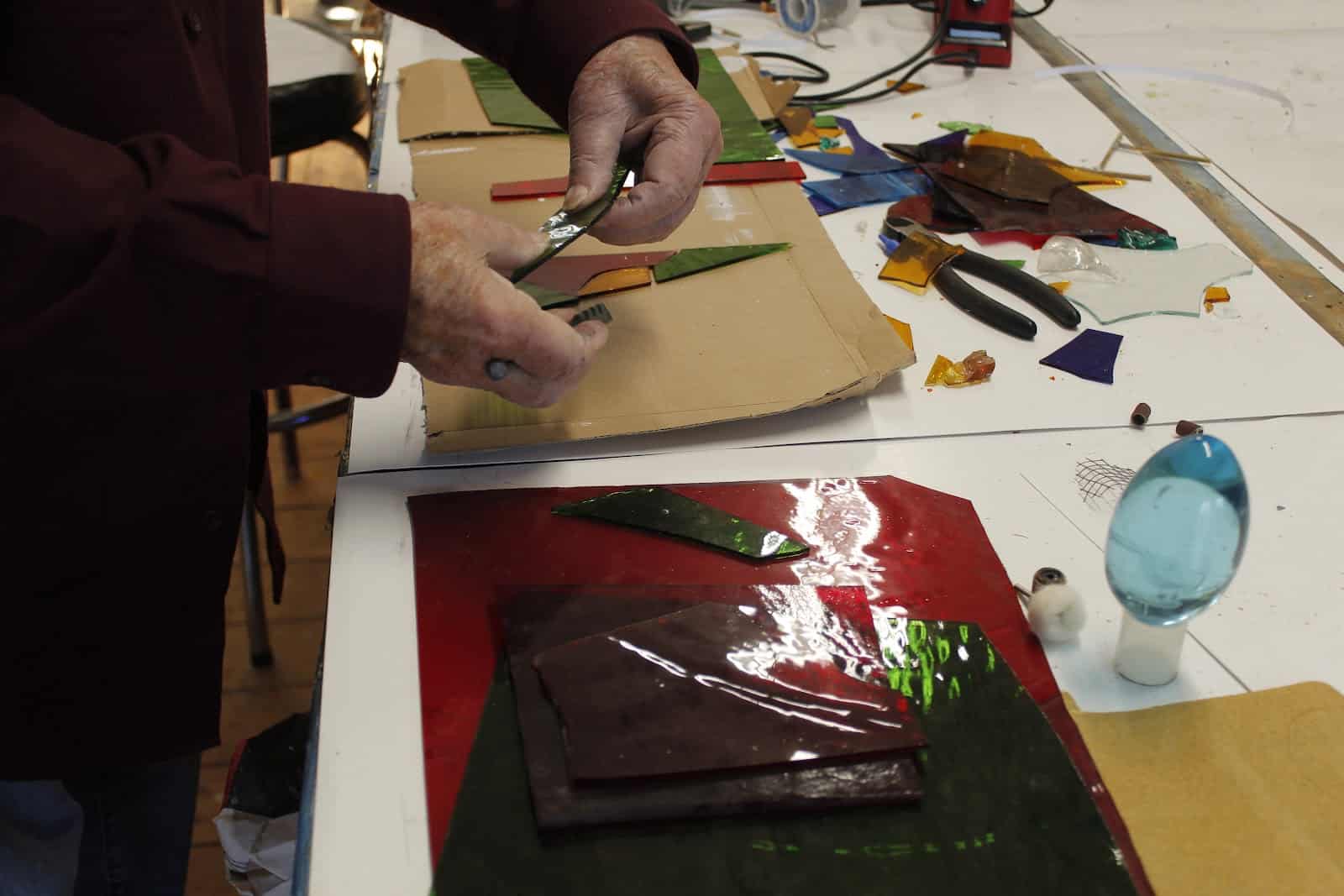
Ferguson is also in the business of teaching. His studio becomes a classroom every Saturday morning where he teaches how to make stained glass pieces. Many of his students are older professionals, including vascular surgeons and chemists, who have not had the experience to connect with their creativity.
“They’re all different, successful older people, but they get a big thrill when they actually do something that is creative,” he said. “I don’t want them to do what they know, you know, butterflies and things. I want them to do something that comes out of their fantasies.”
Ferguson said that it can be hard to keep the imagination healthy while focusing on the factual things in life, but it is important to learn how to express oneself.
“I think a person being able to express your imagination in a tangible way is a gift,” Ferguson said.
Author

Related Articles

Saying No to New: A guide for ditching distractions and reclaiming your life
Weston Native and New York Times editor Eric Athas has written “Say No to New: Why New Things Are Stealing Your Time, Money and Happiness and How to Take Back Your Life.”
Photos: Plein air painting at Lands Sake Farm
Photographer Nicole Mordecai stopped by the Art Sketchers Club last week.