
District report: MCAS scores strong, but work is needed
School officials shared their MCAS report Monday, showing strong scores, but emphasizing room for improvement.
While Massachusetts Comprehensive Assessment System (MCAS) scores remain high in Weston, district officials are looking toward more ambitious targets as the schools grapple with learning loss from the pandemic, the repeal of the MCAS graduation requirement and the implementation of teaching and learning initiatives.
James “Kimo” Carter, assistant superintendent for teaching and learning, shared a deep dive into the district’s results at Monday’s School Committee meeting, and while scores are well above the state average, they fell below achievement levels earned in prior years.
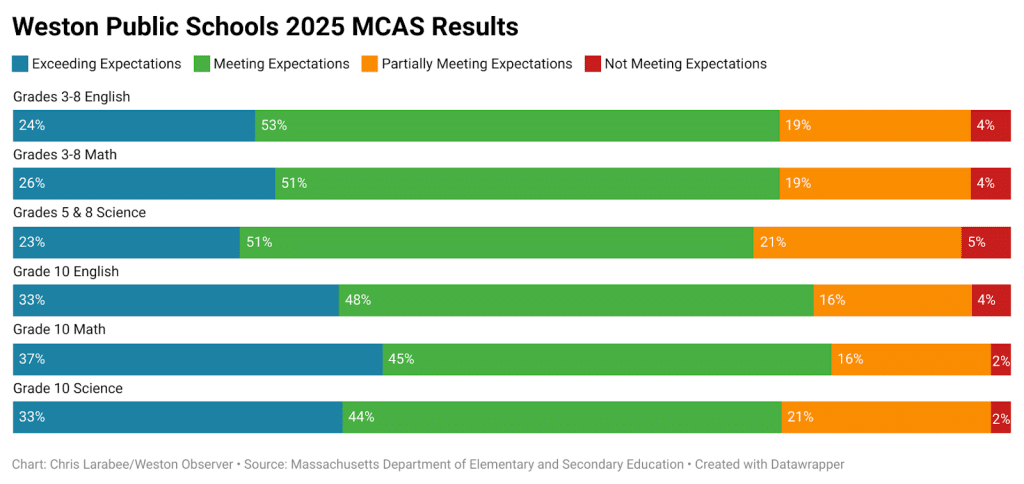
Broadly, Weston’s elementary and middle school students scored well on the MCAS compared with the rest of the state, with 76% of students in grades three through eight meeting or exceeding expectations in English language arts and 77% hitting that benchmark in math, compared to the state average of 42% in English and 41% in math.
At the high school, 10th grade students earned strong marks on the MCAS, with 81%, 82% and 77% of students meeting or exceeding expectations in English, math and science, respectively. Those numbers, while well above the state average, dipped from the previous year.
Three ups, three downs
In his presentation, Carter highlighted three positive trends and three areas where the district can improve.
Elementary school students achieved strong overall scores across every category, with the third grade scores being the highest in the state.
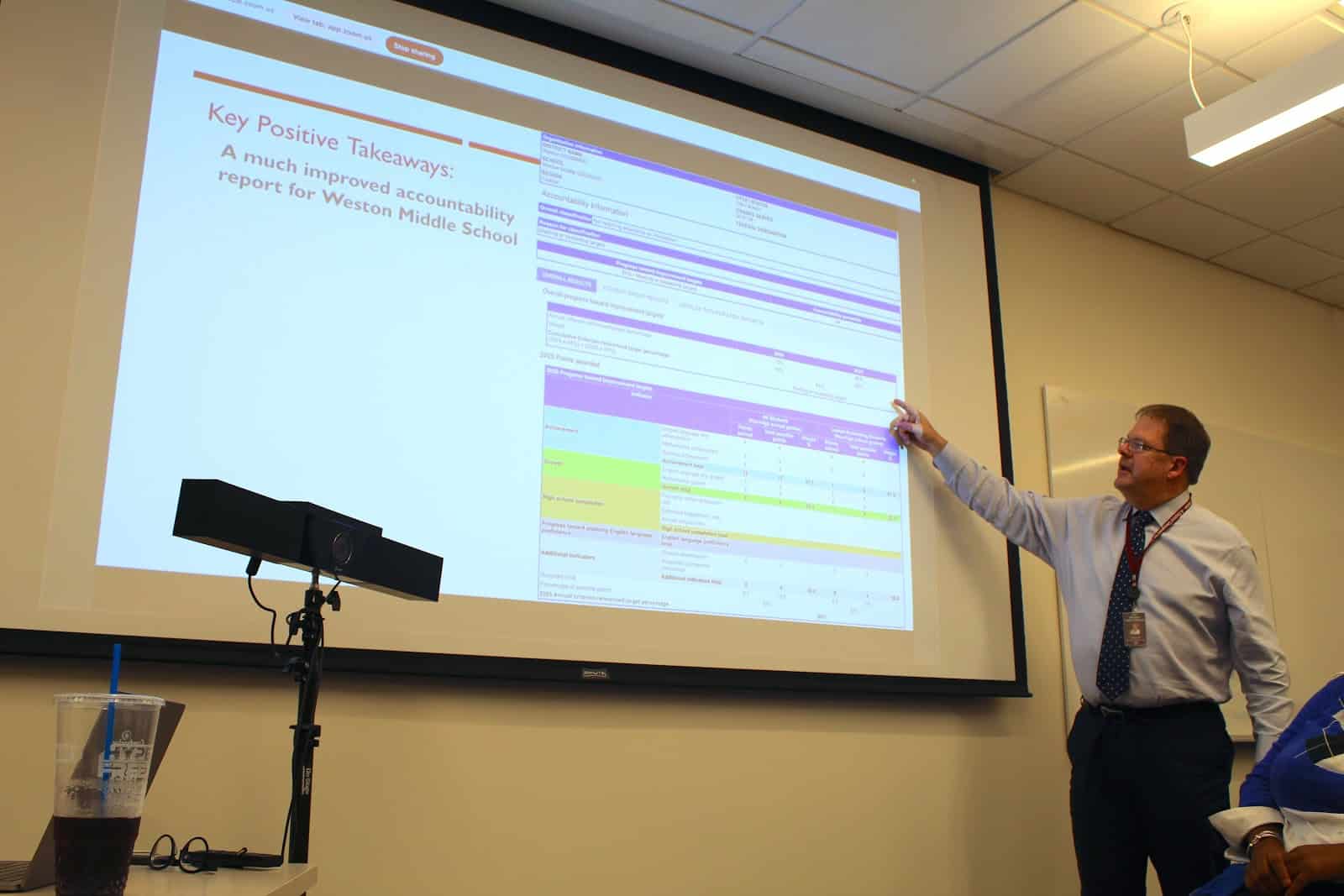
Weston Middle School also saw a large improvement in the Department of Elementary and Secondary Education’s accountability ratings — 88% this year, up from 72% last year — which measure progress toward student achievement goals, absenteeism and other indicators. In particular, Carter said, the middle school was “much stronger with our lowest-performing students,” indicating the introduction of a reading interventionist and expanding the role of the math interventionist has been successful.
“Our students who traditionally struggle did a lot better, and I think that’s something to celebrate,” he said.
Carter shared the district’s increased performance among grades three through eight students in specific subgroups: African American, Hispanic or Latino and students with disabilities, who all saw improved scores in math and English language arts over last year.
“The trend is positive, though we have a long way to go for our students with disabilities,” he said, noting a 6% increase in English and 2% increase in math. “We still have a ways to go, but we’re moving in the right direction for all of those subgroups.”
Room for improvement
Carter expressed concern over high school test scores. This is the first year the MCAS is a “low-stakes” test, as students do not need to pass it to graduate from high school, and Carter said this may have resulted in a dip in scores.
Carter said the high school overhauled its ninth grade physics course this summer to make it more engaging and accessible for all students, but “we’re not sure if those changes in instruction are going to translate to stronger MCAS scores or not.”
Carter also discussed the districtwide need to close achievement and opportunity gaps for African American students and students with disabilities as part of the 2026 growth goals. African -American students are about 7% to 15% below the district’s goals, while students with disabilities are well below the district’s targets in 10th grade English and math.
Closing the learning gaps
Carter said the district is pursuing two strategies to close these gaps. The first is high-quality instruction, a combination of high-quality instructional material and three approaches to teaching: universal design for learning, social-emotional learning and culturally responsive pedagogy.
The other is creating a multi-tiered system of supports, a school-wide, data-driven framework for improving learning and behavioral outcomes for all students. The district has been implementing these initiatives over the last six years starting with the elementary schools.
“Creating a multi-tiered system of support, really focusing on high-quality instruction and also teaching strategies that remove barriers for many students, that’s what we’re focusing on in the high school and the scores are not yet showing that,” Carter said.
The pandemic and competency determination
Swirling around MCAS scores in Weston, and all of Massachusetts, are two factors that may have negatively impacted scores: the long-ranging effects of the COVID-19 pandemic and the fallout from repealing the exam as a graduation requirement.
Weston’s 2025 results, while high, still lag behind the district’s 2019 scores, with School Committee member Tiao Xie asking if some lower scores, such as the current seventh grade cohort, could be attributed to pandemic learning loss.
Superintendent Karen Zaleski said the effects of the pandemic are known at this point, and it is up to the district to ensure students are supported to get them to where they need to be.
“I don’t want to blame the pandemic anymore. We know there are factors there, but at this point, to me, the bigger factors are we have just begun,” Zaleski said, referencing the data-driven interventions across all disciplines undertaken by the district. She notes that progress from those initiatives is further ahead in the elementary school than it is in the high school.
School Committee member Kenneth Newberg said folks need to “take a moment and recognize how outstanding these results are,” but he added he sees the dip in 10th grade MCAS scores as a reaction to the test no longer being required.
“The older kids know, and if we don’t make it seem important, this is what’s going to happen,” he said. “It’s going to be less and less informative and helpful, and really just waste our kids’ time.”
Zaleski said the onus is on the district to ensure students take the exam seriously, but Weston’s drop in scores following the repeal of the MCAS is consistent with the statewide trend.
“We’re not going to blame the fact that MCAS is no longer required because I want to take ownership of it as a district,” she said. “But of course that is a real factor.”
“We are in the very beginning stages of what we are doing,” she added. “We take this very seriously.”
Author

Related Articles

Community the key to success for Wayland-Weston Rowing
Over the years, the town of Weston has become a breeding ground for individual and team success in the sport of rowing

Students, parents take to the roads for Bike to School Day
The wheels on the bus go round and round, and last week, bicycles, scooters and skateboards joined the ride to school.
Town Government 101: What’s in a feasibility study?
You hear about feasibility studies for a variety of projects around the community – fire and police stations, the school building project, to name a few – but perhaps you may not know what the document actually represents.