
Backyard Naturalist: You can go home again: Visiting yesteryear’s backyard
For a nature lover, the journey to and from a place like South Dakota guarantees a change in scenery–and the avifauna that go with it.
When you pay your registration fee to attend your high school reunion far away, you have expectations about the gathering. But you know, of course, that you never really know what to expect.
For a nature lover, the journey to and from a place like South Dakota guarantees a change in scenery–and the avifauna that go with it. We started with a stop in a Minneapolis suburb to enjoy a mini-reunion with beloved kinfolk near one of Minnesota’s 11,000 lakes. Bald Eagle Lake’s shore was a short walk from my brother’s place. While not much of a birder, my brother nonetheless was the first to sense motion at the edge of the reeds not far offshore. Wow–my best look at the shy, skulking sora ever! Drinks are on me. On the morning walk with my early-riser sister-in-law, she motioned to a few lawn ornaments. Their movement revealed them to be real, live sandhill cranes. Chalk up another best-look-ever sighting of a creature I’d seen only at a great distance in Massachusetts.
The 200-mile drive west to the reunion with two of my classmates featured some bird talk, but no official birding stops. Fields on either side of the two-lane blacktop offered views of countless sugar beet and soybean harvests. Prodigious quantities of crops were being extracted from endless rows by machines costing half a million dollars or so. Once at our destination, we plotted out a hometown tour that included the obligatory drive by each of our former residences, schools and playgrounds. The cherry on top would be a drive around Lake Kampeska, the town’s favorite recreational resource. The sloughs on the right (where some of my classmates used to trap muskrat for pocket money) yielded a squadron of a dozen American white pelicans gliding across a momentarily clear blue sky. Then the sky darkened from the west, and pelting rain drowned out our plans to hike around the cattails to spy a late migrant yellow-headed blackbird, and maybe hear its strangled honk of a call.
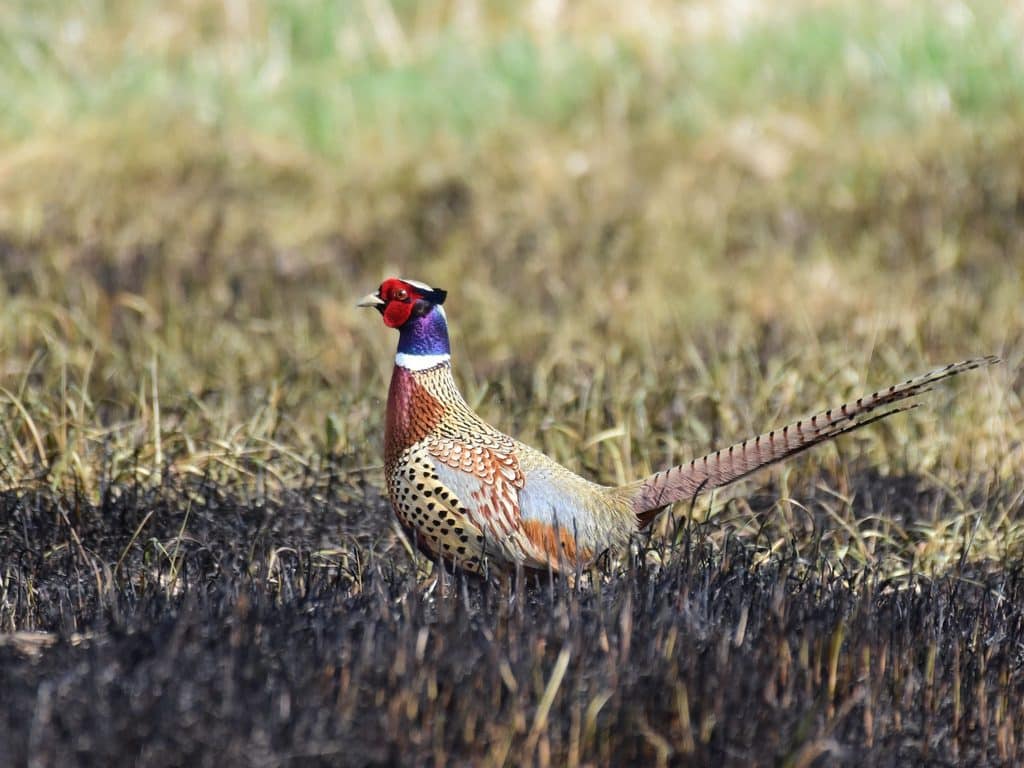
From the shelter of a seasonal park building’s patio, rafts of hundreds if not thousands of birds far offshore attracted our attention. Our attempts to tag them with a definitive identification failed. According to my BirdCast app, millions of birds were due to cross the county that weekend, but none were candidates for the slick of waterfowl we were then observing. An hour later we saw huge flocks of ring-billed gulls winging past from where we had spotted those mystery masses. Had they just fattened up on schools of fish before pressing on? Just then at the edge of some lakeside woods, what should appear but the state bird of South Dakota: the ring-necked pheasant, in all his splendor! Ka-ching: an absolute must-get bird during any visit home.
Serendipity revisited us on the trek back to Minnesota. My classmate had heard tell of a birding hotspot not far off the route. A couple of turns on gravel roads brought us to Salt Lake. This shallow body of water boasts the highest salinity of any lake between the Atlantic Ocean and Utah’s Great Salt Lake. We scanned the surface, slapping IDs on as many species as we could without the aid of our telescopes, sadly resting uselessly in our home closets. Ruddy ducks, scads of coot, a teal or two, a small number of redheads, a murmuration of medium-sized shorebirds scouting out a prime landing spot, and migrating swallows weighing down the telephone lines behind us. Oh, to get back there in spring to greet the dozens more species of migrants sporting their breeding plumage.
Our last species before our flight home: a bald eagle, gliding over the pickleball courts in Wolfe Lake Park.
Author

Related Articles

In the Stacks: Spooky reading suggestions for scaredy cats like me
It’s spooky season – do you need some reading suggestions to fit the mood?