
Backyard Naturalist: Small but mighty, that’s our Weston chickadee
What weighs less than a couple of pocket-change quarters, is present in virtually all of Weston’s backyards and is the state bird?
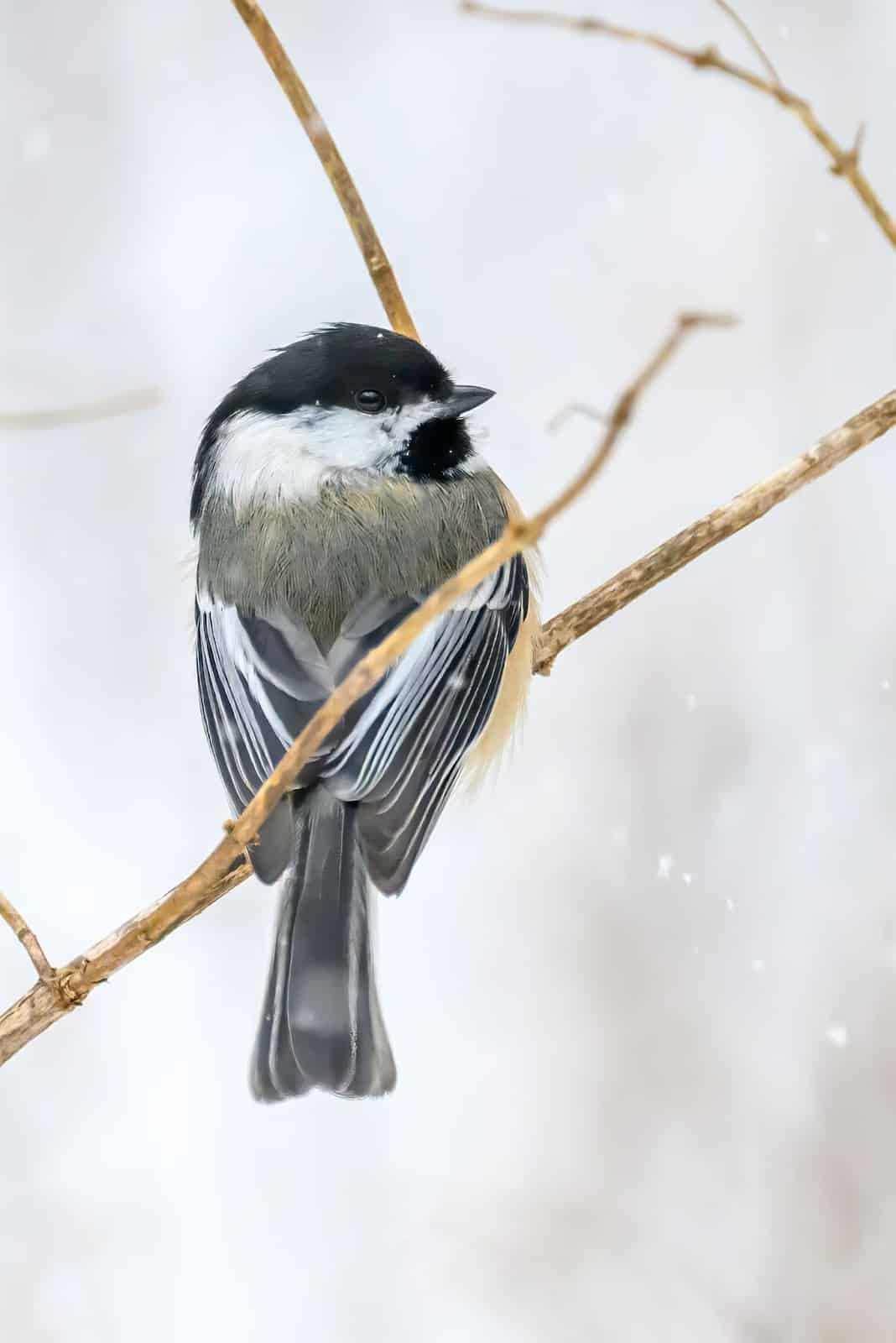
What little marvel of nature weighs less than a couple of pocket-change quarters, is present in virtually all of Weston’s backyards and for the last 85 years has carried on its tiny, fluffy shoulders the weight of serving as the state bird of the Commonwealth?
Yes, indeedeedee, that would be our very own black-capped chickadee (a.k.a. Poecile atricapillus). This is the bird that our Legislature honored as exemplifying the virtues prized by New Englanders since the days of the Pilgrims: hardy, steadfast, reliable, resilient in the face of the harshest winters and ultimately a ubiquitous feature on the landscape of the entire state.
Just how does this smidgeon of a creature cope in our often unforgiving climate? By being the Eagle Scout of avifauna, and living by the “Be Prepared” motto. Our state bird is constantly ready to face challenges and (perhaps unintentionally) to help others. Fueling a heart that beats 500-1,000 times per minute is a constant challenge. So, when all half-dozen young have fully fledged in the summer, the little chickadee busies itself caching away as much food as possible for the long, dark winter. It finds good hiding places for energy-rich seeds in tree crevices, behind peeling bark and in knotholes. During this caching time, the chickadee’s hippocampus – the part of the brain associated with spatial memory – grows by a remarkable 30%. This enlarged hippocampus also enables the chickadee to retrieve its treasures months later – and even to remember where the food with the highest energy content was stored.
As winter approaches, they’ll also add 30% more feathers to their “coats.” A knothole proves to be the perfect nighttime shelter to scooch into to avoid the elements. Come morning, our chickadee will need to do a lot of foraging and cache-accessing to maintain its 108-degree body temperature.
As they search for food to stoke their metabolic stoves, chickadees become blabbermouths. They don’t even pretend to keep secrets. Other birds wait to hear these “first responders” sound off about the discovery of a new food source. Chickadees are invariably the first to return to my refilled feeders; the other neighborhood species are never far behind. Ally birds also instinctively tune in to listen for one of the 16 distinct chickadee vocalizations – the voice of the local news – whether it signifies the presence of food, or the approach of a predator.
In the latter case, our hero will start with a “freeze” call. As many as two dozen chickadees will join in to lay down a drumbeat of “chickadee-dee-dee” calls – the more “dees” the higher the degree of danger. You can be sure that their allies – nuthatches, titmice, woodpeckers and sparrows – will join them in surrounding the prey (often an eastern screech owl or a Cooper’s hawk), blasting it with birdsong that says “we see you and you’ll not have us for your lunch!”
When the migrant warblers return from their cushy vacations in the neotropics, en route to their own nesting sites in the boreal forests, it’s our chickadee’s voice that they heed when it comes time to find food and avoid predators.
So, how about you? Have you noticed the new vibe in the air as you walk your dog? Listen carefully and you’ll hear our resident species using their songs to start reclaiming their breeding territories and re-establishing their pair bonds. For the black-capped chickadee, it means they’re voicing a bright “feee-beee” and already looking for this year’s new knothole (not last year’s), where they can lay down some moss, add some fur and hair and plan to lay their eggs. Stay tuned for a sequel on “the family life of the black-capped chickadee.”
“The sound of birds stops the noise of my mind.” – Carly Simon
Author

Related Articles

History Corner: Honoring the Noble Train of Artillery of Gen. Henry Knox
Weston Historical Society President Pam Fox highlights the 250th anniversary of Henry Knox passing through Weston.
Library Corner: What’s New? The Art and Science of Library Collection Management in 2026
Library Director Jennifer Warner takes us through how she and her staff manage the library’s collection.
Backyard Naturalist: Traveling for a fresh perspective on Weston woods
What does “your backyard” encompass? To get a new view on his own, Backyard Naturalist Michael Pappone traveled to Mexico.