
Backyard Naturalist: Sailing on a research vessel: Another kind of blue wave
Backyard Naturalist Michael Pappone rode a literal blue wave on his recent trip to the Stellwagen Bank National Marine Sanctuary.
The blue wave rolled inexorably from the Atlantic to the Pacific last Tuesday as the R/V Auk rolled gently through the waves on the high seas under blue skies. Our research vessel steamed out of Scituate Harbor with a crew of three working the boat, two Stellwagen Bank National Marine Sanctuary scientists and a volunteer posse of five.
My group of volunteers included a medicinal chemist, a whale-cruise naturalist, a seabird specialist gigging her way from tern to puffin projects, a medical data analytics specialist and your very own Backyard Naturalist. We dutifully thanked the weather gods for calm waters and temperatures well above normal. Then we got down to business: surveying the avifauna of the sanctuary.
As the boat moved along its prescribed data-collection transects, we cycled through our observation roles. For the first hour my job might be to spot marine mammals and radio to the captain below: “Flybridge to Auk!” reporting the presence of whales, dolphins or porpoises in the boat’s path. Then it’s time to rotate to the “recorder” chair, clutching a clipboard and making notes of the sighting details barked out by the person playing the “observer” role. You’ll record the species, distance, angle from the boat, flight direction and behavior of the bird. Maybe you’ll get an hour off before you rotate into the observer station.
You can catch your breath in the cabin where there’s a head, a refrigerator, a microwave (I nuked a burrito) and a table.
Back on the flybridge, you grab your binoculars and scan the waters. Wait – is that a greater shearwater, or is it a Cory’s shearwater? Did anyone catch a hint of yellow on the beak?
We cross paths with humpbacked whales synchronizing their spout-blowing like Olympic athletes, or tail-flopping to signify exactly what, I wonder? Schools of white-sided dolphins and harbor porpoises punctuate our avian record-keeping efforts. Most of the birds that we logged into our survey forms would have names unfamiliar to most land-lubbers. They belong to species that are seldom seen from shore. The northern fulmar, for instance, breeds north of Alaska and in far northeastern Canada. Its idea of flying south for the winter is to visit our coastal waters. The great shearwater breeds in the south Atlantic islands and visits our off-shore waters from May to November. Cory’s shearwater breeds in the Azores and cliffs in the Mediterranean, visiting us during its migration to colder waters. Wilson’s storm-petrels breed in the Antarctic and range northward in their non-breeding season. We catch a glimpse of the occasional pomerine jaeger and an Arctic tundra breeder, which pirates other birds’ catches.
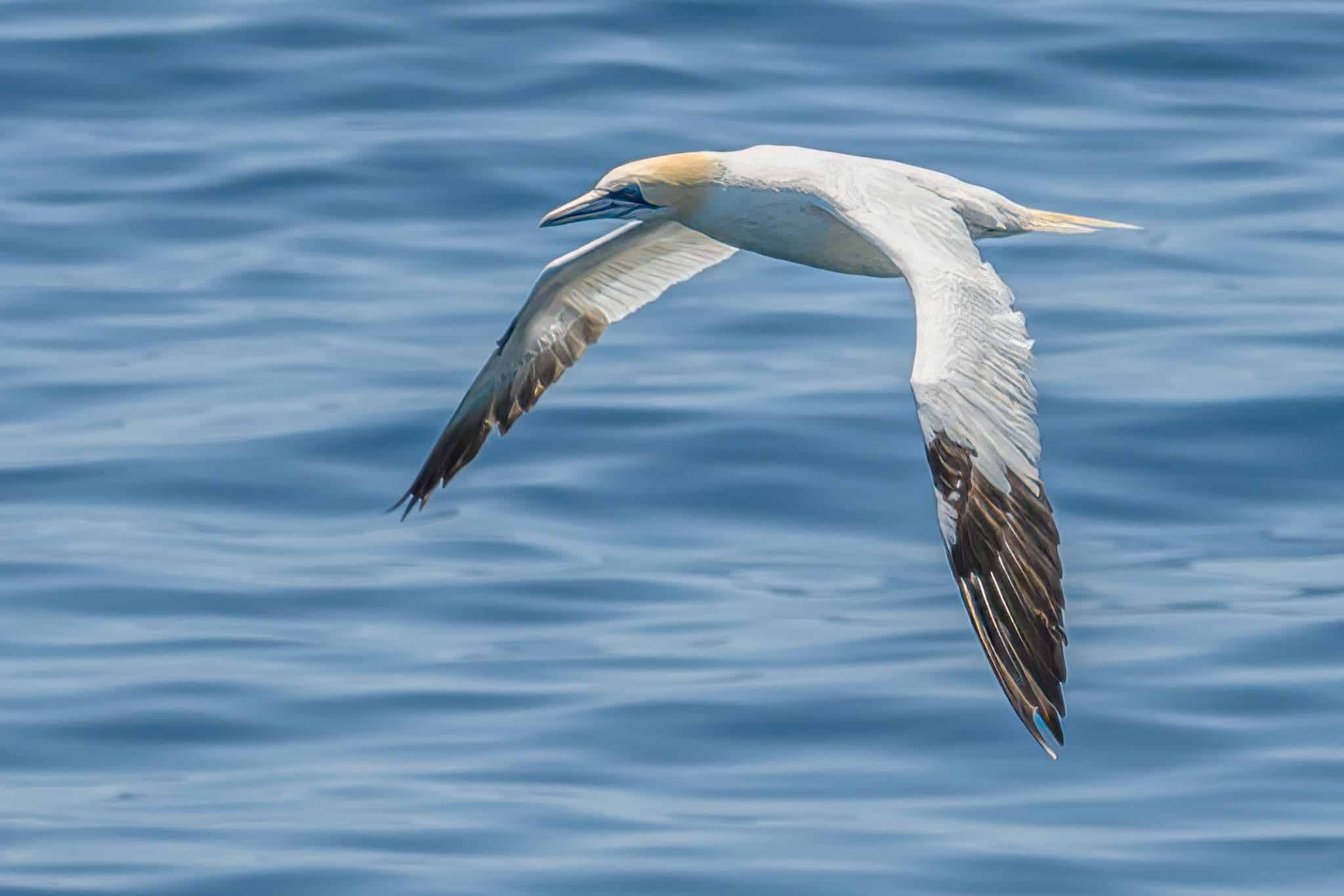
My bird of the day would certainly be the charismatic northern gannet (Morus bassanus). The gannet is our largest North Atlantic seabird, boasting a wing-span nearly equalling that of a bald eagle and weighing six or more pounds. That’s as much as your neighborhood great blue heron. Their super-power: plunge-diving! Gannets have stream-lined bodies that enable them to dive like a falcon – but into water – from a height of 50 feet. Its reinforced skull helps dampen the force of the impact with the water as it snatches a mackerel or herring for a quick underwater lunch. With waterproof feathers, subcutaneous air sacs in its lower body to augment its oxygen supply and extra membranes to protect the eyes under water, you have the makings of a clean, mean diving machine. With a life expectancy of 20 or more years, the gannet will be around to play a starring role in many a pelagic seabird survey.
Author