
Backyard Naturalist: Our harbinger of spring shares some secrets
The American robin, despite living here all year, are Backyard Naturalist Michael Pappone’s sign of spring.
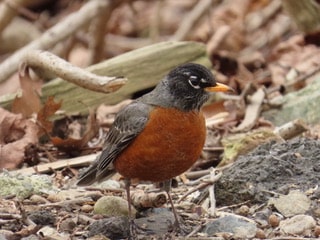
A fleeting shadow and a rush of wingbeats above my head mean the American robin is back building her first nest of the season, safely tucked into the overhang on our son’s entryway. And it reminds me that I’m overdue in extending my welcome to this iconic harbinger of spring. I’m also going to spill some of the secrets that our most familiar of songbirds has been hiding from its fans.
Trigger alert: we’ll be touching on such sensitive topics as gluttony and infidelity!
Yes, our quintessential early bird is endowed with many qualities that are worthy of our admiration. It greets–actually anticipates–the dawning of each new spring day with its unmistakable cheerily-cheerily-cheerily-cheerio song at full volume. It’s secret? The lengthening of days causes hormonal changes that prompt the bird to sing. Indeed, it’s our earliest nester, too. It closes out the day after sunset with more songs and calls, long after its neighbors have gone silent. It’s more widely recognized as America’s prototypical example of a bird than any other species. Also impressive is the robin’s unique ability to detect and eject the eggs laid in its nest by the brood-parasitic brown-headed cowbird.
Belying their claim to be a first sign of spring, they are actually a species we can find here every day of every year. While the birds nesting in your rhododendrons have probably migrated to southern parts of the country, their Canadian and northern New England kin have seamlessly taken their place here in Weston. Robins are with us all year long; we just need to know where to look for them.
In the spring, of course, they’re busy hopping on our freshly-watered lawns in plain sight, hunting insects, caterpillars, beetles and earthworms. Another secret: robins are gluttons. They can slurp up 14 feet of worms a day during breeding season. In the winter, their diet consists primarily of berries and fruits of trees and shrubs: crabapple, dogwood, cedar, holly and hawthorne are favorites. So look for that usually solitary robin up in the branches, where they flock in scores or even hundreds to feast together.
Another well-kept secret: communal robin roosts in winter can grow to a quarter of a million birds.
During the breeding season, the female takes charge of nest-building. She’ll pair with the partner that she thinks looks most like her, an example or positive assortative mating. Then she’ll lay four robin’s egg blue eggs, one a day. She’ll warm them by remaining on the nest 75% of the daytime hours and all night long. She also has a secret spot called a brood patch–bare skin on her belly that she can hold against the eggs for extra toastiness. Only about one quarter of the chicks will survive the season. Predators like domestic cats (please keep yours indoors) are the biggest culprit. Raccoons, squirrels, chipmunks and even house wrens prey on the eggs. Various hawk species snatch the young, and a fox will make short work of a fledgling that falls to the ground. Robins compensate for those losses by nesting an extra time or two each season. Despite apparent monogamy, the female will usually raise at least one chick that is the offspring of extra-pair coupling. Now that secret’s out, too!
At 370,000,000 individuals, the robin is the most numerous species in the United States, breeding in every county in the commonwealth and every state in the Union. Step outside and celebrate spring with this willing companion!
Author