
MCAS scores stay steady in 2026
MCAS results released by the state on Sept. 22 show Weston Public Schools students continue to earn high marks.
Massachusetts Comprehensive Assessment System (MCAS) results released by the state on Sept. 22 show Weston Public Schools students continue to earn high marks.
Students across Weston Public Schools far outperformed their peers across Massachusetts, nearly doubling state averages in every grade and subject. The MCAS, no longer required for high school graduation, is administered each spring in grades three through eight and 10th grade. Students are tested in English language arts, math, science and technology and, beginning last year, civics.
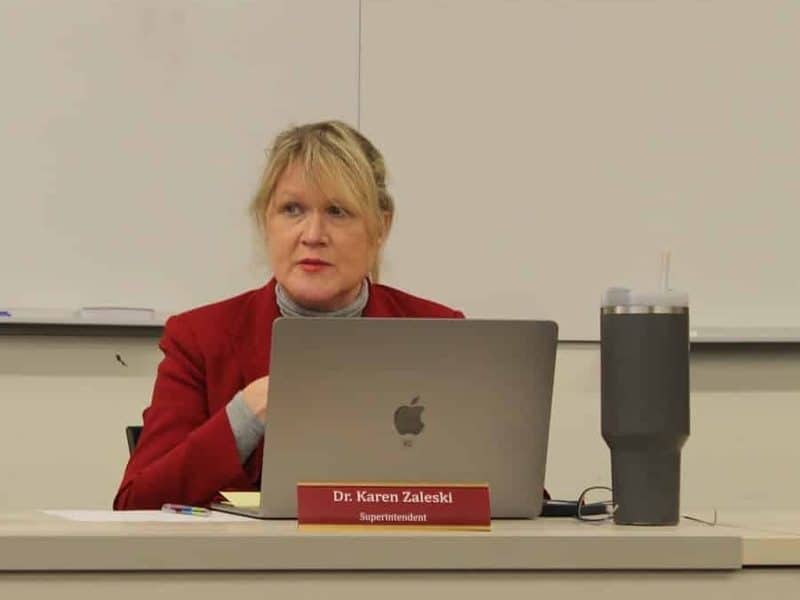
Superintendent Karen Zaleski declined to comment on the results, as the district is conducting a full analysis, which will be shared with the School Committee and public later this fall.
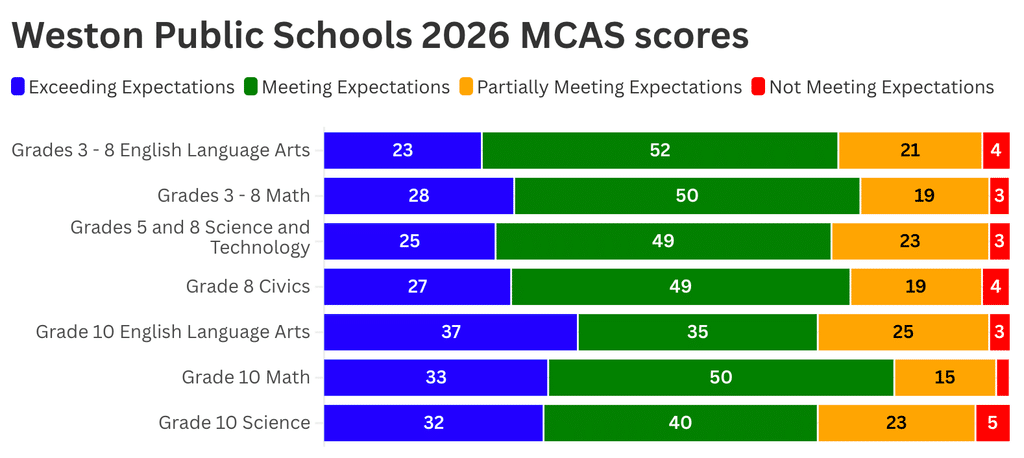
Scores were generally stable from the 2025 results. In grades three through eight, 76% of students in English and 79% of students in math met or exceeded expectations. Additionally, 74% of students in science and technology/engineering met or exceeded expectations.
Around Massachusetts, fewer than half of students in grades three through eight met or exceeded expectations, about 40% in each subject.
At Weston High School, top-scorers were higher than last year in some subjects, with a greater share of students exceeding expectations. There were more students exceeding expectations this year in English, up to 37% from 33% last year. A quarter of students partially met expectations, an increase from 16% from 2025.
While fewer students exceeded expectations in math, fewer students also partially met expectations, with a big increase in those who passed the MCAS. At Weston High School, 33% exceeded expectations, with 50% meeting them. In science, 32% exceeded expectations and 40% met expectations. Across the state, 45% of 10th graders in English, 44% in math and 41% in science met or exceeded expectations, respectively.
Broadly, about one-fifth of Weston students in all grades partially met expectations in all subjects, and a small portion did not meet expectations. This is significantly better than state results, which show about 20% of all students failed to meet expectations in each subject area.
While Weston’s scores remained strong in every subject area – even as state scores continue to decline – the district, like many other communities, is still slightly lagging behind its pre-pandemic scores by a few percentage points.
The district, however, is looking past the pandemic. In its 2025 results analysis, Zaleski and other administrators said it is up to the district to get students back to their previous high marks. Part of that work is a sweeping data-driven intervention initiative, which has been implemented in recent years.
“I don’t want to blame the pandemic anymore. We know there are factors there, but at this point, to me, the bigger factors are we have just begun [new data-driven interventions],” Zaleski said in fall 2025.
This year, 14 districts returned to or exceeded pre-pandemic performance in grades three through eight, according to the Department of Elementary and Secondary Education (DESE). Last year, 63 districts reached their pre-pandemic scores, according to the agency.
With many districts struggling to increase their English scores, DESE is advocating for more “evidence-based early literacy instruction.” Weston is ahead of the curve, having already introduced a revamped K-5 early literacy curriculum.
“The Healey-Driscoll Administration and the Legislature both recognized the urgent need to focus on early literacy, with the governor’s Literacy Launch initiative and the recent passage of legislation that requires districts to use evidence-based early literacy curricula,” Education Secretary Stephen Zrike said in a press release. “With this strong focus and support on early literacy, I am confident that we will see improved outcomes in our English language arts performance.”
DESE is also focused on decreasing chronic absenteeism, defined as missing at least 10%, or around 18 days, of school. In the 2025-26 school year, about 17.1% of students across the state were chronically absent. Chronic absenteeism is less of an issue in Weston, but 8.4% of students were chronically absent.
Author

Related Articles

Superintendent contract in review
With the School Committee considering Superintendent Karen Zaleski’s future with the district, she made a pitch for her job on Sept. 28.