
Rep. Peisch concerned about upcoming health care cuts, education
Earlier this month, Rep. Alice Peisch briefed residents about current events on Beacon Hill and challenges to state government.
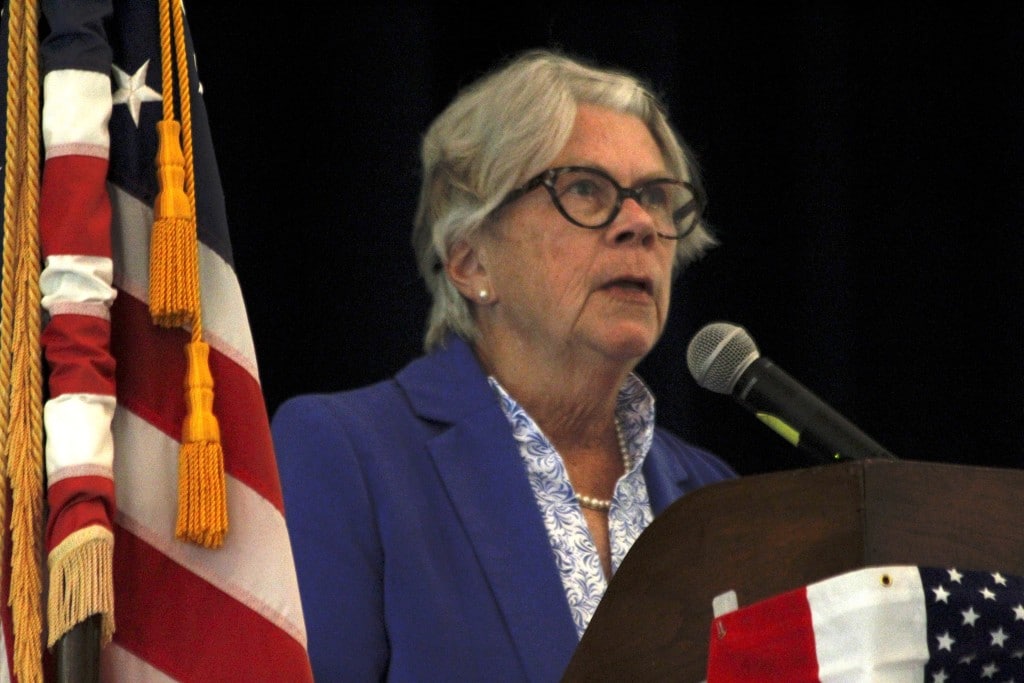
Rep. Alice Peisch spoke in Weston earlier this month, ahead of the annual meeting of the League of Women Voters. She briefed the gathering about current events on Beacon Hill, challenges to state government posed by actions at the federal level and potential consequences of upcoming ballot questions.
Peisch has served in the state House of Representatives since 2003 and is currently assistant majority leader and chair of the Committee on Ballot Issues. She is serving on the House Committee on Ethics and the House Committee on Rules.
The unpredictability and changeability of the current federal government is making state-level planning difficult, Peisch said. The most concerning issue will be upcoming cuts to Medicaid, set to take effect in January, which will require the state to partially make up the shortfall by cutting other areas of the budget. She cited overall cuts to health care and education funds, as well as cuts to research grants as areas hit by actions of the Trump administration.
“The impact of these cuts is significant, especially for institutions of higher learning and the biotech industry,” she said.
Peisch said many constituents have reached out to her with concerns about immigration enforcement in Massachusetts. She discussed the Protect Act, passed earlier this year, which limits state and local cooperation with federal immigration enforcement, restricts civil immigration arrests at courthouses, prohibits new agreements between local law enforcement and ICE agents, and provides support for immigrant victims of crime and trafficking.
Attorney General Andrea Joy Campbell, Peisch said, has had some success challenging federal orders, including challenging a pause on funding for English language-learner programs.
Peisch also spoke about the recent passage of a data privacy act aimed at protecting consumer data, and the current work on a bill requiring evidence-based literacy instruction in all elementary school curricula. She is also working on a bill that would implement a bell-to-bell cellphone ban in school and include social media restrictions for minors.
She closed with a discussion of some of the questions that will be on the ballot this fall, ranging from protecting water and nature, repealing the state’s marijuana regulations, improving access to public records and rent control.
Throughout her long career, Peisch said, her primary goal has been improving public education. She is increasingly concerned that the quality of public education in the state is too reliant on its reputation for excellence.
MCAS scores, which were dropping even before the pandemic, have not recovered, she said.
“Even before Covid, things were headed in the wrong direction, particularly with respect to students from under-resourced families and communities and the gap between those in this district and students from less well-resourced communities is growing, not declining.”
Low-income children in Mississippi are now scoring better than their counterparts in Massachusetts, she said.
“It’s an ongoing challenge,” she said. “It’s an issue that pits local control against the state, which is often not a popular issue.”
Author
Related Articles

29th annual Rotary Club car show set for Sept. 26
For Richard DeVito Jr., a member of the Weston & Wayland Rotary Club, relating life experiences to the cars people drive is the essence of the organization’s biggest community event: the annual Antique and Classic Car Show.
Flock contract frozen as Police seek feedback
The national conversation about police surveillance has come to Weston.

Steps for Sotos to raise money for first-of-its-kind MGH clinic
A local family is hosting Steps for Sotos, a walk-a-thon to raise money for MGH’s Sotos Syndrome Clinic.