
Route 30 project heading toward crossroads
There is another opportunity for residents to take a look at detailed plans of the Route 30 project on June 30.
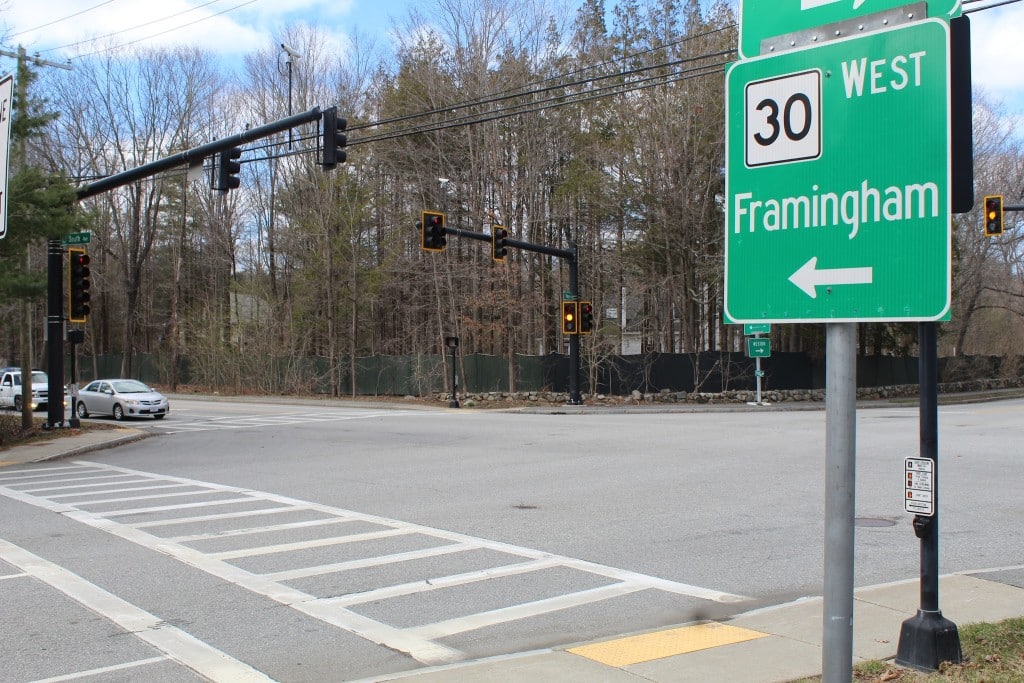
Following last month’s overwhelmingly negative listening sessions, the Traffic and Sidewalk Committee is hosting another opportunity for residents to take a look at detailed plans of the Route 30 project on June 30.
The in-person meeting will be held in the Police Department’s training room from 7 to 9 p.m., and consultants from Howard Stein Hudson (HSH) will be on hand to answer questions, according to committee Chair Ann Wiedie.
The $18.5 million state-funded project is a 3.7-mile reconstruction of Route 30 from the Natick town line to the intersection of Cutters Bluff Road that will widen the driving surface, create a 10-foot shared-use path, improve pedestrian crossings, update drainage and make connections to other sidewalks and paths along the route.
The project is currently at the 75% design phase. Although Weston residents have already appropriated nearly $1.54 million in design fees – $938,000 in 2018 and $600,000 in 2024 – it could still, as some residents requested last month, be stopped. The Select Board will likely have the final say on whether it advances to the next stages, according to a timeline shared by Town Engineer Jason Lavoie.
“After [the June 30] meeting, they will need to put together a memo with all the comments they think should be addressed by HSH. [The Traffic and Sidewalk Committee] then needs to vote to approve the memo to have it submitted to the Select Board for their review and potential approval,” Lavoie said in an email. “The Select Board will then have a public meeting, and either accept the memo, accept the memo with edits or deny it.”
During the Select Board’s June 9 meeting, member Anupam Sachdev said he was apprehensive about potentially killing a project that residents approved at Town Meeting.
“Otherwise we are unilaterally pulling the rug from folks who voted twice to move it forward,” Sachdev said. “I think the appropriate thing would be to bring it back to Town Meeting.”
If the Select Board – down to three voting members on the matter because two have recused themselves – votes to advance the project, Town Manager Leon Gaumond said residents will “more than likely” have one more chance to weigh in as the state will require Weston to acquire land along the project corridor.
“At some point in the future, there will be a request, if this project moves forward, for additional funds for easement takings and the like,” Gaumond said. “If the Select Board decides that they would not like to advance the project any further, my guess would be that it would stop at that time, or when the current scope of work is completed.”
The project has proven to be divisive in town since a revised proposal was brought forward two years ago.
The original 2018 proposal, overwhelmingly approved by Town Meeting in a 563-35 vote, included a 5-foot-wide sidewalk along the entire corridor. An additional funding request was brought forward at the 2024 Annual Town Meeting because the design had been changed to include the shared-use path, or buffered bicycle lanes, as required by the Massachusetts Department of Transportation’s “Healthy Design Standards” to keep the project on the state- and federally funded Transportation Improvement Plan, according to language on the warrant.
That 2024 appropriation was approved by a much narrower margin, 285-203.
Barbara Fullerton, a Winter Street resident, said the initial design was more acceptable, as it had much less of an impact on the environment. The revised project, she added, is too disruptive to the corridor for it to be worth that much taxpayer money from the state.
“A sidewalk isn’t very intrusive; if you look at the sidewalks we have in town they’re not very wide … It’s not what people expected,” Fullerton said. “If we’re spending $20 million on this, which is a huge amount of money, how many people are going to benefit from this? Is it going to be the people who live on Route 30 bearing the brunt of the damage while people in Wayland or someone else can benefit from this?”
Fullerton, who serves on the Tree Advisory Group, said her top concerns were environmental, as 360 trees would need to be removed to accommodate the shared-use path. HSH noted in previous presentations 252 of those trees would be replaced on a one-to-one ratio, while other plantings would include shrubs, perennials and ground cover.
“There are places where we saw you could avoid cutting down a significant tree … if you curve the bike path, and are a little more thoughtful in where you put the path,” she said. “It’s going to be visually intrusive on the whole Route 30 corridor and it’s going to make it a lot less like a rural country road. It’s going to be more like Newton or Boston.”
David Hutcheson, a Coburn Road resident and avid cyclist, said he is in favor of the project because it will provide widespread public benefits by potentially easing vehicular traffic and allowing pedestrians and cyclists to safely travel alongside the busy road. He noted that while he understands some concerns, change is inevitable in a community.
“You need public infrastructure to support the activities of people in the town,” he said. “I think their objections might be overblown.”
He said the level of concern surrounding the project is similar to the negative reception the Mass Central Rail Trail received in 1997, when Weston voters shot the proposal down at Town Meeting. Decades later, the project was approved, and he said it has been a wonderful amenity for Weston and the region.
“The trail was ultimately built, and we all benefited from that in my view,” Hutcheson said. “If the project gets a thumbs down from Weston, we’ll be hurting ourselves. I think the Select Board and Town Meeting voters will need to be very careful on this one.”
More information about the Route 30 project, including detailed plans, can be found on the town website.
Author

Related Articles
Didn’t receive a mail-in ballot? Plan ahead for November
With several reports of voters not receiving their mail-in ballots ahead of the state primary, residents are encouraged to make backup plans for November’s general election.
Route 20, Boston Post Road, Highland Street up next for safety changes
As residents await construction at one crash-prone Route 20 intersection, MassDOT is reviewing proposals for the troublesome Route 20, Boston Post Road and Highland Street intersection.
Senior housing project preps details for Town Meeting warrant
Ahead of Special Town Meeting, Planning Board members continue to press the developer behind Reserve Weston, the senior housing proposal planned for 300 Wellesley St.