Op-ed: Weston is a tale of two cities
Frank Caine makes a case for forming an Economic Development Committee.
By Frank Caine
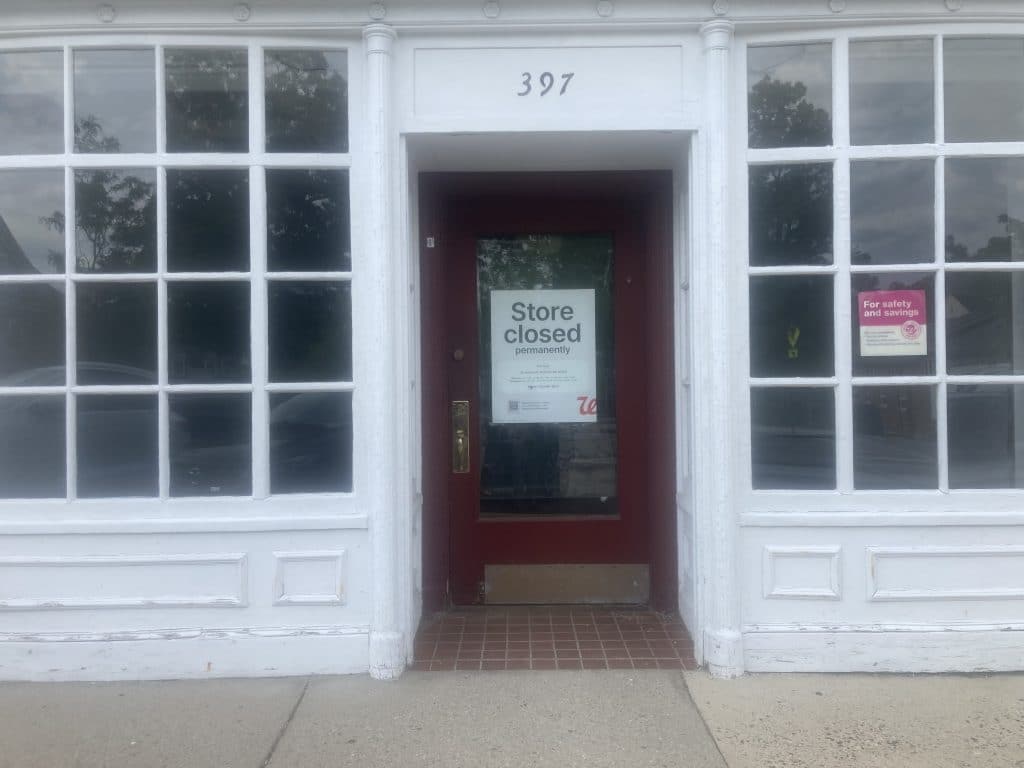
Recently, I took a walk for about a mile from the east end of the town center to the west. I took note of some of the commercial and residential properties along the way. By the time I got done, I had counted eight empty storefronts and two dilapidated privately-owned structures. I thought about the fact that Weston no longer has a drug store or a hardware store. But I did count four banks, three real estate offices, five churches, three training studios, and one dine-in option, Heirloom.
It dawned on me that this is how Weston shows itself to visitors, current residents and potential residents. These images send an unintended message; they suggest that we don’t care about the look, feel or vibrancy of our town. We made a point of moving utilities underground, but the Josiah Smith Tavern, though pretty on the outside, is feeling like a stalled cause at the moment.
I have friends who are former Weston residents now living in Woodstock, Vermont. Woodstock once had similar challenges. Buildings were aging, facades needed attention, and despite the town’s natural charm, the village center wasn’t attracting new commercial activity. In 2018, a small group of residents presented the Select Board with a proposal to do two things: establish an Economic Development Committee, the charter for which included, among other things, researching options for rehabilitating commercial structures; and developing specific proposals and resourcing plans for reinvestments in the town center, in some instances involving collaboration with commercial property owners. All proposals would be approved by the Select Board.
There were four keys to Woodstock’s success. First, the group was comprised of volunteers with the experience to understand the engineering and technical complexities of the town’s challenges, and to create the right incentives for refilling empty storefronts. They didn’t subcontract the research and planning to consultants or other committees. Second, they leveraged existing Vermont state incentive programs for rehabilitating town centers. Third, they kept focus on projects linked to economic development and attracting visitors. Fourth, they maintained a direct working relationship with the Select Board. Of 120 recommendations submitted between 2018 and 2025, 118 were approved.
There are those in Weston who would say that we can’t do anything about empty storefronts that are privately owned; that we can’t pre-empt the rights of those owners, that we have wastewater treatment constraints on further development, that we’re already short on parking, that we don’t want the Town Center any more crowded than it is. Some or all of that may be true. But the Woodstock EDC faced similar obstacles and somehow found a way to design a process that worked.
Efforts like these require resources to succeed. Weston taxpayers already fund a 3% surtax for the Community Preservation Committee. The CPC has supported many important projects to protect historical features of our town and support recreation and housing. Some say the highest-priority preservation projects are behind us and that CPC resources have grown far beyond what future preservation projects will require. What if some portion of that 3% were redirected toward development — toward a “CDC”? What if we could entice a few residents with the right development experience to form a serious redevelopment group, as Woodstock did? Massachusetts offers several relevant state initiatives, including the Massachusetts Historic Rehabilitation Tax Credit, the Transformative Development Initiative, and the Community One Stop for Growth portal, which streamlines access to various development grants.
Given where we are and what the photos are telling us, why wouldn’t we want to fix whatever isn’t working and, in the process, give residents more reasons to enjoy the town center? I don’t think we’re talking about the CPC, the Planning Committee, the Permanent Buildings Committee or the Town Manager’s Office. This seems like a different mandate requiring different skills, as Woodstock demonstrated. An actual economic development plan for the town center would be a serious challenge — but the return on such an investment would arguably be high.
We don’t need to be Woodstock, nor do we need to mimic Wellesley. But we ought to be able to do better than we’re doing.
Frank Caine is a Weston resident.