
Revised MBTA Communities proposal heading to Town Meeting
Weston officials advanced a revised MBTA Communities zoning plan, setting the proposal for a decisive Special Town Meeting October 15.
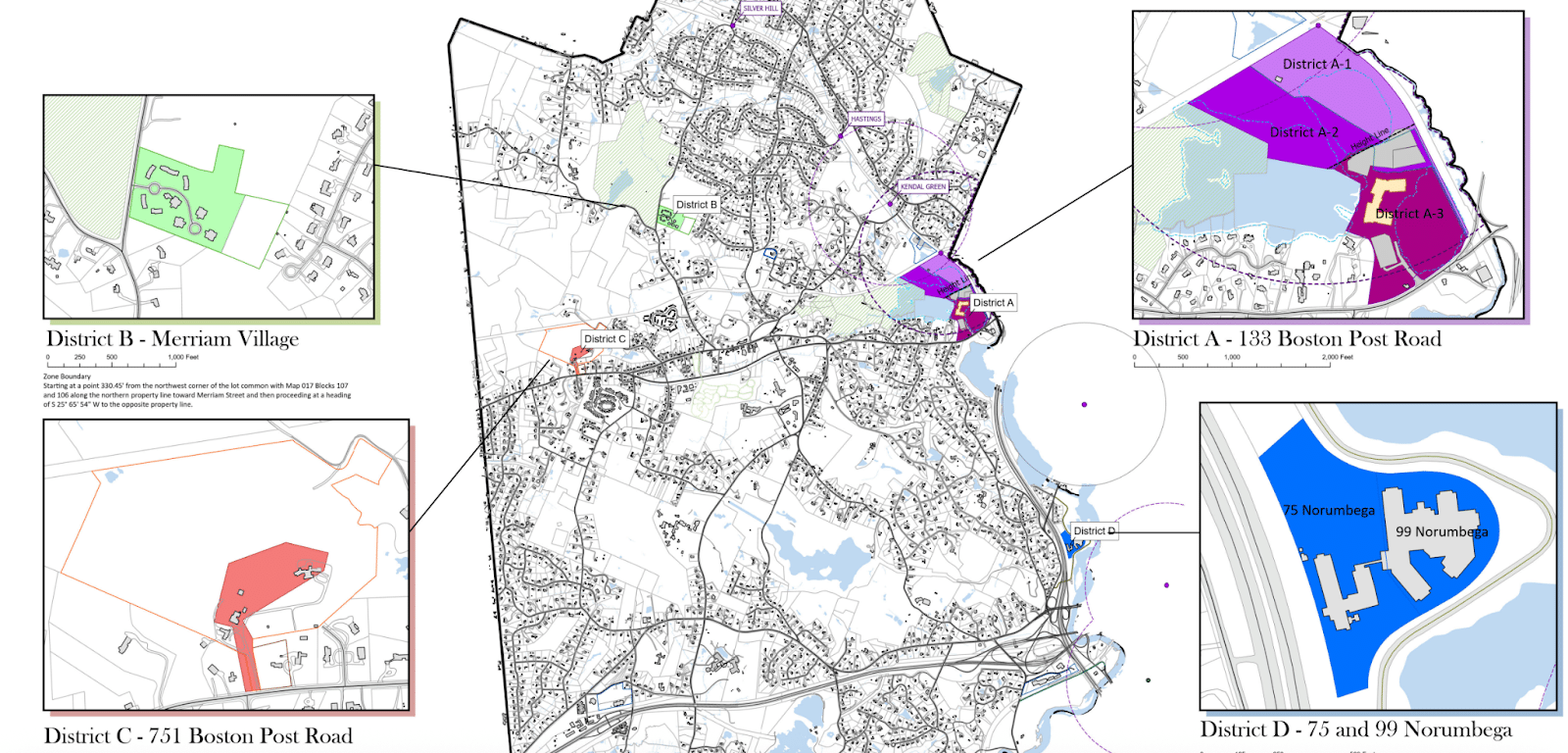
After months of meetings, the Planning Board and Select Board on Sept. 3 presented their zoning proposal to bring Weston into compliance with the MBTA Communities Act.
At the first of several public hearings for the proposed zoning overlays, which will come before residents at Special Town Meeting Oct. 15, the Planning Board and Select Board Chair Lise Revers shared the new plan’s focus on encouraging development fitting Weston’s character.
Weston is currently noncompliant with the MBTA Communities Act, as the state set a July 14 deadline. Revers said the additional planning time allowed the boards to develop a proposal best serving Weston.
“I really believe the town has taken enough time to come up with a plan that is not just compliant with 3A,” Revers said, “but is something that can actually enhance our town in the future.”
The plan proposes creating four multifamily zoning overlays of varying densities around town. Three of the proposed zones are considered to be long-term zoning districts unlikely to be developed in the near future: Merriam Village, 751 Boston Post Road and 75/99 Norumbega Road. The key overlay, located at the 133 Boston Post Road campus owned by Boston Properties BXP, proposes a phased build-up of a multigenerational neighborhood.
The law requires that Weston must create one or more zoning districts totaling a minimum of 50 acres and allowing for the development of 750 units of multifamily housing. Districts must have a density of at least 15 units per acre, and at least 40% of the total units need to be located within a half mile of the Kendal Green Commuter Rail station. Developments in the overlay would be allowed by-right, but would be subject to site plan approval from the Planning Board. All multifamily developments with 10 or more units would be required to make 15% of those units affordable.
Additionally, since the Kendal Green stop could be relocated by the MBTA in the future, the town received state approval to develop its plan based on the potential new location of the station, allowing the entirety of 133 Boston Post Road to fit into the half-mile radius requirement.
133 Boston Post Road
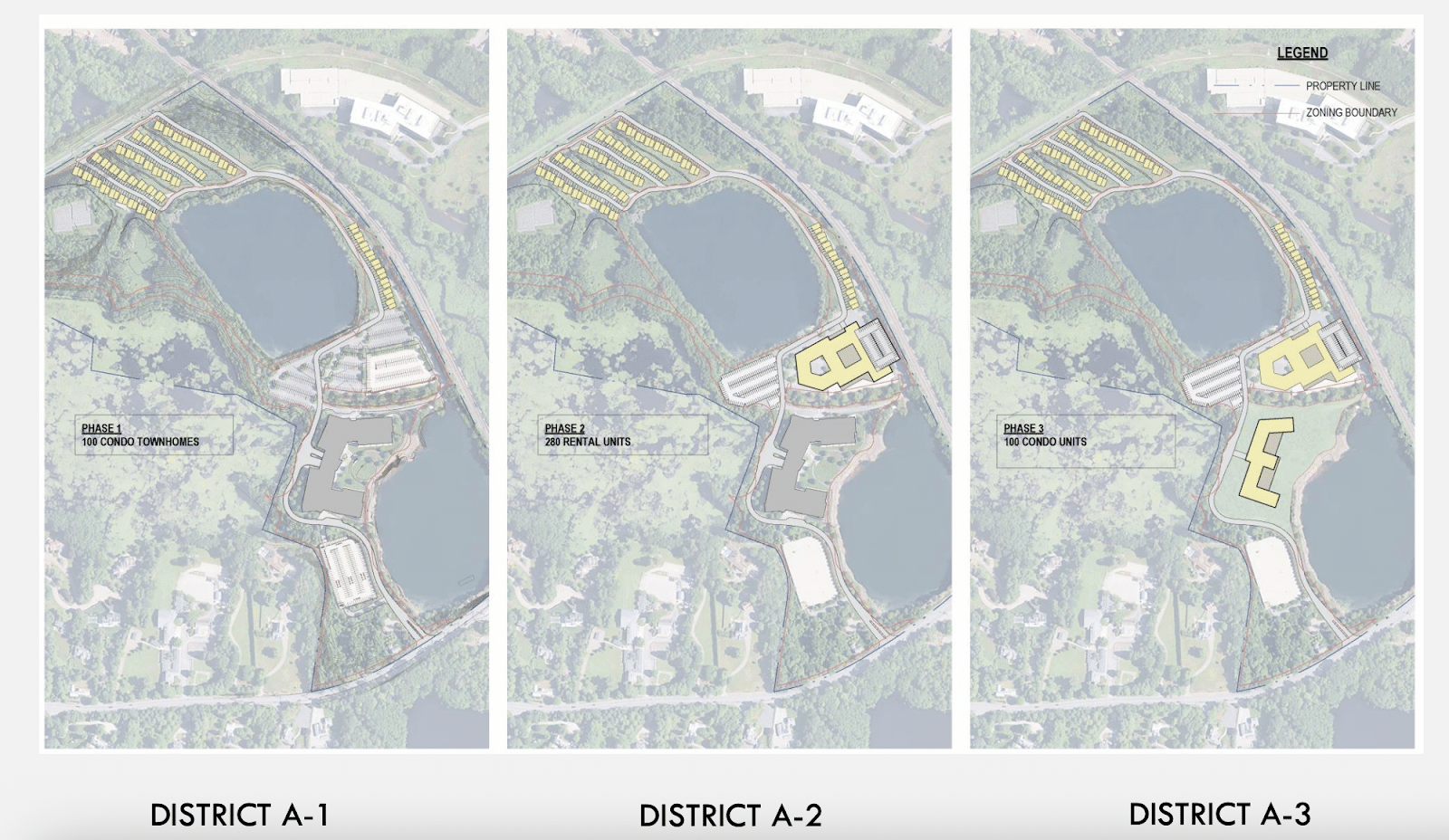
If residents approve the bylaw, the first development would be at the 133 Boston Post Road district. Boston Properties is proposing 100 townhomes in Zone A1, the northeast corner of the site; 280 multifamily units in Zone A2, the existing parking structure between two ponds and adjacent to the MBTA tracks; and 100 age-restricted units in Zone A3, currently the site of a 350,000-square-foot office building.
Planning Board member Al Aydelott said the site has the potential to support a neighborhood meeting Weston’s housing production goals, while having little to no impact on the town. He coined “Quarry Pond Village” as a potential name for the development.
“On this site we imagine it to be an inclusive, welcoming community consistent with Weston’s scale and character,” Aydelott said. “If we get it right, I think it could be a great addition to the town … We think [the developments] would represent opportunities for people to live with various lifestyles comfortably and surrounded by amenities that I think anybody would want to share.”
If completed, the three-phase development would increase the town’s current housing stock by 10%, Aydelott said, and there would be “40 fewer vehicles than there are now.”
“It’s a small increase that brings a large reduction,” Aydelott said, “and I think that’s an interesting and positive outcome for this very complicated challenge.”
Longer term zoning goals
The other three districts would be long-term zoning designations that would not see development right away, if ever.
The layout of the Merriam Village neighborhood, which currently accommodates 62 age-restricted, affordable units, ensures any future development is constructed near the existing units. Any additional building would require amending the development agreement and obtaining Town Meeting approval, giving residents control over what is developed, according to Revers.
“Any housing that could be developed under 3A zoning would be both senior housing and affordable housing, which is exactly the type of housing our housing production plan called for,” Revers said. “We don’t expect anything to happen on this property in the near term.”
At the 751 Boston Post Road site, construction of 172 units is already underway under Chapter 40B affordable housing zoning. The proposed overlay only allows for 99 units, fewer than the current development, and Planning Board Chair Leslie Glynn said it is designed in a way that it would be “very unlikely” the property owners would try to convert the project from 40B to 3A.
Finally, at 75 and 99 Norumbega Road, the site of Charles River Recovery and the Maplewood assisted living facility, which have about 75 and 99 units, respectively, Town Planner Imaikalani Aiu said the overlay concentrates zoning on the Maplewood site. He noted the parcels lie “apart from the rest of town” and any potential developments would likely not affect the community.
“This is part of the long-term zoning strategy to keep this as something that is unlikely to happen,” Aiu said. “If it does get built, it’s not going to be much more than the impact there now.”
Potential impacts if plan does not pass
If Special Town Meeting does not approve the plan, and if the town does not have one in place by January, the state attorney general’s office will begin to take enforcement action. Those actions could range from daily fines to the appointment of a special master, who could implement a map on behalf of the state.
The state has already withheld a $278,000 literacy grant from Weston Public Schools, but Revers said that the remainder of state funding for the schools is “predicated on a favorable vote.”
“The bottom line here, regarding the legal issue, is whatever we may personally think of the MBTA Communities Act, the courts have spoken, and they have spoken strongly that the act is valid and enforceable,” Revers said.
The potential appointment of a special master is a “real question mark,” she said. “We don’t know if the state would take that kind of approach to the issue.”
Several of the more than 25 residents who attended the Sept. 3 virtual public hearing expressed their support for the proposal.
Background
While the Planning Board unveiled its plans at the Sept. 3 public hearing, it has been a long road to get there.
The MBTA zoning first came before residents at December 2024’s Special Town Meeting, where it was overwhelmingly rejected by voters, 195-544, following a Planning Board recommendation to vote down the proposal.
That proposal would have created multifamily overlay zoning at five areas of Weston: The Granite Brook Landscape Company at 199 Church St. and Hobbs Brook Road; 133 Boston Post Road; 0 and 9-13 Riverside Road, the Greatland Lab development and former Liberty Mutual campus; 75/99 Norumbega Road; and 100 Brown St., the Wightman Tennis Center.
The Planning Board, in a 4-1 vote, recommended rejecting the bylaw, as the penalties that could have been imposed by the state and the consequences of non-compliance were in flux due to outstanding litigation, according to a Dec. 2 memo sent to the moderator by Town Planner Imaikalani Aiu.
At the 2025 Annual Town Meeting, voters took no action because the warrant article was too similar to the one previously brought before voters, which would have violated Massachusetts General Law Chapter 40A, Section 5’s prohibition on Town Meeting action for two years on zoning bylaw articles rejected at Town Meeting.
The town, in a statement, said legal developments in Attorney General v. Town of Milton — a now-settled case in which the state Supreme Judicial Court declared the 3A law to be legal — prevented the town from making necessary preparations for the May Town Meeting, as there was not enough time to “responsibly develop an alternative 3A compliance plan.”
On May 13, one week after Weston’s Annual Town Meeting, the Select Board and Planning Board formed a joint working group holding weekly meetings to produce a new 3A zoning plan.
The regulatory deadline was July 14. In a July 9 letter to the Executive Office of Housing and Livable Communities, the Select Board stated Weston is aiming to be in compliance with the 3A regulations by Oct. 15.
“We believe that Weston’s new plan could result in timely construction of over 300 units of multifamily housing located adjacent to Weston’s MBTA station,” the letter reads, “thereby fulfilling the state’s goal to increase the housing stock in Massachusetts.”
What happens next?
The Planning Board will hold at least two more public hearings on the proposed bylaw on Sept. 24 and Oct. 1. More information on the bylaw proposal is available at westonma.gov/1884/3A-MBTA-Multifamily-Zoning.
Special Town Meeting is set for Wednesday, Oct. 15, at 7 p.m. in Weston High School’s auditorium, 444 Wellesley St. The last day to register to vote is Oct. 3.
Author

Related Articles
After special election, what comes next?
Will the expanded Select Board galvanize resident participation in town government?
Judge denies motion to remand ‘Weston Whopper’ decision
A judge has denied a motion asking the state Housing Appeals Committee to reconsider its stance on the “Weston Whopper.”

Voters approve Select Board expansion
Voters approved the expansion of Weston’s Select Board to five members, which will occur in May at the annual town election.