
Backyard Naturalist: Protect the great horned owl, your partner in pest control
Meet the great horned owl in Michael Pappone’s Backyard Naturalist column.
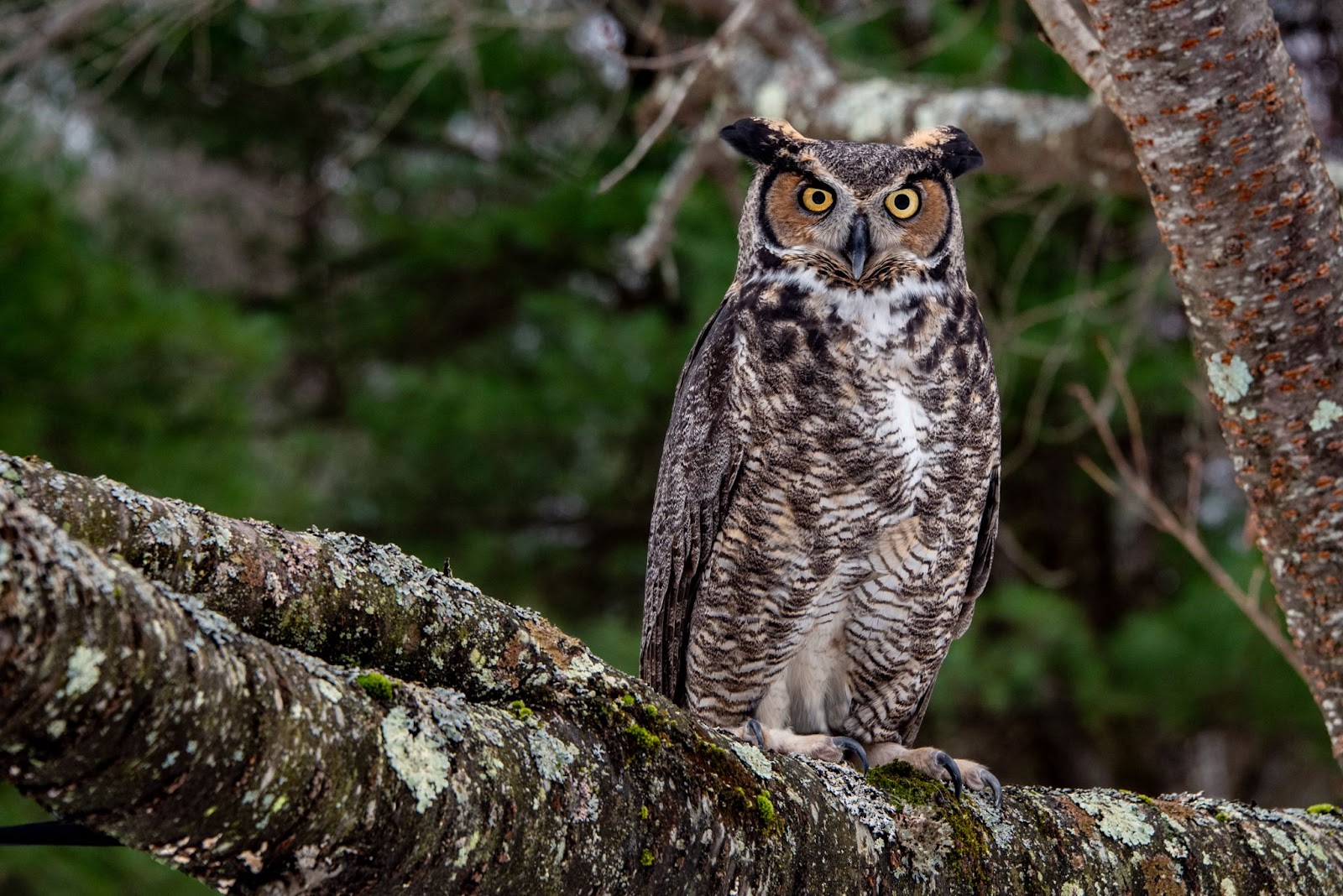
On a weekend bicycle ride some years ago, the sight of a little pile of feathers by the side of Codman Road brought me to a screeching halt. A close inspection revealed the beheaded corpse of an eastern screech owl.
Follow-up research left little doubt that this bird’s sad ending had come as a consequence of its having ventured too deeply into the “patch” of a great horned owl.
Our local “hoot” owl, Bubo virginianus, is the largest of our owls, weighing in at around 3 pounds for males, over 4 pounds for females, and boasting a nearly 5-foot wingspan. It is a master of superlatives: it claims the longest lifespan – up to 20 years – of all North American owls; has the largest eyes, has the most extensive range and consumes the most varied diet of all the owl species.
Yes, that includes those other owl species, as well.
The great horned owl comes wonderfully equipped with a suite of weapons to wreak carnage. The eyes have a preponderance of rods that enable exquisite night vision. The neck has twice the number of vertebrae (14!) as our necks, allowing this fearsome hunter to swivel his head and see in all directions. His hearing is acute, assisted by facial disc feathers that direct the sounds of its prey to its ears. Its soft feathers provide not only excellent insulation but enable nearly silent, stealth-mode flight. Its sharp talons are powered by muscles so strong that it requires 28 pounds of force to pry their grip loose.
While the occasional bird may regret having crossed the path of this killing machine, it’s the pests who have the most to fear. Are rabbits attacking your new rose bushes or rhodies? Well, they’re his favorite main course. A nightly diet of a dozen mice and voles, swallowed whole when they’re caught, provides a check on rodent proliferation. Watch out sleeping waterfowl: geese and ducks who nest in the open are at risk of a nocturnal visit by a silent hunter. Rats and raccoons attracted to the neighborhood by human populations are on the menu, too. So, whatever you do, do not use bait poisons like SGARs (second generation anticoagulant rodenticides) around your homes or businesses. They’re killing the very creatures that nature relies on to provide some balance among the critters out there.
Save Weston Wildlife has worked with the town to ban these chemicals from town property, and is supporting legislation to ban them statewide – a ban already implemented in many other places. For more information, visit savewestonwildlife.org.
And how about that hoot? This time of year we can count on hearing the hoo-hoo hoo hoooo, hoooo hoo booming from the woods as pairs re-form their bonds. The male’s low-frequency song can carry for up to three miles on a calm and quiet night, inviting the female to a duet in which she sings more of an alto. When things get hot and heavy, their songs become an ‘indescribable assemblage of hoots, chuckles, screeches and squawks – often given so rapidly and disconnectedly that the effect is both startling and amusing’ (F.M. Baumgartner, 1938).
Is it any surprise, then, that the young begin to vocalize before they even hatch?
This bird has no known predators. It suffers the mobbing of crows and ravens while it’s trying to roost, to be sure. And a fallen nestling or egg will make a nice snack for a lurking fox or raccoon. But make no mistake about it: this avian apex predator sits pretty comfortably atop the food chain from coast to coast.
“An owl sound wandered
Along the road with me.
I didn’t hear it–
I breathed it
Into my ears.”
William Stafford, American poet
Author

Related Articles

Make it a Habit: Seasonal Affective Disorder and understanding the winter blues
Your good mood might disappear along with the sun Are you just experiencing winter blahs, or is it something more serious?