
Backyard Naturalist: My next guest needs no introduction
The northern cardinal is the star of this week’s Backyard Naturalist column.
“Cardinal – Are you bringing me a message from the other side… Do you have some kind of magic to bring…Are you just watching and waiting for spring?”
That’s what Grammy Award-winning artist Kacey Musgraves wondered in her plangent song honoring her friend, the legendary musician John Prine (1946-2020), after he passed to the other side.
Birds – cardinals in particular – were seen in folklore as angels visiting from heaven to comfort the bereaved, and to serve as a connection between our lives and the hereafter.
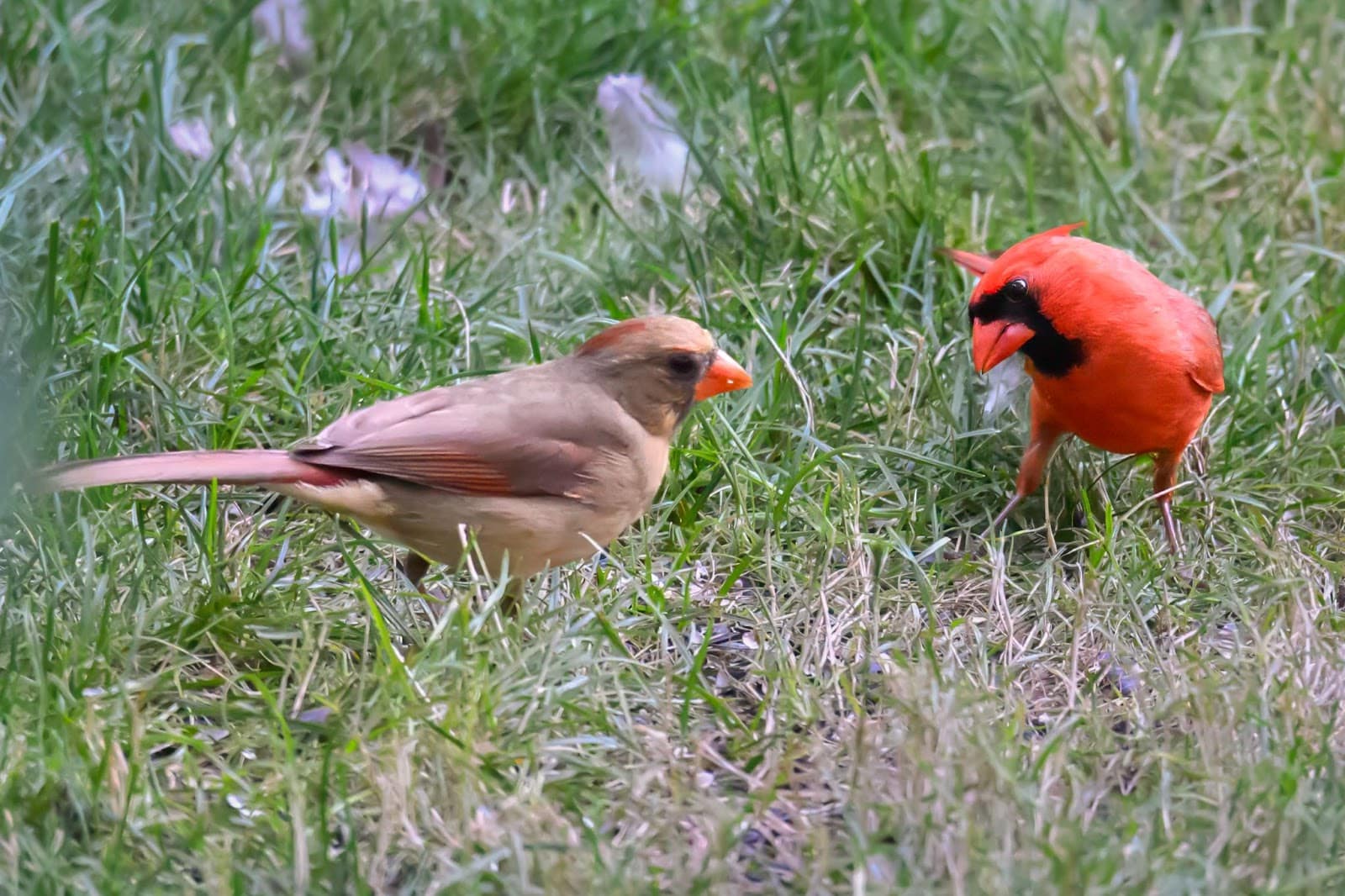
Is there a soul that isn’t stirred by the sight of that bold red bird with his jaunty crest and jet-black highlights – whether his message comes from the ethereal realm or not? I’m content that my taupe and rose female cardinal cheers me by being the first visitor to my Birdfy camera-feeder every morning. And later, Mr. Cardinal scoops up sunflower seeds from below the feeder, showing off nicely against the snow-dusted lawn.
I’m not the cardinals’ only fan, I know. They’re the state bird of more states (seven) than any other bird. They were (until the 1918 Migratory Bird Treaty Act) prized as pets. Their extensive range guaranteed them a familiarity that never degenerated into contempt.
Cardinals thrive from the Yucatan in Mexico, throughout the United States east of the Rockies, all the way to the Maritimes in Canada – and even breed in faraway Baja California. But folks in Weston have only relatively recently had the privilege of calling them neighbors. Until 1958, bona fide wild nesting observations of the species in the commonwealth were rare. Now, we enjoy our share of the estimated 100 million cardinals in North America. That’s owing in large part to human influences, including climate change and our backyard winter feeders. Also, Weston offers a particularly welcoming environment: dense forest cover interspersed with open areas, woodland edges, brushy fields, wooded wetlands and parks.
These sexually-dichromatic birds exhibit a gratifying degree of loyalty to their mates and their territory, so you’ll likely see the same pair year after year. The northern cardinal (Cardinalis cardinalis) owes its name to the Roman Catholic clergy, whose cardinals for centuries have worn red robes and caps. That lovely shade of red reflects the species’ ability to metabolize carotenoid pigments in its diet to create plumage pigmentation of a different color. Maybe that’s the “some kind of magic [they] bring?”
After the first sunny days in late February, the male will ascend to the heights to broadcast his clear-toned whistle of “birdie-birdie-birdie” or “what-cheer-cheer-cheer,” announcing his resolution to defend his territory for as far as his voice can carry. When his mate responds, he’ll butter her up with some sunflower seeds, passed from beak to beak – one of my favorite sights at the feeder, and reason enough to stock your feeder with plenty of their favorite snack. Maybe reinforce your own pair-bond by sharing a cashew with your honey.
But I digress.
Mr. Cardinal will supply his mate with food while she’s busy building the four-layer cup nest for their progeny (a three-to-nine-day task). While she incubates the eggs, he hunts down the protein-rich insects that will enable their young to fledge. The pair can repeat this cycle several times in any given breeding season. When all survivors have dispersed, you’ll only hear the “clink” and “chip” calls they exchange. It’s no longer necessary to expend all that energy on territorial defense songs.
Is their change of tune a sign from the spirit world – a “message from the other side?” Or is the cardinal simply saying “Off on vacation; enjoy your summer?”
Author