Reconfiguration of Rt. 20 intersection targets frequent crashes
The Route 20, Boston Post Road, Wellesley Street intersection has the highest crash rate in town. What is being done to address it?
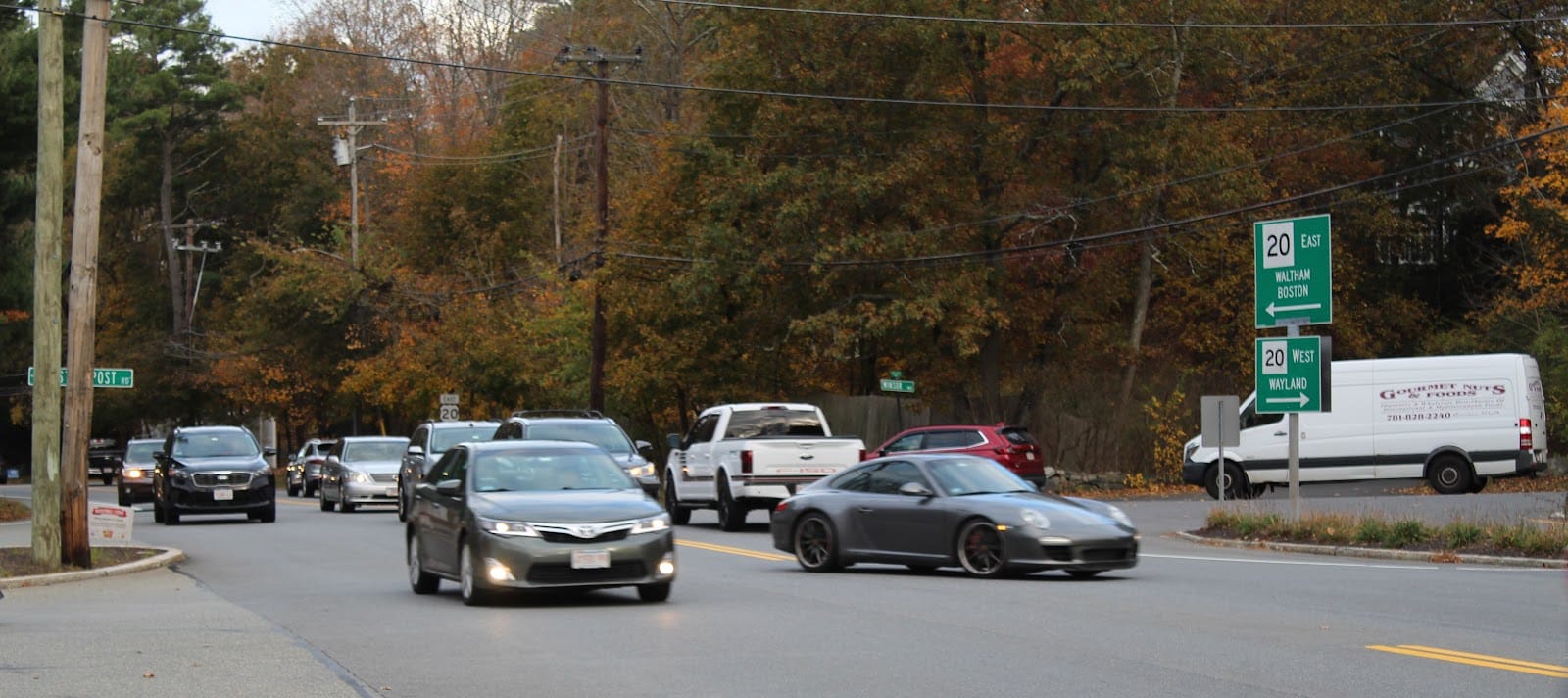
It’s a common sight around 5 p.m. each day. A line of cars with left blinkers flashing where Route 20, Boston Post Road and Wellesley Street meet, waiting for vehicles to crisscross the town’s main artery as more drivers line up on the north and south sides of the intersection.
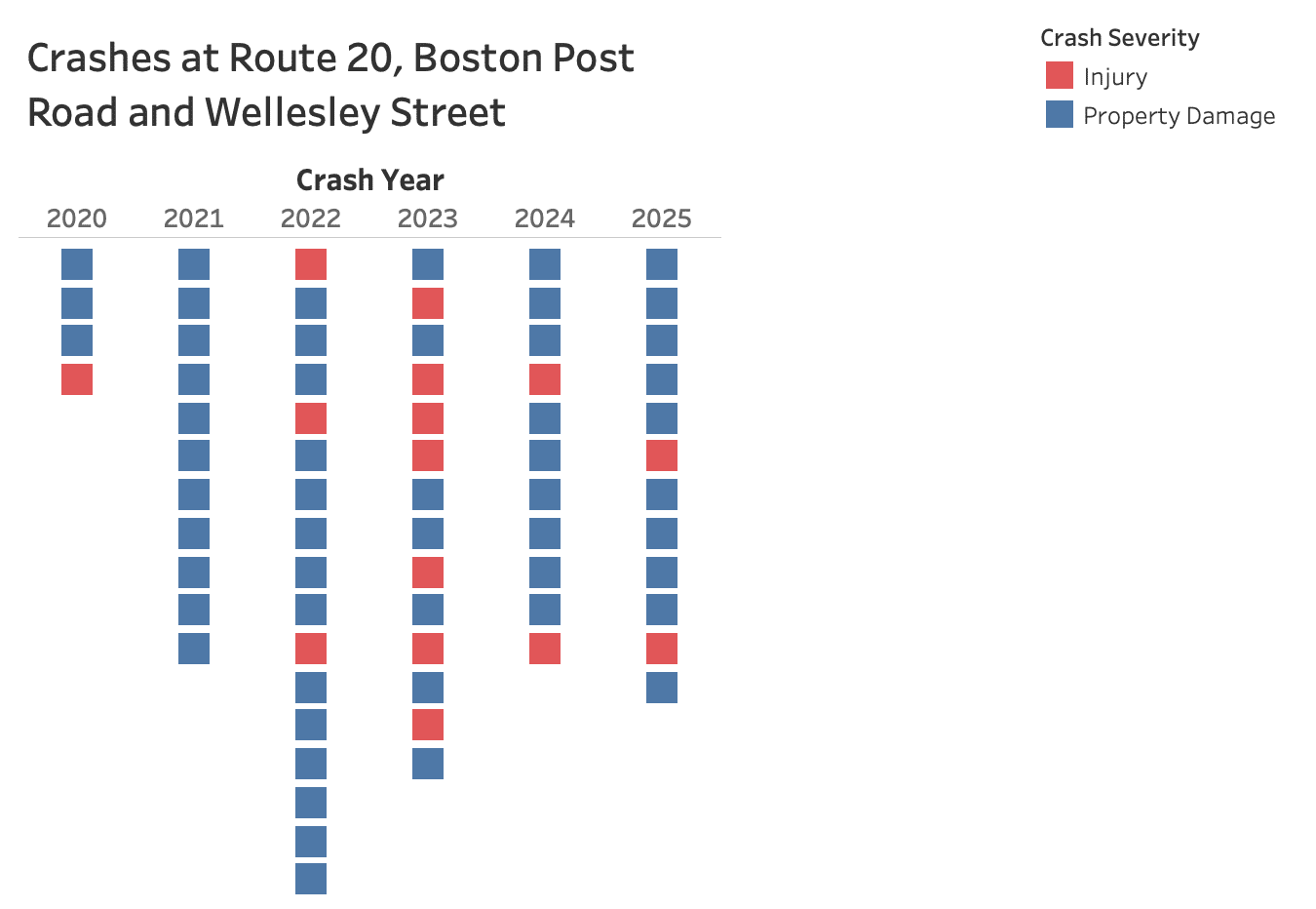
This intimidating five-legged intersection has the highest crash rate in Weston, with at least 69 reported collisions in the last five years, according to the Weston Police Department. Data from the Massachusetts Department of Transportation (MassDOT) shows even more crashes just outside the intersection, reporting up to 90 total vehicle crashes at the intersection, Wellesley Street, Boston Post Road and the privately owned Winsor Way over the last half-decade.
With five legs of entry, a cut-through for Winsor Way drivers trying to get to Wellesley Street and what can seem like never-ending traffic on Route 20, many drivers end up avoiding a left turn unless it is absolutely necessary.
“I personally never take a left,” Town Engineer Jason Lavoie said. “Even if we didn’t have traffic, it’s just an odd intersection.”
Why so many crashes?
While the geometry of the intersection isn’t always at fault, it doesn’t help, according to Police Department Capt. Thomas Kelly, who serves as an ex-officio member of the Traffic and Sidewalk Committee.
Inattention is one of the most common reasons for accidents. The category includes drivers looking at cellphones, conversations in the car and other distractions – along with failures to yield while turning and, occasionally, an impaired driver.
“It’s the whole gamut,” Kelly said.
While the intersection has the highest crash rate in Weston, Kelly said injuries are rare. Rear-ends are the most common crash type and the majority of accidents result in damage to vehicles, rather than people. Typically, he noted, folks trying to turn from Wellesley Street are so focused on making sure the road is clear for their turn, they forget to check if the vehicle in front of them has already turned, resulting in a fender bender.
Traffic and Sidewalk Committee Chair James Doyle said the constant flow of traffic on Route 20, interrupted by cars turning left and right from Boston Post Road and Wellesley Street, can make it difficult to navigate.
“One of the things about the intersection is, it currently operates as a free-for-all, particularly in the peak commuting periods,” Doyle said. “There’s a lot of jockeying. If you’re not familiar with the intersection, it can be somewhat scary.”
What’s the answer?
The high crash rate could soon be mitigated, though, as MassDOT plans a reconfiguration of the Route 20, Boston Post Road and Wellesley Street intersection, scheduled to begin this summer, with a final completion date targeted for summer 2028.
Over the course of those two years, the five-legged intersection will be redesigned to the more common – and safer – four-way intersection with a traffic light. The two divided lanes will be merged into a typical intersection shape, with left-turn lanes available for drivers on both Boston Post Road and Wellesley Street. The Winsor Way cut-through will be moved further south on Wellesley Street to avoid connecting it to the main intersection, and additional turning lanes will be created on Route 20.
Additionally, sidewalks on Wellesley Street will be extended to Boston Post Road and will connect to crosswalks to allow safer crossing for pedestrians and cyclists. Finally, there will be infiltration infrastructure for water management, as well as plantings to aid stormwater filtration.
“That will be really good when it’s all said and done,” Lavoie said. “It’ll look nice, it’ll function well and it will add some environmental improvements.”
Kelly said he expects the traffic light will significantly increase the safety of an intersection that has always ranked as the top crash location in the Weston Police Department’s data.
“I think the reconfiguration will help,” he said.
In total, MassDOT estimates the project price tag to be about $4.14 million, with federal money expected to cover about 80% of the project. MassDOT will pick up the remaining 20%. No town money will be expended on construction, although the town has previously spent $478,330 for studying and engineering.
Weston has explored the topic for more than a decade, retaining engineering firm Vanasse Hangen Brustlin (VHB) in 2013 to study Route 20’s intersections.
In that 12-year-old study, VHB and the Traffic and Sidewalk Committee concluded that the highest priority area was Route 20, Boston Post Road and Wellesley Street. The committee supported the installation of a traditional four-way intersection with a traffic light, as well as additional pedestrian and cyclist infrastructure.
“It was recognized that there was a lot of congestion at School Street and people would use Boston Post Road over toward Wellesley Street, which is unsignalized, as a kind of escape valve, but that was a dangerous escape valve,” Doyle said, noting the project started as a “high-level needs assessment” that turned into analysis.
Doyle said the project’s process took more than a decade because the town was working to get into the state’s Transportation Improvement Program, known as TIP, which requires meeting 25% design and 75% design milestones, and working with residents to determine which configuration and features would be most effective.
One of the most important details to come out of the public process, Doyle said, was the addition of a 400-foot sidewalk connecting Wellesley Street to the intersection. Once that sidewalk is complete, there will be a continuous pedestrian walkway from the town center to the middle and high school campus.
“It involved a lot of public outreach,” Doyle said. “We think the project is going to be a huge improvement in safety and connectivity.”
Author

Related Articles
AG’s office finds minor Open Meeting Law violation
The state Attorney General’s office determined Weston’s Select Board committed a minor Open Meeting Law violation in a decision released last month.
Town Meeting participation under the microscope
While there are more than 8,600 registered voters, a fraction – typically ranging around 3% to 6% – come together each May for Weston’s Annual Town Meeting.